Almost a century ago, the scholar-turned-medical-missionary Albert Schweitzer published a little bombshell of a book with the bland title of The Quest of the Historical Jesus (1906; reissued this year in paperback by the Johns Hopkins University Press). Schweitzer reviewed the history of critical studies of the life of Jesus, starting with the early eighteenth-century skeptic Hermann von Reimarus and concluding with the late nineteenth-century liberal theologian William Wrede. The central argument of Schweitzer's book at the opening of the twentieth century is startlingly appropriate also at its end.
Scholar after scholar, Schweitzer contended, had looked for Jesus down the deep well of history and had seen instead the scholar's own reflection. Some writers on Jesus marshaled impressive intellectual tools, from archaeological research to literary analysis, from comparative studies of Near Eastern religions to examination of talmudic materials. Others relied on personal intuition, perhaps a journey or two to the Holy Land, and vivid imagination to construct their own "lives of Jesus." But in almost every case, Schweitzer concluded, two centuries of supposedly rigorous investigation had produced a wide range of portraits of Jesus, each of which bore a suspicious resemblance to the artist and none of which was conclusive.
Charlotte Allen has come to the same conclusion after almost another century of biblical scholarship. In her new book, The Human Christ: The Misguided Search for the Historical Jesus (Free Press), she begins by surveying early Christian understandings of Jesus, and then takes up her story proper with eighteenth-century Enlightenment inquiries into the "human" Jesus—that is, the "real" Jesus stripped of the superstitions and myths that had attached to him somehow over the centuries. Drawing her narrative up virtually to the present—yes, the Jesus Seminar appears, as do other contemporary scholars—Allen's rather lightly argued verdict is Schweitzer's redux: so-called critical examinations of the Gospels in search of Jesus over more than three centuries have been typically uncritical of the author's own governing biases and have resulted, time after time, in the projection of one's own ideals onto the figure of Jesus of Nazareth.
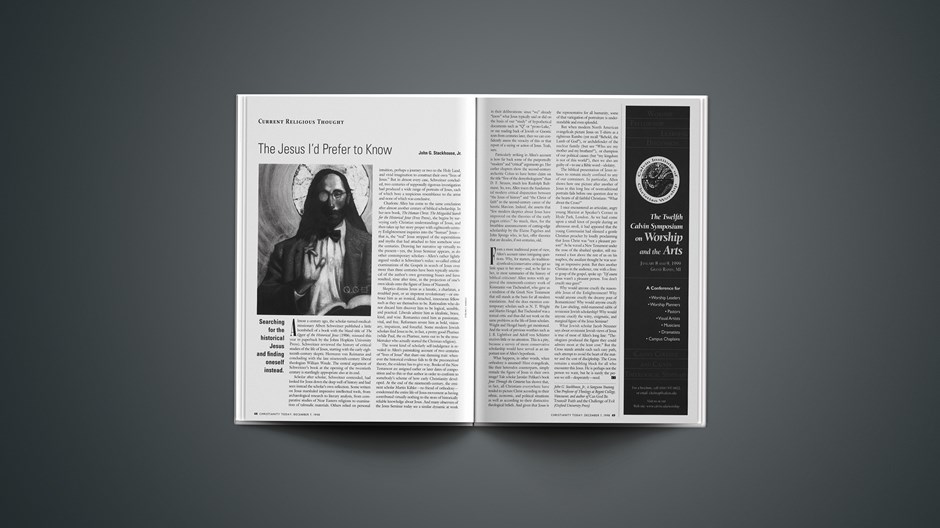
Skeptics dismiss Jesus as a lunatic, a charlatan, a troubled poet, or an impotent revolutionary—or embrace him as an ironical, detached, innocuous fellow such as they see themselves to be. Rationalists who do not discard him discover him to be logical, sensible, and practical. Liberals admire him as idealistic, brave, kind, and wise. Romantics extol him as passionate, vital, and free. Reformers revere him as bold, visionary, impatient, and forceful. Some modern Jewish scholars find Jesus to be, in fact, a pretty good Pharisee (while Paul, the ex-Pharisee, turns out to be the troublemaker who actually started the Christian religion).
The worst kind of scholarly self-indulgence is revealed in Allen's painstaking account of two centuries of "lives of Jesus" that share one damning trait: whenever the historical evidence fails to fit the preconceived theory, the evidence has to give way. Books of the New Testament are assigned earlier or later dates of composition and to this or that author in order to conform to somebody's scheme of how early Christianity developed. At the end of the nineteenth-century, the eminent scholar Martin Khler—no friend of orthodoxy—condemned the entire life-of-Jesus movement as having contributed virtually nothing to the store of historically reliable knowledge about Jesus. And many observers of the Jesus Seminar today see a similar dynamic at work in their deliberations: since "we" already "know" what Jesus typically said or did on the basis of our "study" of hypothetical documents such as "Q" or "proto-Luke," or our reading back of Jewish or Gnostic texts from centuries later, then we can confidently assess the veracity of this or that report of a saying or action of Jesus. Yeah, sure.
Particularly striking in Allen's account is how far back some of the purportedly "modern" and "critical" arguments go. Her earlier chapters show the second-century archcritic Celsus to have better claim on the title "first of the demythologizers" than D. F. Strauss, much less Rudolph Bultmann. So, too, Allen traces the fundamental modern critical disjunction between "the Jesus of history" and "the Christ of faith" to the second-century career of the heretic Marcion. Indeed, she asserts that "few modern skeptics about Jesus have improved on the theories of the early pagan critics." So much, then, for the breathless announcements of cutting-edge scholarship by the Elaine Pagelses and John Spongs who, in fact, offer theories that are decades, if not centuries, old.
From a more traditional point of view, Allen's account raises intriguing questions. Why, for starters, do traditional/orthodox/conservative critics get so little space in her story—and, to be fair to her, in most summaries of the history of biblical criticism? Allen notes with approval the nineteenth-century work of Konstantin von Tischendorf, who gave us a rendition of the Greek New Testament that still stands as the basis for all modern translations. And she does mention contemporary scholars such as N. T. Wright and Martin Hengel. But Tischendorf was a textual critic and thus did not work on the same problems as the life-of-Jesus scholars. Wright and Hengel barely get mentioned. And the work of previous worthies such as J. B. Lightfoot and Adolf von Schlatter receives little or no attention. This is a pity, because a survey of more conservative scholarship would have served as an important test of Allen's hypothesis.
Article continues below
What happens, in other words, when orthodoxy is assumed? Have evangelicals, like their heterodox counterparts, simply remade the figure of Jesus in their own image? Yale scholar Jaroslav Pelikan's book Jesus Through the Centuries has shown that, in fact, all Christians everywhere have tended to picture Christ according to their ethnic, economic, and political situations as well as according to their distinctive theological beliefs. And given that Jesus is the representative for all humanity, some of that variegation of portraiture is understandable and even splendid.
But when modern North American evangelicals picture Jesus on T-shirts as a righteous Rambo (yet recall "Behold, the Lamb of God"), or archdefender of the nuclear family (but see "Who are my mother and my brothers?"), or champion of our political causes (but "my kingdom is not of this world"), then we also are guilty of—to use a Bible word—idolatry.
The biblical presentation of Jesus refuses to remain nicely confined to any of our containers. In particular, Allen shows how one picture after another of Jesus in this long line of nontraditional portraits fails before one question dear to the hearts of all faithful Christians: "What about the Cross?"
I once encountered an articulate, angry young Marxist at Speaker's Corner in Hyde Park, London. As we had come upon a small knot of people during an afternoon stroll, it had appeared that the young Communist had silenced a gentle Christian preacher by loudly proclaiming that Jesus Christ was "not a pleasant person!" As he waved a New Testament under the nose of the abashed speaker, still marooned a foot above the rest of us on his soapbox, the assailant thought he was scoring an impressive point. But then another Christian in the audience, one with a firmer grasp of the gospel, spoke up: "Of course Jesus wasn't a pleasant person. You don't crucify nice guys!"
Article continues below
Why would anyone crucify the reasonable Jesus of the Enlightenment? Why would anyone crucify the dreamy poet of Romanticism? Why would anyone crucify the Law-abiding, mild-mannered rabbi of revisionist Jewish scholarship? Why would anyone crucify the witty, enigmatic, and marginal figure of the Jesus Seminar?
What Jewish scholar Jacob Neusner says about revisionist Jewish views of Jesus is true of most of Allen's long line: "Theologians produced the figure they could admire most at the least cost." But the Cross stands amidst each such easy path, each attempt to avoid the heart of the matter and the cost of discipleship. The Cross remains a stumbling block for all who encounter this Jesus. He is perhaps not the person we want, but he is surely the person we still—desperately—need.
John G. Stackhouse, Jr., is Sangwoo Youtong Chee Professor of Theology at Regent College, Vancouver, and author of Can God Be Trusted? Faith and the Challenge of Evil (Oxford University Press).















 While we pray for peace, we need moral clarity about this war.
 A Christian reconciliation group in Israel and Palestine warned that war would come. Now the war threatens their relevance.españolالعربيةFrançaisрусскийУкраїнська
 The plan would organize UMC churches in four global regions, with each given more leeway around same-sex marriage and other theological issues.






