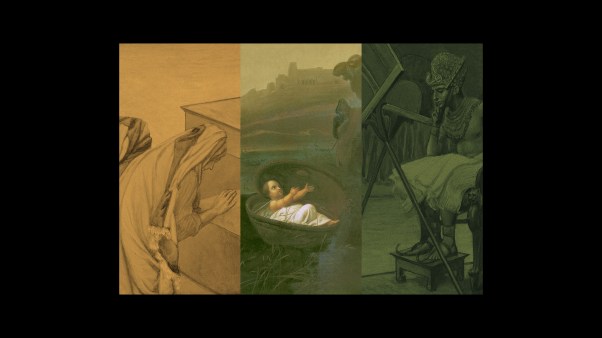

Hollywood, having had its fill of religious boycotts, is bending over backwards with the new DreamWorks production about Moses, The Prince of Egypt. I felt privileged to be invited not once, but twice to a private screening of the animation in process—until I learned that several hundred other people had made the same pilgrimage to meet with Jeffrey Katzenberg at DreamWorks.
What an industry! For four years, 400 people, many of them skilled artists, have been working on a project that cost well over $100 million. They’ll know in two weekends whether it will make or lose a bundle. No wonder they want the religious community on their side.
The Prince of Egypt is a fine film by any standard and takes surprisingly few liberties with the biblical story. Impressed, I agreed to write a chapter for Destiny and Deliverance, the book that will serve as a companion to the film, with the proviso that I could write about Deuteronomy, the recap of Moses’ life. That book, often overlooked, contains personal outpourings by Moses as poignant and heart-rending as anything in the Bible.
Consider, for example, Moses’ depiction of the horrors awaiting those who disobey the covenant (Deut. 28:64-68):
Then the Lord will scatter you among all nations, from one end of the earth to the other. … There the Lord will give you an anxious mind, eyes weary with longing, and a despairing heart. You will live in constant suspense, filled with dread both night and day, never sure of your life. In the morning you will say, “If only it were evening!” and in the evening, “If only it were morning!”—because of the terror that will fill your hearts and the sights that your eyes will see. The Lord will send you back in ships to Egypt on a journey I said you should never make again. There you will offer yourselves for sale to your enemies as male and female slaves, but no one will buy you.
As the Israelites stepped across the Jordan River, curses like these rained down on them from a choir standing on a mountaintop. Antiphonally, another choir shouted out potential blessings. In this natural amphitheater, the two choirs loudly vocalized the stark alternatives of obeying or disobeying the covenant with God.
In addition, Moses set up large stones coated with plaster on which were written the words of the law. God longed for the covenant to succeed: “Oh, that their hearts would be inclined to fear me and keep all my commands always, so that it might go well with them and their children forever!” Repeated rebellions in the wilderness had taken a toll, however. After Sinai, even God spoke of the future with a tone of resignation, like the parent of a drug addict helpless to stop his own child from self-destructing.
Two staged memory lessons were not enough. Write down a song, God said, and teach it to the Israelites as a witness to history. Laws written on stone and plaster, curses and blessings broadcast from the mountaintops—these sights and sounds will fade away. Make them learn my words by heart. Drill the message inside them.
Thus, at the birth of their nation, euphoric over the crossing of the Jordan River, the Israelites premiered a kind of national anthem, the strangest national anthem that has ever been sung. It had virtually no words of pride or hope, only doom.
When I submitted my chapter to the readers at DreamWorks, they were scandalized. Why this pessimism, this fatalism, this latent anti-Semitism in a book celebrating the grand miracle of the Exodus? In the margin beside some of the strongest passages, a Jewish proofreader wrote, “Where is this from!?” I pointed out that each questionable quotation came directly from Deuteronomy, part of the sacred Torah.
Modern readers, excited by the thrill of the Exodus, pay little attention to the 400 years of misery that preceded it, or the abysmal failures that followed. Which is why the Bible includes Deuteronomy in the first place, and why we optimistic Americans ought to pay it more mind.
Others have borrowed parts of Moses’ message, but no one has quite got it right. Liberationists of all stripes have appropriated the language of Exodus, yet all lack Moses’ unstinting realism. They drift into utopian promises of a Promised Land that has never been—and will never be—realized this side of eternity. Often these utopians end up creating a political system more tyrannical than the one they sought liberation from.
Likewise, pietist Christians have borrowed Moses’ vision to describe a Victorious Christian Life on the other side of Jordan. The last seven chapters of Deuteronomy should forever disabuse us of that notion. Life with God is never so easy, so settled. Not for the Hebrews then, and not for us living today. The pilgrim must ever progress, uphill, meeting new enemies around every bend.
The Old Testament should come with a warning: Don’t read Exodus without also reading Deuteronomy. It would save a lot of disillusionment—for moviemakers, for politicians, and also for preachers.
Copyright © 1998 Christianity Today. Click for reprint information.