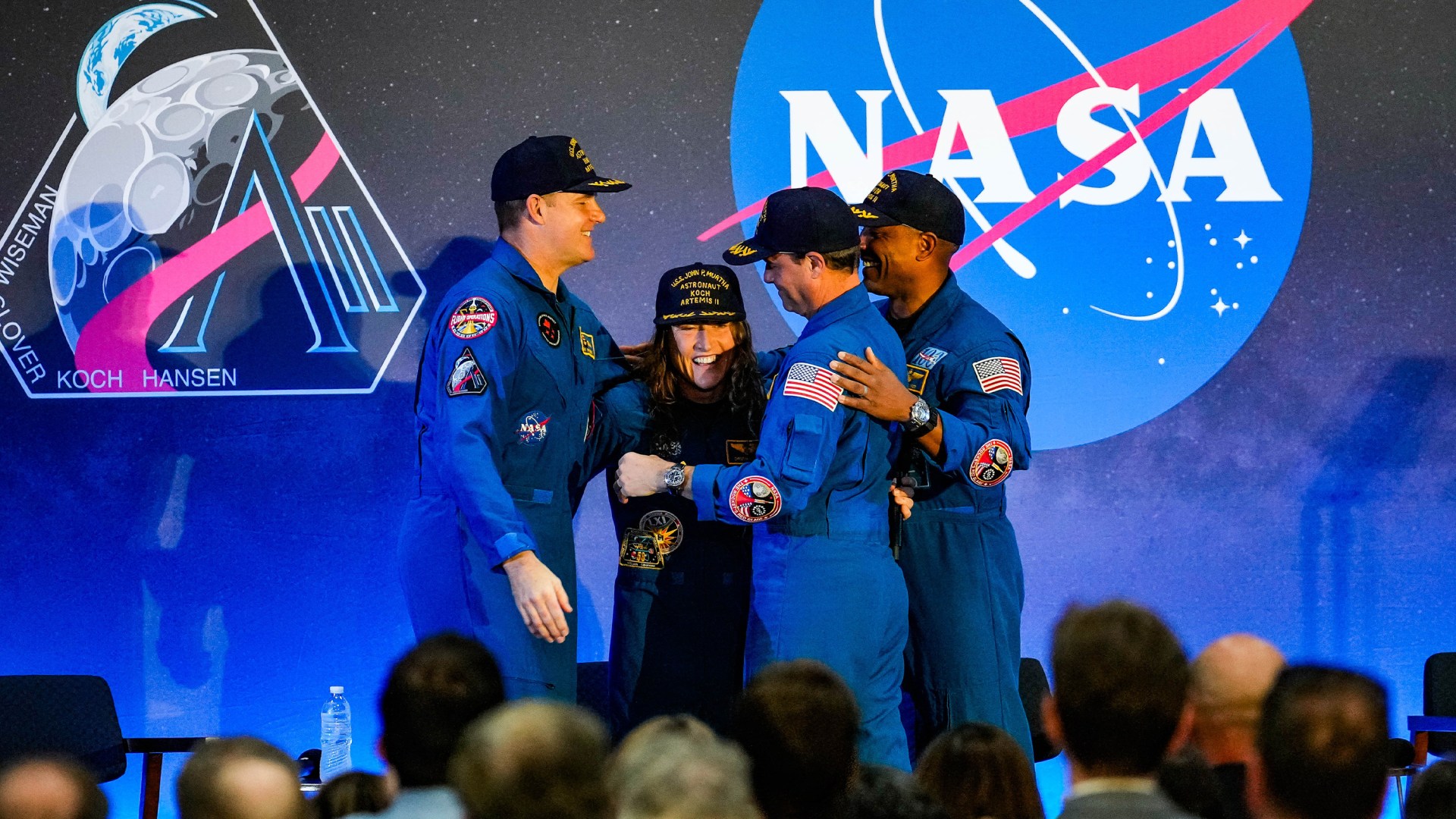
On April 10 at 5:07 p.m. Pacific Daylight Time, Integrity, the crew-named Artemis II spacecraft, splashed down off the coast of San Diego after its ten-day mission around the moon and back. Driving on a freeway a few hundred miles north of their landing spot, I listened live to NASA’s radio broadcast. The crew—which is the first to return to the moon since 1972’s Apollo 17 mission—splashed down after their 694,481-mile journey, concluding Artemis II.
I honked my horn in celebration, wondering if other drivers were similarly glued to the mission. After entering Earth’s atmosphere at approximately 24,000 miles per hour, its heat shield enduring up to 5,000 degrees Fahrenheit, the capsule splashed into the Pacific Ocean at just 19 miles per hour.
Some had questioned the heat shield’s efficacy, so after six minutes of radio silence (as the capsule was engulfed in plasma), I exhaled in relief the same way I do when one of my teenagers who has been out of cell-service range makes it home. Reid Wiseman, Victor Glover, Christina Koch, and Jeremy Hansen were home. My tears fell unexpectedly.
Some of the trepidation is familiar for Gen Xers. I am a bit too young to remember what many older Gen Xers remember—how teachers rolled TVs into students’ elementary school classrooms so they could watch history on January 28, 1986. But that day proved disastrous as, 73 seconds into the flight, the Challenger shuttle exploded, killing all seven passengers (one of whom was a teacher under the Teacher in Space Project).


In the days since the Artemis II astronauts’ safe arrival, I’ve wondered about my sudden emotion and the proliferation of chatter on social media under #moonjoy. From doing group hugs and working while a floating jar of Nutella stole the spotlight to wearing eclipse sunglasses like ’80s kids and recreating the Full House TV show intro, the four astronauts were full of joy.
While NASA’s social media team made their updates fun and effective—like by producing a video of the crew’s playfulness, smiles, group hugs, and joy in their work as evidence of “moon joy [noun]”—I think it’s more than marketing prowess or Saturday Night Live sketches that have people still talking about the mission. It’s also more than the crew’s scientific discoveries, the stunning photographs from the back of the moon, or even the mission’s historic firsts.
What has kept us following Artemis II is simple: It has been a constant reminder that being human is a gift and being human together is a joy.
During the week of the Artemis II mission, what was happening around the moon and what was happening in our earth-bound politics was a study in contrasts. President Donald Trump threatened to wipe out a civilization—threats from which he has since backed away for at least a time—while Glover, a Christian and Integrity’s pilot, told those back on earth, “I can really see Earth as one thing.” He continued, “When I read the Bible and I look at all of the amazing things that were done for us, who were created … You are special in all of this emptiness. … We are the same thing, and … we’ve got to get through this together.”
About a week before Trump posted both an AI-generated picture of himself as Jesus (since deleted) and a diatribe against Pope Leo, Glover reminded us that the globe is a sort of spacecraft—that we’re on mission together in the middle of the cosmos. Glover’s message is far more compelling and rarer in our moment of mudslinging.


Glover’s words are also a message of integrity—in keeping with the crew’s character. The astronauts, after all, named their craft Integrity for the “trust, respect, candor, and humility” they shared with the engineers, planners, and others involved with the mission, and they recognized how many people they needed for success. The word integrity at its core also means “wholeness.” We act in accordance with who we are. Four people at the pinnacle of their careers, rather than being puffed up with pride, felt their own smallness and pointed us back to one another.
Every small decision places us on a path toward either pride or humility. Luke’s gospel tells us, “A good man brings good things out of the good stored up in his heart, and an evil man brings evil things out of the evil stored up in his heart. For the mouth speaks what the heart is full of” (6:45).
With their giddy awe and humility in space’s vastness, the astronauts modeled we are more than tribal infighting, wars, an unstable economy, and the countless daily burdens of life in a fallen world. No matter our circumstances, it is a gift to be on earth, and it is a gift to be human together.
It’s tempting to think the only world is one defined by a harsh law of survival of the fittest. It’s easy to believe that the vileness of political rhetoric is all there is. It can even be intoxicating to believe ugliness is how we get things done. But these four astronauts reminded us there is a better way.


Christians especially live by a new narrative: For those who are in Christ, the utter goodness and beauty of Jesus will snuff out blinding pride in ourselves and others that leads to death and destruction. Even now God invites us to live out this better story together.
In much the same way age brings perspective—we see that the things that upset us decades ago are much smaller than they appeared—space brings perspective too. In the astronauts’ first press conference, Koch spoke about her vantage point from space and how her understanding of a crew had grown: “A crew is a group that is in it all the time no matter what, that is stroking together … with the same purpose, that is willing to sacrifice silently for each other, that gives grace, that holds accountable. A crew has the same cares and the same needs, and a crew is inescapably, beautifully, dutifully linked.”
She noted, observing our planet, “Earth was just this lifeboat hanging undisturbingly in the universe. … There’s one new thing I know, and that is, Planet Earth, you are a crew.” May the church lead the way, modeling being a crew for the sake of our neighbors.
Glover has already started. Back on the ground, the pilot gathered with his neighbors and told them from his driveway, “Some of us have never met before. And you know whose fault that is? Ours. So let’s choose to do this. … Let’s be neighbors. I don’t know if you heard me say it, but God told us to love him with all that we are and love our neighbors as ourselves. I love you.”
Ashley Hales is editorial director of features at Christianity Today.