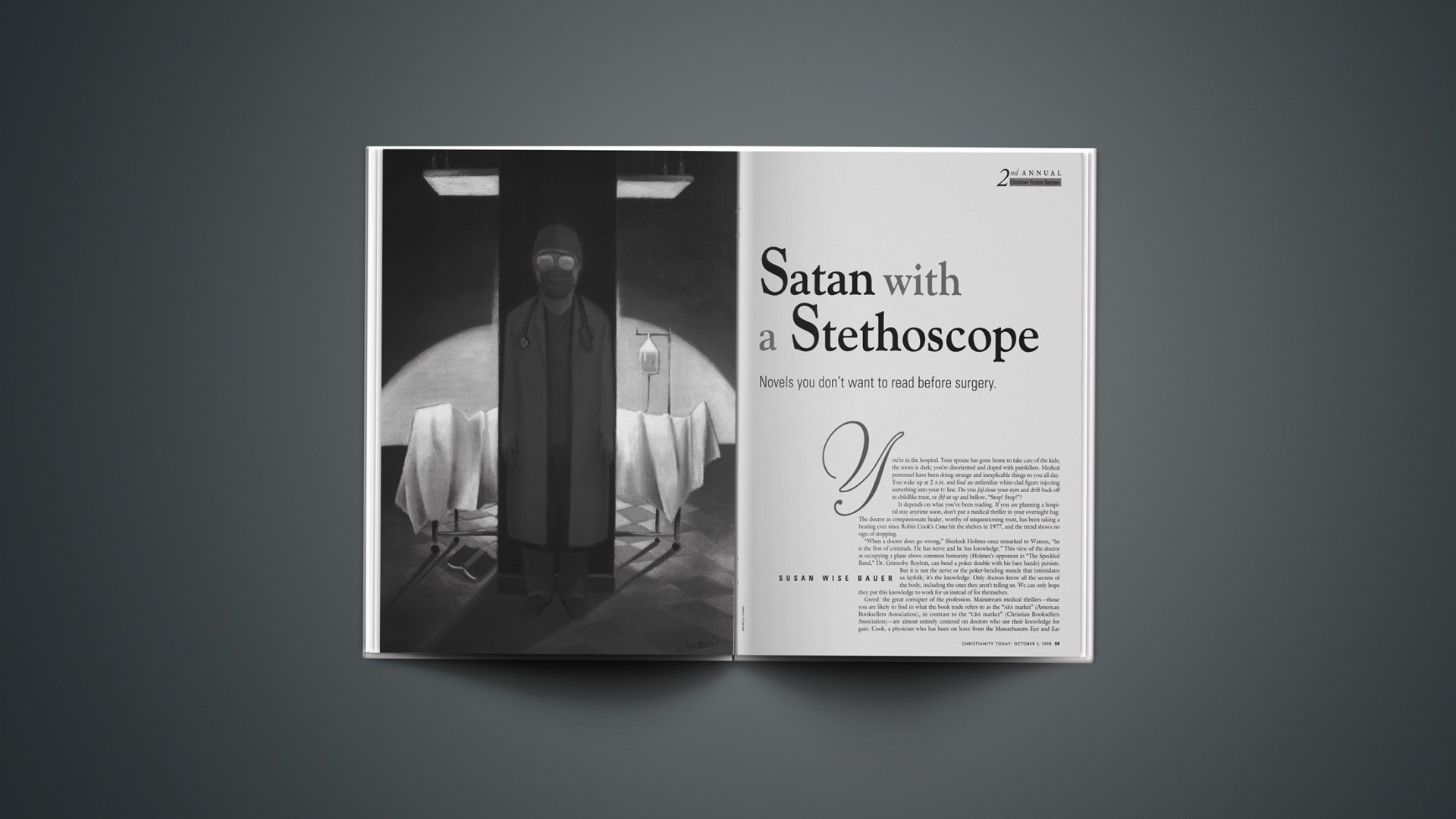

You’re in the hospital. Your spouse has gone home to take care of the kids; the room is dark; you’re disoriented and doped with painkillers. Medical personnel have been doing strange and inexplicable things to you all day. You wake up at 2 a.m. and find an unfamiliar white-clad figure injecting something into your iv line. Do you (a) close your eyes and drift back off in childlike trust, or (b) sit up and bellow, “Stop! Stop!”?
It depends on what you’ve been reading. If you are planning a hospital stay anytime soon, don’t put a medical thriller in your overnight bag. The doctor as compassionate healer, worthy of unquestioning trust, has been taking a beating ever since Robin Cook’s Coma hit the shelves in 1977, and the trend shows no sign of stopping.
“When a doctor does go wrong,” Sherlock Holmes once remarked to Watson, “he is the first of criminals. He has nerve and he has knowledge.” This view of the doctor as occupying a plane above common humanity (Holmes’s opponent in “The Speckled Band,” Dr. Grimesby Roylott, can bend a poker double with his bare hands) persists. But it is not the nerve or the poker-bending muscle that intimidates us layfolk; it’s the knowledge. Only doctors know all the secrets of the body, including the ones they aren’t telling us. We can only hope they put this knowledge to work for us instead of for themselves.
Greed: the great corrupter of the profession. Mainstream medical thrillers—those you are likely to find in what the book trade refers to as the “ABA market” (American Booksellers Association), in contrast to the “cba market” (Christian Booksellers Association)—are almost entirely centered on doctors who use their knowledge for gain. Cook, a physician who has been on leave from the Massachusetts Eye and Ear Infirmary since he hit the bestseller list, pops out a thriller every year or so, and his string of novels provides a useful sort of index to the depredations of greed.
In 1987’s Outbreak, hemorrhagic fever appears in three separate chains of hospitals that provide an innovative service: managed care. Widespread panic and a sudden drop-off in business follow. Eventually, we discover that a right-wing group of private practitioners is to blame; they have conspired to spread disease in HMOs in an attempt to protect their own patient base. Marissa, Outbreak‘s perky CDC investigator, looks at the head bad guy and sees his “expensive silk shirt, the heavy gold cuff links, the tasseled Gucci loafers. … It all represented the conspicuous consumption of a wealthy doctor, now fearful of the new medical competition, of changing times, of medicine no longer being a seller’s market.”
Greed is also central to 1995’s Contagion, which is practically the same novel in reverse. This time the good guys are the private doctors who’ve been driven out of business by the managed-care giants: specifically, one Jack Stapleton, who lost his ophthalmology practice to the huge for-profit chain AmeriCare. AmeriCare sweeps through Middle America, “gobbling up practices and hospitals with bewildering speed” and destroying the quality of patient care. When odd epidemics start appearing in AmeriCare facilities, Stapleton hunts down the villain: another managed-care chain, spreading germs to put the competitor out of business.
Medical thrillers go through fashions—fetal-tissue research, euthanasia, Ebola, genetic tinkering, managed care—and the current fashion appears to be illegal transplant organs. Take, for example, the most recent novels of doctors-turned-writers Tess Gerritsen and Leonard Goldberg. In Gerritsen’s Life Support, doctors grow genetically altered embryos in the wombs of hired prostitutes. The embryos turn into blobs of tissue studded with dozens of pituitary glands; the doctors abort the pregnancies and then transplant these glands (for a substantial fee) into rich elderly patients who want their youth back. This would work fine, except that Gerritsen’s greedy doctors eventually step over the line by killing a couple of adults, which leads to their detection by a perky female doctor named Toby. And in Goldberg’s Deadly Harvest, a perky female doctor named Joanna goes searching for a liver for her critically ill sister. Instead, she discovers an organization that grows babies for organ donation. “Oh, my God!” screams Joanna. “The children … are being kept like animals, to be sacrificed when needed?” The villain, a greedy doctor, shrugs: “It’s a moneymaker.” Fashions come and go; greed always remains.
Mainstream thrillers show little awareness of the spiritual dimension of greed; Christian thrillers make the spiritual dimension all too visible.
Medical thrillers have only recently appeared in the cba market, and the greater number are written by nondoctors. Alton Gansky’s By My Hands and Marked for Mercy (1996 and 1998 respectively) are billed as medical suspense. By My Hands revolves around the hunt for a mysterious Healer who performs several cures at a local hospital and then disappears; Marked for Mercy deals with physician-assisted suicide. Gansky himself is a pastor, not a doctor, and it shows. In By My Hands, the putative central character is Dr. Rachel Tremaine, a woman surgeon who finds nurses a “chronic annoyance” and treats her patients with “impatience and disdain.” One of those patients turns out to be pastor Adam Bridger. Despite his emergency appendectomy, Bridger visits parishioners in the hospital, convinces a Jehovah’s Witness to accept a blood transfusion, outargues atheists and New Age philosophers, and even convinces the antagonistic Rachel that a minister’s training is just as rigorous as a doctor’s. (“A theological education is not a cakewalk. … Most ministers with doctorates have a working knowledge of Hebrew … Koine Greek … and at least one modern language.” “What’s your point?” Rachel inquires.)
Gansky’s point is clear by the end of the book, when the villain is unmasked: he’s the manager of a traveling word-of-faith evangelist, determined to find the mysterious Healer and make a mint by organizing gigantic healing services. He is, in fact, the ecclesiastical equivalent of an ABA thriller-villain: a man who uses his calling for personal gain. But the novel is church-centered, not doctor-centered. Gansky’s Marked for Mercy makes several good and sometimes unexpected points about physician-assisted suicide, but it’s not a true medical thriller either (even though the central character is a perky female doctor with fawn hair and blue eyes). Rather, it’s a mystery that happens to involve doctors.
Sigmund Brouwer’s Double Helix (1995), on the other hand, features many of the markers of an ABA thriller—an evil doctor who grows babies in surrogate wombs, a maverick independent hero (Slater Ellis), and a perky female investigator named Paige (she isn’t a doctor, but she has spectacular red hair, and legs that go “to her shoulders”). But while the ABA bad guys want money, Van Klees is trying to create a superrace. As he explains to hero Slater Ellis:
“Any genetic change you make in an embryo will be passed on to the next generation. I was laying the groundwork for future scientists to evolve us into superhumans. … In the long run, we can mold the human species to our own vision.”
Van Klees is a more chilling villain than his mainstream counterparts; he’s an actual zealot, driven by something other than gain. But Brouwer is a writer, not a doctor, and Double Helix has more adventure than medicine in it.
Harry Lee Kraus, Jr., a general surgeon who practices in Virginia, wrote the first cba medical thriller, the unfortunately titled Stainless Steal Hearts (1994). The title is supposed to serve as a pun; the villain of the story, cardiothoracic surgeon Michael Simons, is literally “stealing” the hearts of aborted fetuses for his research. The fact that this pun made it into the title of the book points up a difficulty with all of Kraus’s books: He needs a strong editorial hand. His medical scenes are vivid, and he plots well, but his point of view swings wildly back and forth, he inserts large chunks of backstory in the middle of his action, he steps out of his characters to editorialize, and when his bad guys swear, they emit annoying strings of %$#*&.
But Kraus’s medicine (and his capacity for creative paranoia) rivals that of his ABA colleagues. In Stainless Steal Hearts, evil doctor Simons theorizes that hearts from late second-trimester abortions could be transplanted into infants born with congenital defects. To test this procedure, he teams up with a local abortionist to obtain fetal hearts. Together, the two of them encourage women to wait as late as possible before aborting; Simons then experiments on the still-living fetuses.
What’s behind the evil? Like Brouwer’s Van Klees, Simons isn’t driven by greed alone. In fact, he’s developed an interest in New Age writings.
At first he began with some meditation techniques that he learned at a local university seminar. Occasionally during a time of meditation, or when he was envisioning himself in a position of great influence, he would gain the impression of an idea or thought that seemed to originate outside his body. Later he began having a strong sense of guidance in some of his research.
Money considerations aren’t completely absent from Kraus’s thrillers. In Fated Genes, pediatric surgeon Weber Tyson rations care for retarded infants, justifying himself with the explanation that “debilitated infants won’t have to live on as needless burdens on an already overtaxed society.” But it turns out that Tyson is being manipulated by Lenore Kingsley, president of United Biotechnical Industries. Lenore is also a Satanist who worships with a local coven, even bearing several children for sacrifice in Satanic rituals, and Tyson is simply an instrument for a demonic plan.
In Lethal Mercy, the spiritual evil gets even more obvious. As Simons (making a repeat appearance) operates on the son of his enemy, a demonic creature clings to his back and whispers in his ear; overhead, an angelic warrior stands ready to protect the child. And in The Stain, Kraus’s latest book, a rich philanthropist hires doctors to create clones. But the intent behind this high-dollar project is purely spiritual: to clone dna found on the shroud of Turin, to prove that Jesus was simply human, nothing more.
Like all too many cba novelists, both Gansky and Kraus tend to insert “anchor” characters, ideal Christians who don’t doubt, and who serve as a “normative” voice. Belle, the praying grandmother in Fated Genes, Kerri, the trauma nurse in The Stain, pastor Paul Carpenter in Marked for Mercy—they are capable of explaining God’s will, too virtuous to be real (“With Kerri Barber, prayer was like breathing. … She enjoyed an ongoing spontaneous consciousness of God’s presence in her life that many believers yearn for”), and far too ready to supply mini-Bible studies on demand (“Find Philippians chapter one,” Paul Carpenter tells a character, in the time-honored tradition of Christian fiction. “Do you want to read it out loud, or shall I?”).
But these books are, after all, thrillers. The characters are no more exaggerated than Cook’s wicked managed-care providers, happily spreading 1918 flu virus acquired from a frozen Eskimo corpse; or Goldberg’s spectacularly brilliant, beautiful, and courageous medical examiner, Joanna Blalock. The true distinctive between mainstream and Christian medical thrillers seems to lie in the deepest motivations of the evil doctors. In the ABA, the dollar is the ultimate villain. In the cba, Satan always lurks beyond the dollar.
This is perfectly good theology. After all, in the medical-thriller villain, we see the reflection of the serpent’s face. “Know enough,” he whispered to Eve, “and you too will have the powers of a god. Know enough, and you can satisfy your own desires.” The self-serving doctor, using knowledge to acquire instead of to heal, responds to this same temptation. The greedy physician—like the greedy lawyer, ad executive, or church administrator—is, ultimately, the servant of the Destroyer.
But how is this theme best worked out in fiction? Mainstream thrillers show little awareness of the spiritual dimension of greed; Christian thrillers make the spiritual dimension all too visible. The battle with greed is a spiritual battle, yes, but the battlefield is not the coven down the road. The fiercest skirmishes are not fought between angels and demons, hovering in the air above the operating table. The battlefield is the human heart; the war is fought out with human hands; and any novelist ignores the human face of evil at his own peril.
Consider Kraus’s The Stain, which begins (like Cook’s Contagion) with a managed-care giant taking over a private practice. Dr. Seth Berringer lands himself in a mess, trying to protect himself in the face of managed care’s unreasonable demands. Is this a spiritual battle? Of course it is. But Kraus subordinates it to the novel’s central plot, the demonic attempt to clone Jesus and destroy Christianity. As a matter of fact, when Berringer becomes a Christian, his managed-care problems seem to dissolve. He has been worried about finding work outside the Coast Care system; after his conversion, he says confidently, “I’ll be returning to work soon. This town hasn’t completely abandoned me. You’ll see. Besides, God is in control now.”
But surely a Christian medical thriller should deal, at least in passing, with the hard question: How does a Christian physician operate day-to-day in a system that defines itself by profit? Such a medical system may not have Satanists lighting candles in the corridors, but the serpent is certainly slithering through its halls. The recognition that greed, whatever form it takes, is itself a demonic force—this, in the end, is what will separate the Christian medical thriller from its mainstream equivalent.
Susan Wise Bauer’s second novel, Though the Darkness Hide Thee, was recently published by Multnomah. She teaches literature at the College of William and Mary.
Copyright © 1998 Christianity Today. Click for reprint information.