
YET WILL I TRUST HIM
Understanding God in a Suffering World
by John Mark Hicks College Press, 337 pages, $19.99
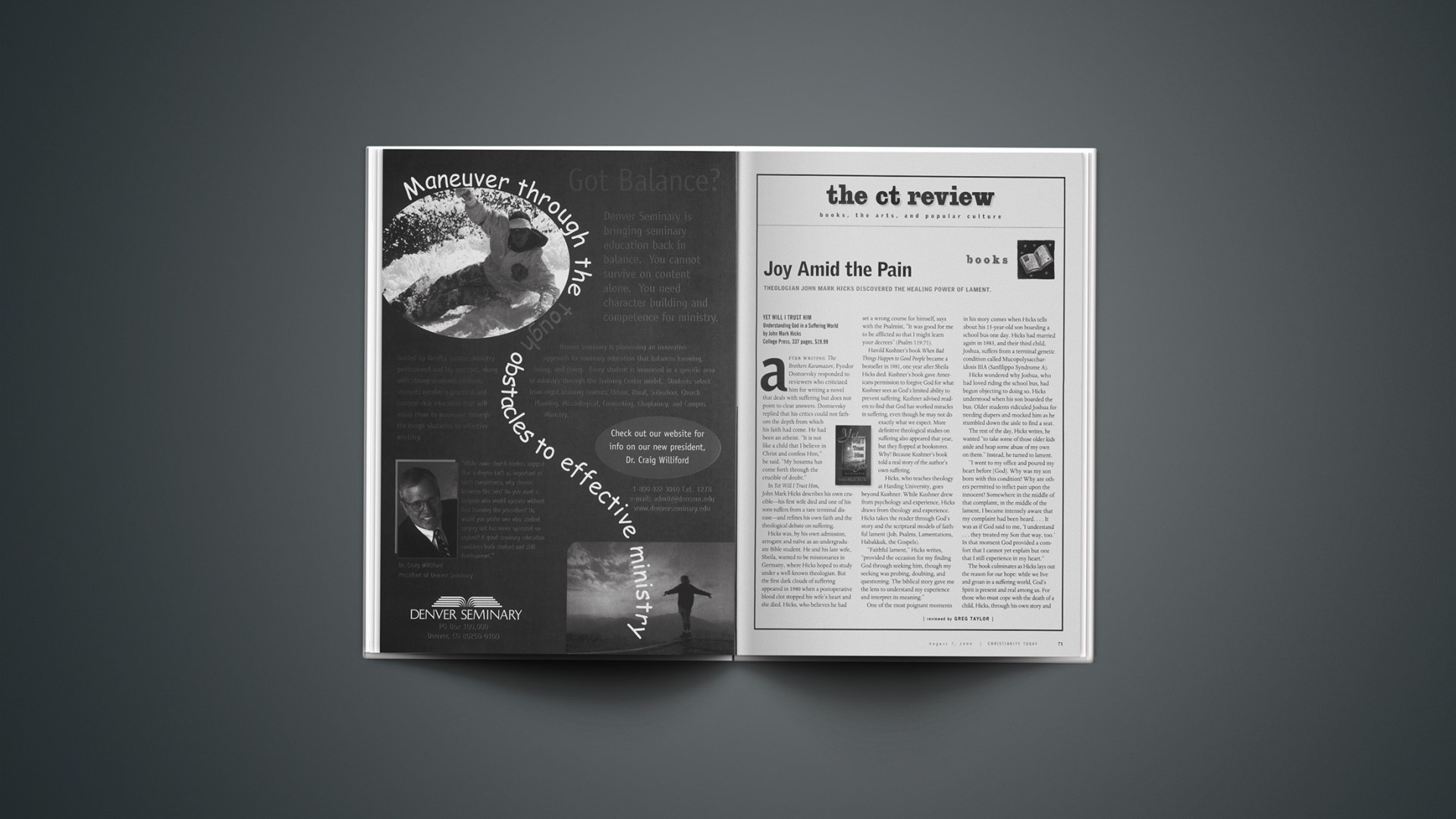
After writing The Brothers Karamazov, Fyodor Dostoevsky responded to reviewers who criticized him for writing a novel that deals with suffering but does not point to clear answers. Dostoevsky replied that his critics could not fathom the depth from which his faith had come. He had been an atheist. “It is not like a child that I believe in Christ and confess Him,” he said. “My hosanna has come forth through the crucible of doubt.”
In Yet Will I Trust Him, John Mark Hicks describes his own crucible—his first wife died and one of his sons suffers from a rare terminal disease—and refines his own faith and the theological debate on suffering.
Hicks was, by his own admission, arrogant and naïve as an undergraduate Bible student. He and his late wife, Sheila, wanted to be missionaries in Germany, where Hicks hoped to study under a well-known theologian. But the first dark clouds of suffering appeared in 1980 when a postoperative blood clot stopped his wife’s heart and she died. Hicks, who believes he had set a wrong course for himself, says with the Psalmist, “It was good for me to be afflicted so that I might learn your decrees” (Psalm 119:71).
Harold Kushner’s book When Bad Things Happen to Good People became a bestseller in 1981, one year after Sheila Hicks died. Kushner’s book gave Americans permission to forgive God for what Kushner sees as God’s limited ability to prevent suffering. Kushner advised readers to find that God has worked miracles in suffering, even though he may not do exactly what we expect. More definitive theological studies on suffering also appeared that year, but they flopped at bookstores. Why? Because Kushner’s book told a real story of the author’s own suffering.
Hicks, who teaches theology at Harding University, goes beyond Kushner. While Kushner drew from psychology and experience, Hicks draws from theology and experience. Hicks takes the reader through God’s story and the scriptural models of faithful lament (Job, Psalms, Lamentations, Habakkuk, the Gospels).
“Faithful lament,” Hicks writes, “provided the occasion for my finding God through seeking him, though my seeking was probing, doubting, and questioning. The biblical story gave me the lens to understand my experience and interpret its meaning.”
One of the most poignant moments in his story comes when Hicks tells about his 15-year-old son boarding a school bus one day. Hicks had married again in 1983, and their third child, Joshua, suffers from a terminal genetic condition called Mucopolysacchar idosis IIIA (Sanfilippo Syndrome A).
Hicks wondered why Joshua, who had loved riding the school bus, had begun objecting to doing so. Hicks understood when his son boarded the bus. Older students ridiculed Joshua for needing diapers and mocked him as he stumbled down the aisle to find a seat.
The rest of the day, Hicks writes, he wanted “to take some of those older kids aside and heap some abuse of my own on them.” Instead, he turned to lament.
“I went to my office and poured my heart before [God]. Why was my son born with this condition? Why are others permitted to inflict pain upon the innocent? Somewhere in the middle of that complaint, in the middle of the lament, I became intensely aware that my complaint had been heard. … It was as if God said to me, ‘I understand … they treated my Son that way, too.’ In that moment God provided a comfort that I cannot yet explain but one that I still experience in my heart.”
The book culminates as Hicks lays out the reason for our hope: while we live and groan in a suffering world, God’s Spirit is present and real among us. For those who must cope with the death of a child, Hicks, through his own story and through the stories of David, Job, and Jeroboam losing children, explains how the death of a child is not without meaning, that little children, even in death, testify to the Kingdom of God. Though Hicks does not focus on doubt, he might have spent more time there. The book targets serious university students, and these readers probably want something more thorough on the crucible of doubt.
The last chapter is a practical guide on how to speak to those who suffer, that is, how to avoid being like Job’s friends, whom Hicks calls “worthless physicians.” Hicks warns against saying such things as “It was God’s will” or “God plucked a rose out of his garden” or “It was for the best—some good will come of this.”
Even after the death of his first wife and the increased suffering of his son (his speech and bodily functions have deteriorated to the level of an infant), Hicks writes, “Joy still abounds in our family, but it is a joy that lives alongside of lament, alongside of anger, sadness, and sometimes doubt. It is a joy mixed with tears and refined by suffering.”
Greg Taylor is a missionary with Uganda Missions.
Related Elsewhere
Yet I Will Trust Him is available at the Christianity Online bookstore and other book retailers.
Christianity Today has tackled questions about the nature of God and how we respond to him in times of pain in articles like ” The God Who Suffers ” and ” The Benefit of the Doubt .”
Within a three-month period, Marshall and Susan Shelley saw two of their children die. Marshall, Leadership‘s senior editor, reflects on how these losses have affected his relationship with God in “My New View of God.”
Books and Culture reviewed a book that argues “at its core spiritual life involves being overwhelmed , by both the good and the bad.”
Reviews and information from the author of Yet I Will Trust Him are available at Amazon.com.
John Mark Hicks has also written about the baptismal theology of Alexander Campbell , K.C. Moser’s theology of justification and role in the Churches of Christ , and abortion .
Copyright © 2000 Christianity Today. Click for reprint information.