Two competing theologies vie for the future of evangelicalism.
There is no more boring concept of God than that traditionally presented by philosophical theism. Besides which, who wants to pray to an abstract and uninvolved deity? Certainly, the classic philosophical arguments tend to yield a "maximal Being" rather than the God of the Bible who loves his creatures passionately and hates corruption and oppression. The biblical God is not boring, but is, as Pascal wrote: "Fire! God of Abraham, God of Isaac, God of Jacob, not of the philosophers and scholars. Certitude. Certitude. Feeling. Joy. Peace. God of Jesus Christ."
At the Evangelical Theological Society's meeting in November, several scholars updated the classical philosophical arguments for God—not as a mere philosophical exercise, but as an attempt to oppose a growing challenge to classic understandings about God. Called "openness of God" theology, the challenge has threatened to split at least one denomination. Openness theology (although it has been influenced by process philosophy) roots its popular appeal in the biblical picture of a God who is passionately loving and bent on rescuing the lost creatures he loves. Such a God, this theology argues, does not exist in changeless perfection outside of time, but must rather take risks by engaging his lost creatures in truly mutual relationships that have no guaranteed outcomes. Thus God does not genuinely know the future, and he actually changes his mind when shifting situations demand it. That picture of God—which has important implications for prayer, for prophecy, and for eschatology—is what these classical scholars were trying to combat.
Clark Pinnock, the Canadian Baptist theologian who pioneered openness theology, issued an important challenge after one of these philosophical papers. "You have just made a very liberal move," Pinnock said. "You have constructed your belief from philosophy first and only second checked it with Scripture." Then Pinnock posed the simple question: "What do you make of the Scriptures that say God changed his mind?"
The response—that such passages are "anthropomorphisms"—begged the question. It does not help the case for classical theism to call something anthropomorphism. That just leads to the further questions of when and how we know something is an anthropomorphism—and, even more importantly, what that anthropomorphism is designed to communicate.This brief exchange, which occurred in a hotel's small meeting room, exemplifies a larger reality, though there certainly are classical theists who are engaging the questions more deeply. As theologians like Pinnock, John Sanders (author of The God Who Risks, 1998), and Greg Boyd (author of God of the Possible, forthcoming in May) popularize the openness argument, they appeal boldly to Scripture and seem to take the biblical high ground. For classical theists to retreat into philosophy is a serious mistake strategically. The primary evangelical impulse when confronted with any issue or teaching is to ask:
Does God change his mind? The Bible says he does. To use the quaint language of the King James Version, "It repented the Lord that he had made man on the earth" (Genesis 6:6) and "God repented of the evil, that he had said that he would do unto" the people of Nineveh (Jonah 3:10). Classical theists have long reconciled these texts to the church's traditional teaching that God is in his essence changeless, knows and declares the end from the beginning, and exists outside the flow of time as we mortals experience it. They know the Bible not only tells stories in which God changes his mind, but that it also talks about the changelessness and complete foreknowledge of God.
Indeed, the Bible more than philosophy informs our worship when we sing about God's changelessness. "Great Is Thy Faithfulness" ("There is no shadow of turning with thee") reverberates with echoes of James 1:6 (with God "there is no variation or shadow due to change"). And the classic hymn "Immortal, Invisible, God Only Wise" rephrases Isaiah with these words: "We blossom and flourish as leaves on the tree, / And wither and perish but nought changeth thee."
These and other passages should keep us from reading the Bible's anthropomorphisms simplistically. If we took them at face value, we should as likely sing Joan Osborne's 1995 hit "What If God Was One of Us" in church. Her song impoverishes the glorious idea of the Incarnation and turns God into a poor bewildered "stranger on the bus / trying to make his way home."
What happens when God is said to change his mind? Here the proponents of classical theism and openness part ways.
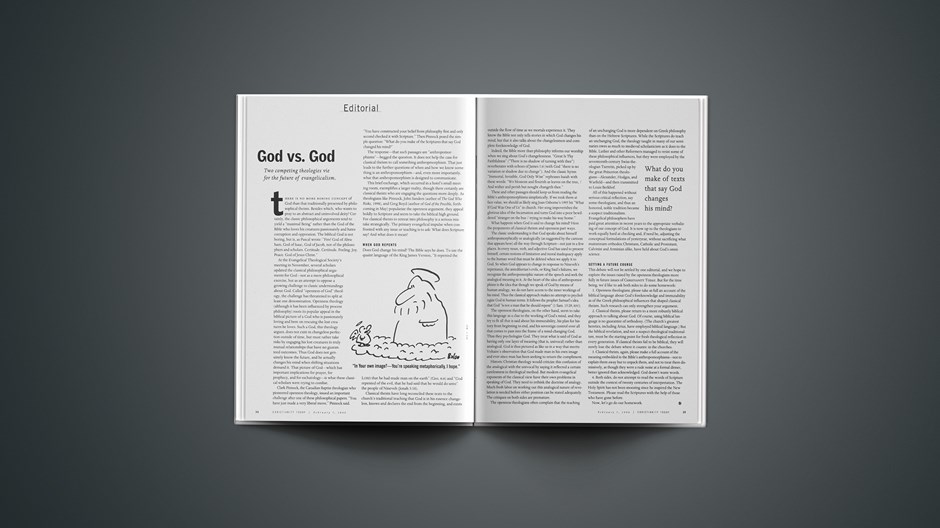
The classic understanding is that God speaks about himself anthropomorphically or analogically (as suggested by the cartoon that appears here) all the way through Scripture—not just in a few places. In every noun, verb, and adjective God has used to present himself, certain notions of limitation and moral inadequacy apply to the human word that must be deleted when we apply it to God. So when God appears to change in response to Nineveh's repentance, the antediluvian's evils, or King Saul's failures, we recognize the anthropomorphic nature of the speech and seek the analogical meaning in it. At the heart of the idea of anthropomorphism is the idea that though we speak of God by means of human analogy, we do not have access to the inner workings of his mind. Thus the classical approach makes no attempt to psychologize God in human terms. It follows the prophet Samuel's idea that God "is not a man that he should repent" (1 Samuel 15:29, RSV). The openness theologians, on the other hand, seem to take this language as a clue to the working of God's mind, and they try to fit all that is said about his immutability, his plan for history from beginning to end, and his sovereign control over all that comes to pass into the frame of a mind-changing God. Thus they psychologize God. They treat what is said of God as having only one layer of meaning (that is, univocal) rather than analogical. God is thus pictured as like us in a way that merits Voltaire's observation that God made man in his own image and ever since man has been seeking to return the compliment.
Article continues below
Historic Christian theology would criticize this confusion of the analogical with the univocal by saying it reflected a certain carelessness in theological method. But modern evangelical exponents of the classical view have their own problems in speaking of God. They need to rethink the doctrine of analogy. Much fresh labor on working out this analogical nature of revelation is needed before either position can be stated adequately. The critiques on both sides are premature.
The openness theologians often complain that the teaching of an unchanging God is more dependent on Greek philosophy than on the Hebrew Scriptures. While the Scriptures do teach an unchanging God, the theology taught in many of our seminaries owes as much to medieval scholasticism as it does to the Bible. Luther and other Reformers managed to resist some of these philosophical influences, but they were employed by the seventeenth-century Swiss theologian Turretin, picked up by the great Princeton theologians—Alexander, Hodges, and Warfield—and then transmitted to Louis Berkhof.
All of this happened without serious critical reflection, say some theologians, and thus an honored, noble tradition became a suspect traditionalism. Evangelical philosophers have paid great attention in recent years to the appropriate verbalizing of our concept of God. It is now up to the theologians to work equally hard at checking and, if need be, adjusting the conceptual formulations of yesteryear, without sacrificing what mainstream orthodox Christians, Catholic and Protestant, Calvinist and Arminian alike, have held about God's omniscience.
Article continues below
Setting a future course
This debate will not be settled by one editorial, and we hope to explore the issues raised by the openness theologians more fully in future issues of Christianity Today. But for the time being, we'd like to ask both sides to do some homework:
Openness theologians, please take as full an account of the biblical language about God's foreknowledge and immutability as of the Greek philosophical influences that shaped classical theism. Such research can only strengthen your argument.
Classical theists, please return to a more robustly biblical approach to talking about God. Of course, using biblical language is no guarantee of orthodoxy. (The church's greatest heretics, including Arius, have employed biblical language.) But the biblical revelation, and not a suspect theological traditionalism, must be the starting point for fresh theological reflection in every generation. If classical theists fail to be biblical, they will surely lose the debate where it counts: in the churches.
Classical theists, again, please make a full account of the meaning embedded in the Bible's anthropomorphisms—not to explain them away but to unpack them, and not to treat them dismissively, as though they were a rude noise at a formal dinner, better ignored than acknowledged. God doesn't waste words.
Both sides, do not attempt to read the words of Scripture outside the context of twenty centuries of interpretation. The Holy Spirit has not been snoozing since he inspired the New Testament. Please read the Scriptures with the help of those who have gone before.
















 While we pray for peace, we need moral clarity about this war.
 A Christian reconciliation group in Israel and Palestine warned that war would come. Now the war threatens their relevance.españolالعربيةFrançaisрусскийУкраїнська
 How groups like Hillsong learned to let go of the literal in favor of creative collaboration.españolPortuguês






