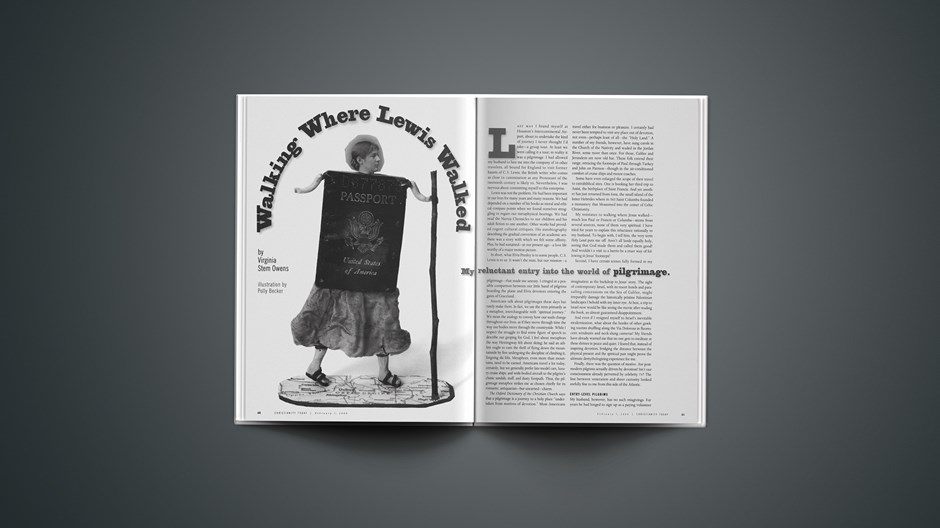
Last may I found myself at Houston's Intercontinental Airport, about to undertake the kind of journey I never thought I'd take—a group tour. At least we were calling it a tour; in reality it was a pilgrimage. I had allowed my husband to lure me into the company of 16 other travelers, all bound for England to visit former haunts of C. S. Lewis, the British writer who comes as close to canonization as any Protestant of the twentieth century is likely to. Nevertheless, I was nervous about committing myself to this enterprise.
Lewis was not the problem. He had been important in our lives for many years and many reasons. We had depended on a number of his books as moral and ethical compass points when we found ourselves struggling to regain our metaphysical bearings. We had read the Narnia Chronicles to our children and his adult fiction to one another. Other works had provided cogent cultural critiques. His autobiography describing the gradual conversion of an academic aesthete was a story with which we felt some affinity. Plus, he had sustained—at our present age—a love life worthy of a major motion picture.
In short, what Elvis Presley is to some people, C. S. Lewis is to us. It wasn't the man, but our mission—a pilgrimage—that made me uneasy. I cringed at a possible comparison between our little band of pilgrims boarding the plane and Elvis devotees entering the gates of Graceland.
Americans talk about pilgrimages these days but rarely make them. In fact, we use the term primarily as a metaphor, interchangeable with "spiritual journey." We mean the analogy to convey how our souls change throughout our lives, as if they move through time the way our bodies move through the countryside. While I respect the struggle to find some figure of speech to describe our groping for God, I feel about metaphors the way Hemingway felt about skiing: he said an athlete ought to earn the thrill of flying down the mountainside by first undergoing the discipline of climbing it, forgoing ski lifts. Metaphors, even more than mountains, need to be earned. Americans travel a lot today, certainly, but we generally prefer late-model cars, luxury cruise ships, and wide-bodied aircraft to the pilgrim's classic sandals, staff, and dusty footpath. Thus, the pilgrimage metaphor strikes me as chosen chiefly for its romantic, antiquarian—but unearned—charm.
The Oxford Dictionary of the Christian Church says that a pilgrimage is a journey to a holy place "undertaken from motives of devotion." Most Americans travel either for business or pleasure. I certainly had never been tempted to visit any place out of devotion, not even—perhaps least of all—the "Holy Land." A number of my friends, however, have sung carols in the Church of the Nativity and waded in the Jordan River, some more than once. For those, Galilee and Jerusalem are now old hat. These folk extend their range, retracing the footsteps of Paul through Turkey and John on Patmos—though in the air-conditioned comfort of cruise ships and motor coaches.
Some have even enlarged the scope of their travel to extrabiblical sites. One is booking her third trip to Assisi, the birthplace of Saint Francis. And yet another has just returned from Iona, the small island of the Inner Hebrides where in 563 Saint Columba founded a monastery that blossomed into the center of Celtic Christianity.
My resistance to walking where Jesus walked—much less Paul or Francis or Columba—stems from several sources, none of them very spiritual. I have tried for years to explain this reluctance rationally to my husband. To begin with, I tell him, the very term Holy Land puts me off. Aren't all lands equally holy, seeing that God made them and called them good? And wouldn't a visit to a barrio be a truer way of following in Jesus' footsteps?
Second, I have certain scenes fully formed in my imagination as the backdrop to Jesus' story. The sight of contemporary Israel, with its resort hotels and parasailing concessions on the Sea of Galilee, might irreparably damage the historically pristine Palestinian landscapes I behold with my inner eye. At best, a trip to Israel now would be like seeing the movie after reading the book, an almost guaranteed disappointment.
And even if I resigned myself to Israel's inevitable modernization, what about the hordes of other gawking tourists shuffling along the Via Dolorosa in fluorescent windsuits and neck-slung cameras? My friends have already warned me that no one gets to meditate at these shrines in peace and quiet. I feared that, instead of inspiring devotion, bridging the distance between the physical present and the spiritual past might prove the ultimate demythologizing experience for me.
Finally, there was the question of motive. Are postmodern pilgrims actually driven by devotion? Isn't our consciousness already perverted by celebrity TV? The line between veneration and sheer curiosity looked awfully fine to me from this side of the Atlantic.
Entry-level pilgrims
My husband, however, has no such misgivings. For years he had longed to sign up as a paying volunteer on an archaeological dig in Israel. But he is wily, and rather than suggest such a radical plunge into pilgrimage, he campaigned for a spiritual destination on an easy entry level—C. S. Lewis's England.
Article continues below
Such a trip would circumvent at least one of my objections to pilgrimages—the present's assault on the imagined past. The time gap between Lewis's life and our own was not so wide as to disturb the scenes in my imagination. Oxford, at least the University, still looks pretty much the same as it did in Lewis's day—or Cranmer's, for that matter, though they no longer burn heretics on Broad Street. Also, both Oxford and Cambridge, where Lewis taught during the last years of his life, are now thoroughly secularized; thus, neither was likely to be overrun with spiritual pilgrims. Moreover, the tour brochure my husband brought home promised a cousin, a biographer, and a Cambridge colleague of Lewis's as guides on various segments of the tour.
My one remaining qualm concerned the rest of the people who had signed up for the trip. Our ages ranged from 16 to 78. Several in the group had never actually read a book by Lewis. Half were students, some of whom had never ventured far from home. Another quarter came from that vast pool which forms the backbone of the American tourist industry—well-heeled widows and divorcées. One of the widows announced at the airport that her primary objective would be snapping up as many Britannia Beanie Babies as she could get her hands on. Several young women showed up with suitcases large enough to hold two full-grown Texans. Inwardly I groaned. We were beginning to look a lot like Chaucer's companions on the road to Canterbury—a mixed bag representing the rich and the poor, the lascivious and the chaste, the learned and the ignorant, the pious and the petty.
An ancient impulse
The Bible doesn't record whether Adam and Eve ever felt the urge to revisit the locked gates of Paradise, but the impulse to pilgrimage appears early in human history. Hindus flocked to Benares to bathe in the Ganges for millennia before the first Christian tour bus cruised Jerusalem. And pious Muslims traveled to Mecca centuries prior to Pope Urban II sending Crusaders to battle the Seljuk Turks for the shrine of the Holy Sepulcher.
Nevertheless, early Christians showed little interest in walking where Jesus walked. Not until A.D. 326, when the Empress Helena, then in her seventies, made the arduous journey from old Byzantium to Jerusalem, did the faithful visit the Holy City out of devotion. As a means of giving thanks for the conversion of her son Constantine, Helena established basilicas at the Mount of Olives and in Bethlehem. So many pilgrims visited these shrines that Church Fathers Gregory of Nyssa, Chrysostom, and Jerome (all of whom did a fair amount of trudging around the ancient world themselves) felt obliged to warn against abusing the practice.
Article continues below
When Palestine fell to the Muslims three centuries later, Christian pilgrims shifted their devotional destination to the tombs of Peter and Paul in Rome. Then in the eighth century, long before the Crusades, a new motive for pilgrimages emerged: sinners were allowed to substitute a journey to an accredited spiritual shrine for public penance for their transgressions.
During plague years of the Middle Ages, when city dwellers fled infection, they often took the opportunity to wipe the moral slate clean as well as enjoy an outing with congenial company by visiting shrines in their own country. Chaucer's pilgrims, for instance, traveled on horseback from the Tabard Inn in Southwark to the martyred Thomas Beckett's shrine in Canterbury, a journey of less than a hundred miles. On the way, they entertained themselves by holding a storytelling contest, turning the trip into the medieval equivalent of a film festival. Indeed, pilgrimages helped to spread and cross-fertilize the most portable of the arts, notably poetry and music.
Another reason for traveling to holy places evolved during the medieval period. A class of professional pilgrims, called palmers for the palm branch they received at the ceremony consecrating their enterprise, made a living from visiting Christian shrines. In exchange for alms and hospitality, they concocted imaginative travelogues with which to entertain their benefactors at the dinner table.
Palmers competed for seats at the best tables by embellishing their tales, like living travel brochures. These professional travelers touted Venice, for example, as the location of one of the water pots from Cana, an ear of St. Paul, the "roasted flesh of Saint Lawrence turned to powder," three of the stones thrown at Stephen, and Goliath's amazing molar, over half a foot long and weighing 12 pounds. Palmers' tales boosted the travel trade to such an extent that pilgrims became one of England's major exports. Outfitting and licensing ships to accommodate spiritual travelers grew into a significant industry.
Article continues below
By the sixteenth century, however, the practice of pilgrimage was being questioned. Erasmus, the free-thinking Dutch tutor to Henry VIII, published a satire titled "Religious Pilgrimages" which claimed that such travel was more self-indulgent than spiritual. A trip to Jerusalem was merely entertainment disguised as piety, Erasmus complained. Bishops were much better off staying home looking after their flocks, noblemen after their estates, and husbands after their wives. These trips might provide pleasure, he allowed, but they rarely improved piety.
During the Reformation, the ranks of pilgrims shrank even more. For one thing, Protestants put no stock in racking up heavenly credits by visiting earthly shrines. Indeed, Reformation theology discouraged any notion that physical objects, whether Jesus' cradle or Saint Swithin's knucklebone, were worthy of veneration or even visitation. Wycliffe particularly and persistently condemned pilgrimages. Pilgrimage, like the Eucharist, became metaphorical. John Bunyan provided the model with his allegorical "progress" of Christian from the City of Destruction to the Heavenly City by way of the Slough of Despond and Vanity Fair.
English Protestants did continue to travel, if only for practical, secular reasons. Up-and-coming young Renaissance men were especially eager to visit Italy, Spain, and the Low Countries to top off their education and to broaden their professional contacts. Making the Grand Tour in the late fifteenth and the sixteenth century was roughly equivalent to acquiring a Harvard M.B.A. today.
Camden, in his History of England, notes in 1577 that "certain young men of promising hopes" were "maintained in foreign countries, at the King's charge, for the more complete polishing of their Parts and Studies." Even Erasmus, so contemptuous of religious pilgrims, found foreign travel educationally obligatory. Journeying to Italy to "take the degree of Doctor," he rhapsodized about Rome: "What sky and fields, what libraries and pleasant walks and sweet confabulation with the learned."
The new Protestant pilgrims
The companions with whom I embarked on the C. S. Lewis quest were all emphatically Protestant, not only in their theology but in their educational objectives for the trip. They may not have intended "a more complete polishing of their Parts" or sought the "sweet confabulations with the learned," but they faithfully attended our leader's lectures on Lewis's fiction, apologetics, and literary criticism. At Malvern College, where the young Lewis boys were educated, we listened attentively to the headmaster explain the mysteries of boarding-school culture. We took notes when a retired Cambridge don reminisced about the mature Lewis's pedagogical style. At Lewis's home in Headington Quarry we snapped photos of the great man's small parlor ("it looked a lot bigger in the movie"), and copied the epitaph from his tombstone at Holy Trinity, his parish church.
Article continues below
We were, on the whole, well-behaved pilgrims. No one, to my knowledge, scratched his name on Lewis's mantel or swiped a book off his shelves for a souvenir. Our decorum would have given neither the Early Church Fathers nor the British Heritage Society cause for complaint.
But though we stole no mementos, we were not completely immune to the primitive pull that physical objects exert on the spiritual imagination. If we had each been presented with something as small as a collar button or a grocery list or on old toothbrush belonging to Lewis, would we not have treasured it, unveiled it to the folks back home the way recent visitors to Israel display their olivewood crosses and vials of Jordan River water?
Admittedly, curiosity motivated much of our exploration. We wandered through the bedrooms at The Kilns, speculating which had belonged to the mysterious Mrs. Moore, which to his December bride, Joy Davidman. After all, our sensibilities have been shaped by celebrity TV. But a hankering for privileged information was not all that drew us there. I believe we harbored some wistful, if unconscious, hope that Lewis's expansive soul might have left a stray smudge on the windowpane, some morsel of his essence seeped into the shabby upholstery of the chair by the fireplace. Perhaps we would not have used the word "veneration" to describe that hope, but what we felt was more than mere curiosity.
A Western Christian named Arculf reported around a.d. 670 that, at the shrine of the Ascension on the Mount of Olives, "the dust on which God stood provides a testimony which is permanent, since his footprints are to be seen in it, and even though people flock there, and in their zeal take away the soil where the Lord stood, it never becomes less, and to this day there are marks like footprints in the earth." Today almost anyone would smile, if not snicker, at Arculf. Such credulity may be touching, but we would require forensic evidence to validate the divine footprint.
Still, when Lewis's younger cousin, Joan Murphey, led our group along Addison's Walk where a conversation with Owen Barfield had changed Lewis's life, a collective frisson of something approaching veneration rippled through our little company of pilgrims. No one exactly searched the path for the footprints of Aslan's author, but we were all conscious that we had walked that day where Lewis walked.
Article continues below
Why do we, I wondered then, with 400 years of the Enlightenment and iconoclasm under our belts, still want to visit these haunts of our heroes? Is it only to produce a more detailed backdrop in our mind's eye for our spiritual champions? Are we, like modern palmers, collecting entertaining tales to carry home?
After the rest of our group headed back to Texas, my husband and I stayed on in England to research details of seventeenth-century life for a book I hope to write. We spent hours in the Museum of London examining Restoration furniture, visited Bath's Museum of Costume to inspect petticoats and stays, pored over Milton's handwriting at Trinity College and Samuel Pepys' gaudily bound library in Magdalene.
But as much as I enjoyed this research, it remained a purely intellectual pleasure. None of it produced the thrill the earlier part of our trip afforded. For a researcher, I learned, is not a pilgrim. Investigation is an analytical enterprise; pilgrimage is a devotional one. Researchers must necessarily stand back from the stage of history to assess the drama played out there. Pilgrims, on the other hand, try to clamber onto the stage in the hopes of drawing closer to the characters.
The Priority of Instances
I would treasure Lewis's grocery list the way I treasure my daughter's baby tooth, still lying at the bottom of my jewelry box—and for a similar reason. Actually handling such physical objects would bring the great man and the little girl close to me in a way simply studying them would not. Mere information does not elicit the kind of response that our group experienced on Addison's Walk or that Arculf felt on the Mount of Olives.
Sitting in the dingy parlor of our Cambridge guest house one morning, our group listened to George Watson, now a white-haired don, tell how he had traveled to Oxford as a young student in 1948 to hear Lewis lecture. Watson describes him as quite short—he puts him at five feet—and looking like "an odd job man." It was a time when critical theory was just beginning to gain the ascendancy over literature among academics. Nevertheless, Watson says, Lewis upheld "the priority of instances," insisting that a work of literature always takes precedence over any analysis of it—just as a person has more reality, substance, than any mere description, however accurate.
Article continues below
Five feet! I'm thinking all the while, distracted from the don's analysis of Lewis's professional stance. Anthony Hopkins wasn't that short in the movie.
Professor Watson continues, simultaneously diffident and self-assured. His hands tremble as he holds his notes, though possibly more from age than stage fright, and he clears his throat frequently. He is quoting Lewis on the task of storytelling--"to help us climb out from under the net of conceptualization."
I glance across the room at the widow who just yesterday found three Britannia Beanie Babies. She is smiling warmly at George Watson—more charmed, I suspect, by his accent and donnish manners than his views on Lewis's literary criticism. And this, I realize suddenly, is precisely what Lewis meant by "the priority of instances."
Like medieval palmers, my husband and I brought our snapshots of Lewis's tombstone, his kitchen, his don's digs, back to Texas where we showed them to friends one Sunday afternoon. One fellow, something of a Lewis aficionado, asked half-jokingly if I had been overwhelmed by treading where the great man had trod. Did violins swell in the background? Did a glow surround the sacred spot?
No, I said, surprised at how my attitude had changed, it wasn't like that at all. As a pilgrim, I had not stepped outside of time into some magical Oz-like kingdom where the ordinary is rendered impotent. If anything, the experience of pilgrimage, with its mundane demands and discomforts, forces one to pay attention to details, to instances. At home, meals and beds are so familiar as to go unnoticed. But when you're a pilgrim, you have to concentrate on plane schedules or you miss your connection, plan for every meal or go hungry, find a bed before night or end up on the street. Paradoxically, the here-and-now matters even more urgently when you're far from home. Such acute attention to the physical present, strangely enough, also makes us permeable to the past.
The sun, I discovered, shines on Oxford—and no doubt on Jerusalem—the same as it does on Texas. The rain falls on the obscure as surely as the famous. That truth diminishes neither place nor time. In fact, it saves incarnation from being just another fancy theological notion. Pilgrimages make us realize that the water which washed over Jesus in the Jordan is still floating around the world somewhere and in some form today.
Article continues below
Human beings build shrines, hallow places, venerate objects, not in order to distance ourselves from our spiritual heroes, but to anchor us to them. Relics, whether your grandmother's cookbook or Lewis's coal scuttle or Saint Columba's coracle, are evidence of the physical reality they share with us. Like us, they are material, not virtual. Such is the power of stark matter, of palpable proximity.
Through grocery lists and baby teeth, instances assert their priority. The dirt on Addison's Walk and the Mount of Olives remind us—no, testify—that Lewis and Jesus lived, not on a mythical Mount Olympus or an internal Nirvana, but in the same world we do. And that, I discovered, is how pilgrimages hallow our lives.
Virginia Stem Owens is author of Daughters of Eve (NavPress) and Looking for Jesus (Westminster John Knox). She lives in Huntsville, Texas.
















 While we pray for peace, we need moral clarity about this war.
 A Christian reconciliation group in Israel and Palestine warned that war would come. Now the war threatens their relevance.españolالعربيةFrançaisрусскийУкраїнська
 How groups like Hillsong learned to let go of the literal in favor of creative collaboration.españolPortuguês






