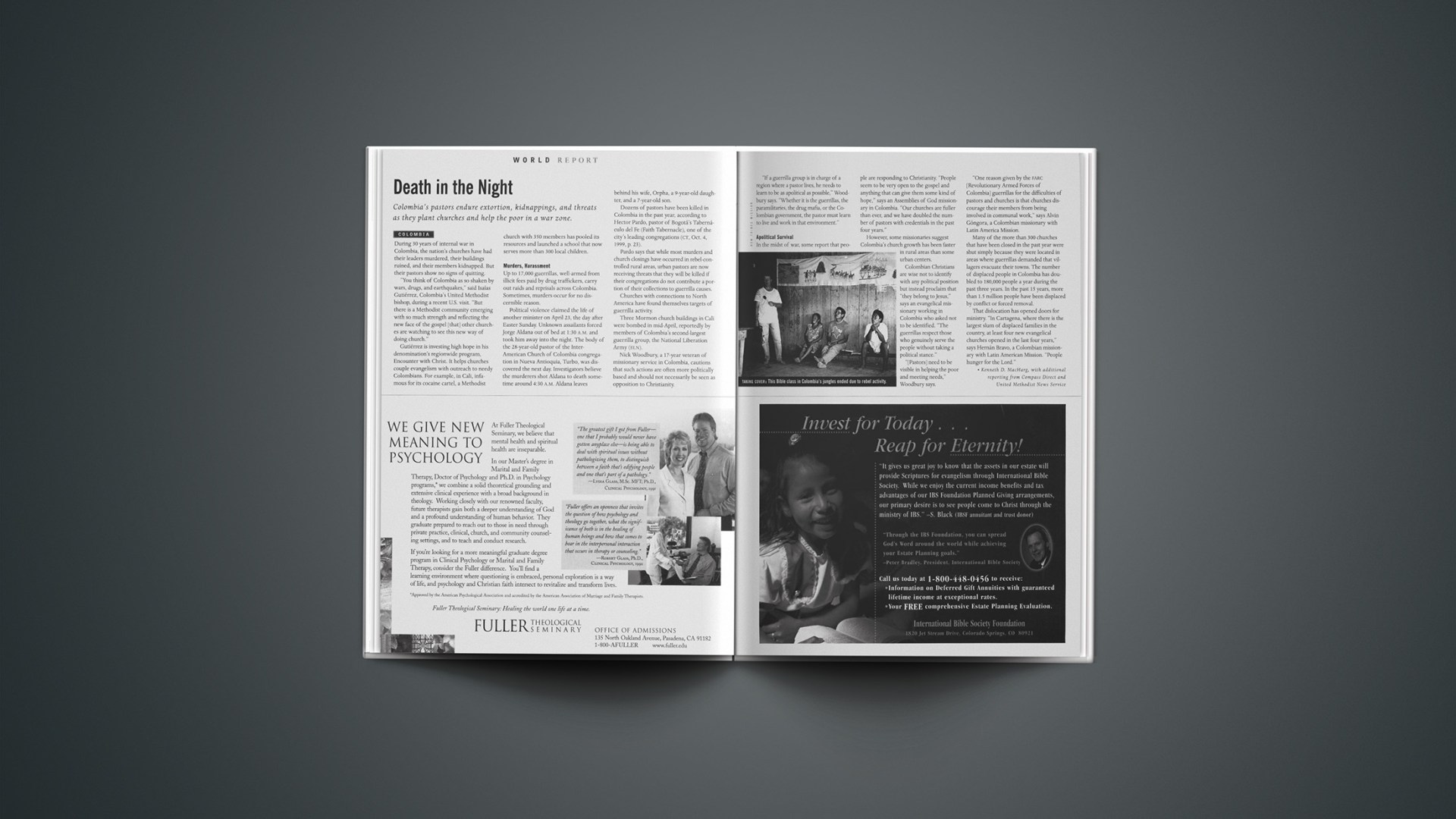

During 30 years of internal war in Colombia, the nation’s churches have had their leaders murdered, their buildings ruined, and their members kidnapped. But their pastors show no signs of quitting.
“You think of Colombia as so shaken by wars, drugs, and earthquakes,” said Isaías Gutiérrez, Colombia’s United Methodist bishop, during a recent U.S. visit. “But there is a Methodist community emerging with so much strength and reflecting the new face of the gospel [that] other churches are watching to see this new way of doing church.”
Gutiérrez is investing high hope in his denomination’s regionwide program, Encounter with Christ. It helps churches couple evangelism with outreach to needy Colombians. For example, in Cali, infamous for its cocaine cartel, a Methodist church with 350 members has pooled its resources and launched a school that now serves more than 300 local children.
Murders, Harassment
Up to 17,000 guerrillas, well-armed from illicit fees paid by drug traffickers, carry out raids and reprisals across Colombia. Sometimes, murders occur for no discernible reason.
Political violence claimed the life of another minister on April 23, the day after Easter Sunday. Unknown assailants forced Jorge Aldana out of bed at 1:30 a.m. and took him away into the night. The body of the 28-year-old pastor of the Inter-American Church of Colombia congregation in Nueva Antioquia, Turbo, was discovered the next day. Investigators believe the murderers shot Aldana to death sometime around 4:30 a.m. Aldana leaves behind his wife, Orpha, a 9-year-old daughter, and a 7-year-old son.
Dozens of pastors have been killed in Colombia in the past year, according to Hector Pardo, pastor of Bogot’s Tabernáculo del Fe (Faith Tabernácle), one of the city’s leading congregations.
Pardo says that while most murders and church closings have occurred in rebel-controlled rural areas, urban pastors are now receiving threats that they will be killed if their congregations do not contribute a portion of their collections to guerrilla causes.
Churches with connections to North America have found themselves targets of guerrilla activity. Three Mormon church buildings in Cali were bombed in mid-April, reportedly by members of Colombia’s second-largest guerrilla group, the National Liberation Army (ELN).
Nick Woodbury, a 17-year veteran of missionary service in Colombia, cautions that such actions are often more politically based and should not necessarily be seen as opposition to Christianity.
“if a guerrilla group is in charge of a region where a pastor lives, he needs to learn to be as apolitical as possible,” Woodbury says. “Whether it is the guerrillas, the paramilitaries, the drug mafia, or the Colombian government, the pastor must learn to live and work in that environment.”
Apolitical Survival
In the midst of war, some report that people are responding to Christianity.
“People seem to be very open to the gospel and anything that can give them some kind of hope,” says an Assemblies of God missionary in Colombia. “Our churches are fuller than ever, and we have doubled the number of pastors with credentials in the past four years.”
However, some missionaries suggest Colombia’s church growth has been faster in rural areas than some urban centers.
Colombian Christians are wise not to identify with any political position but instead proclaim that ” they belong to Jesus,” says an evangelical missionary working in Colombia who asked not to be identified. “The guerrillas respect those who genuinely serve the people without taking a political stance.”
“[Pastors] need to be visible in helping the poor and meeting needs,” Woodbury says.
“One reason given by the FARC [Revolutionary Armed Forces of Colombia] guerrillas for the difficulties of pastors and churches is that churches discourage their members from being involved in communal work,” says Alvin Góngora, a Colombian missionary with Latin America Mission.
Many of the more than 300 churches that have been closed in the past year were shut simply because they were located in areas where guerrillas demanded that villagers evacuate their towns. The number of displaced people in Colombia has doubled to 180,000 people a year during the past three years.
In the past 15 years, more than 1.5 million people have been displaced by conflict or forced removal.
That dislocation has opened doors for ministry. “In Cartagena, where there is the largest slum of displaced families in the country, at least four new evangelical churches opened in the last four years,” says Hernán Bravo, a Colombian missionary with Latin American Mission. “People hunger for the Lord.”
Additional reporting by Compass Direct and United Methodist News Service
Related Elsewhere
Our earlier coverage of the church in Colombia includes:
Colombia’s Bleeding Church | Despite the murders of 120 church leaders, Christians are fighting for peace in one of the world’s most violent nations. (May 18, 1998)
Fate of Kidnapped Missionaries Still Unresolved | Colombia remains thought to end questions are not human after all. (Mar. 29, 2000)
Twenty-five Pastors Killed This Year (Oct. 4, 1999)
Christians Held As Hostages (July 12, 1999)
The U.S. Department of State has recent reports on religious freedom and human rights in general in Colombia. Both are available at the U.S. Commission on International Religious Freedom’s Web site.
Copyright © 2000 Christianity Today. Click for reprint information.