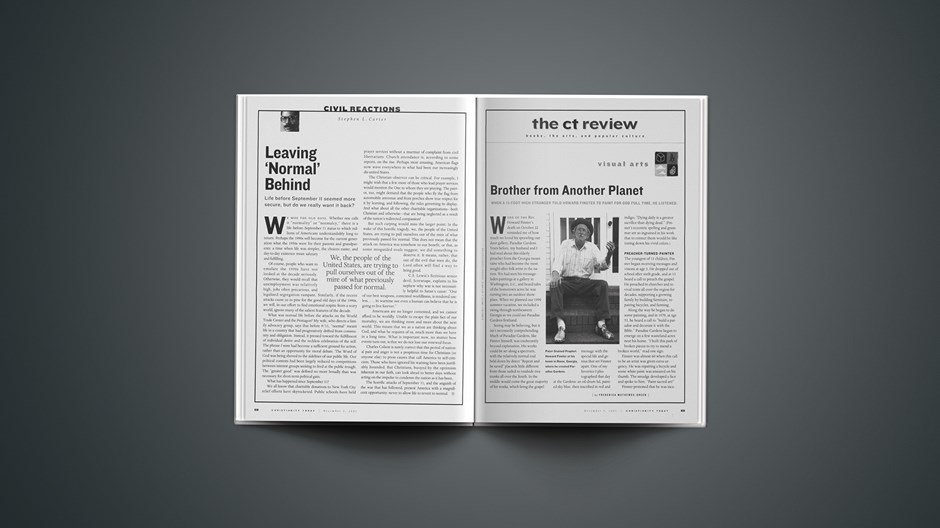
Word of the Rev. Howard Finster's death on October 22 reminded me of how much we loved his sprawling outdoor gallery, Paradise Gardens. Years before, my husband and I had read about this elderly preacher from the Georgia mountains who had become the most sought-after folk artist in the nation. We had seen his message-laden paintings at a gallery in Washington, d.c., and heard tales of the hometown acres he was turning into an outdoor showplace. When we planned our 1990 summer vacation, we included a swing through northeastern Georgia so we could see Paradise Gardens firsthand.
Seeing may be believing, but it isn't necessarily comprehending. Much of Paradise Gardens, like Finster himself, was exuberantly beyond explanation. His works could be set along a spectrum, with the relatively normal end held down by direct "Repent and be saved" placards little different from those nailed to roadside tree trunks all over the South. In the middle would come the great majority of his works, which bring the gospel message with the special life and genius that set Finster apart. One of my favorites I photographed that day at the Gardens: an oil-drum lid, painted sky blue, then inscribed in red and indigo, "Dying daily is a greator sacrifice than dying dead." (Finster's eccentric spelling and grammar are so ingrained in his work that to correct them would be like toning down his vivid colors.)
Preacher-Turned-Painter
The youngest of 13 children, Finster began receiving messages and visions at age 3. He dropped out of school after sixth grade, and at 13 heard a call to preach the gospel. He preached in churches and revival tents all over the region for decades, supporting a growing family by building furniture, repairing bicycles, and farming.
Along the way he began to do some painting, and in 1970, at age 53, he heard a call to "build a paradise and decorate it with the Bible." Paradise Gardens began to emerge on a few wasteland acres near his home. "I built this park of broken pieces to try to mend a broken world," read one sign.
Finster was almost 60 when this call to be an artist was given extra urgency. He was repairing a bicycle and some white paint was smeared on his thumb. The smudge developed a face and spoke to him: "Paint sacred art!"
Finster protested that he was incapable, but the face demanded, "How do you know?"
"It just dawned on me," Finster said. "How did I know?"
It was then that Finster began to paint relentlessly, setting forth the gospel message in every form that his exceptionally fertile imagination could devise. Most of his paintings were made on scrap wood and cutout panels, depicting angels, heavenly scenes, animals, and, most often, portraits—faces with large, luminous eyes fringed with long lashes like the rays of the sun. Images were often subservient to words, however, and most paintings are crowded front and back with Scriptures and admonitions. Painted with thick black outlines and primary colors, the works vibrate with energy.
The clarity and conviction of Finster's images made him popular with art collectors, gallery owners, and some rock bands (including Talking Heads and R.E.M.) whose everyday worlds were no doubt more ambivalent and anxious than these confident scenes. Locals were well familiar with Finster's message but didn't appreciate the art. Sophisticated admirers appreciated the art but could be wholly oblivious to the message.
In 1996 I returned to Paradise Gardens to interview Finster. It was the first time I'd met him, though we had initially corresponded almost ten years before. On the day of our interview, he came into the Paradise Gardens gallery shop wearing a Sunday suit of shiny navy polyester with the cuffs rolled up, and unbuttoned shirt sleeves bunched in his jacket. Then almost 80, he was weakened by arthritis and diabetes, yet still so compelled to produce that he painted in bed with his arms propped up.
He sat in the only chair and opened a bag packed with small paintings on wood. All during our talk he wrote "messages" on these, front and back, with a black laundry marker. He was concerned that it might look like he was laboring on the Sabbath.
He explained that he wouldn't paint on a Sunday, but he figured writing messages was no different than the old days, when he would preach.
Finster talked about the transition from preacher-with-a-paintbrush to professional artist. At first, he said, people told him that it wasn't right to charge for his art. "I got to studying about it, and they was kinda con artists." They would take his paintings without paying and then sell them, "maybe get a hundred thousand dollars from it."
One day a vision convinced Finster that he should devote himself to full-time painting, and let it be his sole source of income.
"I was out on the porch looking down toward the road, and there was a man standing at the gate about 15 feet tall, and his head was as big as a refrigerator," Finster said. The "man of visions" showed characteristic aplomb in the face of what would be to others a bewildering experience.
Article continues below
"He was familiar to me, but I couldn't think of his name to save my life," Finster said. So he asked the giant, "What can I do for you, sir?" He got this answer: "You can get on the altar."
"That surprised me. I had been preaching 40 years; what does he mean?" Finster prayed over it and felt instructed to give up his other work to concentrate on painting. He made a plaque commemorating the decision and imbedded his bicycle tools in it. ("I got $300 for that, and they put it in the High Museum in Atlanta," he told me proudly.)
Insight in a Flash
Visitors to the Gardens asked many questions, and Finster talked with particular joy about God's way of bringing him the answers just at the moment he needed them.
A black woman asked him why God made black people, and the answer "come in a flash," Finster said.
He said to her, "Lady, look out there. Hadn't you seen all kinds of chickens, white chickens, brown chickens—yellow chickens? The reason you're black, God wanted some black people." Finster explained to me that "somebody had interrupted her thinking, that God was holding something agin' her. That's not God's way of doing things. I never saw a face that looked any more pleased."
He told me that the end was coming soon. "I don't think he'll let us go on like this." He described the fate of those unprepared, who are terrified, and the saved, who go forward in joy to meet the Lord.
"Believing in Jesus Christ, that's the way to get there. You're not even supposed to approach the Father without the name of Jesus. And he's sent me to tell 'em just what I'm telling you."
That was the core of Howard Finster: he believed he had been sent to tell everyone that simple message. On my 1990 visit, I took a photo of a sign that depicted Finster with a large cross. In red letters on the cross it reads: I HAVE CARRIED THIS CROSS FROM A CHILD AND AM NOT ABOUT TO LAY IT DOWN. IT HAS BECOME A PART OF ME.
Below the self-portrait is Finster's own best epitaph:
"I am Howard Finster, a stranger from another world. My father and mother, my sisters and brother, my wife, my children, my grandchildren have realy never figured me out. For my kingdom is not of this world. Only my Father in heaven knows me on this planet. And thats why I have been strong and happy. When my work is finished I will go back to the other world."
Frederica Mathewes-Green is author of The Illumined Heart: The Ancient Christian Path of Transformation (Paraclete).















 While we pray for peace, we need moral clarity about this war.
 A Christian reconciliation group in Israel and Palestine warned that war would come. Now the war threatens their relevance.españolالعربيةFrançaisрусскийУкраїнська
 Beyoncé’s right. Whether listening to Cowboy Carter or reading theology, diversity is a good thing.






