
Not long after he began his pastorate in Amsterdam in 1587, Jacob Arminius was asked to refute a pamphlet attacking the doctrine of predestination. Arminius read the document, but instead of producing the expected scathing reply, he found himself drawn to the pamphleteer's position.
John Milton, an avid pamphleteer himself, lamented 57 years later that "the acute and distinct Arminius was perverted merely by the perusing of a nameless discourse written at Delft, which at first he took in hand to confute." Yet when the British Parliament sought to censor printing, Milton argued passionately that ideas—even heretical ones—needed to be exchanged.
"That infection which is from books of controversy in religion is more doubtful and dangerous to the learned than to the ignorant," Milton wrote in his 1644 tract Areopagitica, "and yet those books must be permitted untouched by the licenser."
The advent of fast, cheap printing technologies around the time of the Reformation transformed theological discourse. But ideas had always found ways to spill out of narrow, approved channels—and they still do.
In the first major Supreme Court decision related to the Internet, Reno v. aclu in 1997, justice John Paul Stevens wrote for the majority that, "Through the use of chat rooms, any person with a phone line can become a town crier with a voice that resonates farther than it could from any soapbox. Through the use of Web pages, mail exploders [listservs], and newsgroups, the same individual can become a pamphleteer."
Since that decision, scholars have explored the effects of the Internet on commerce, politics, and numerous First Amendment concerns. But how does the Internet affect theological discourse?
If there are any experts on this emerging topic, they are concentrated in the Baptist General Conference (BGC) and at Bethel (Minn.) College. Within these institutions, people at the epicenter of the "open theism" debate are learning firsthand the positive and negative power of electronic communication.
Letters about a skeptic
Open theism, the idea that God does not fully know the future because humans have not yet made the choices that will affect it, has been called everything from "an enlightening new paradigm" to "merely an extreme form of Arminianism" to "heresy." Open theism did not originate in—and is not limited to—the BGC (the Southern Baptist Convention, for instance, added an anti-open theism clause to its Faith and Message at its June 2000 meeting). But so far it has created more turmoil in the BGC than in any other Christian body.
The leading proponent of open theism in the BGC, Gregory Boyd, teaches at Bethel and pastors Woodland Hills Church in St. Paul, one of the five largest churches in the conference. Last June, he found himself fighting for his theology—and his job—as his denomination debated whether it could be open to openness.
Though Boyd had long espoused openness views, these views invited relatively little debate until five years ago, when BGC pastors started asking about this sentence in Boyd's 1994 book Letters from a Skeptic: "God can't foreknow the good or bad decisions of the people he creates until he creates these people, and they, in turn, create their decisions."
The complaints increased in volume and frequency until, in 1996, Bethel formed an internal committee to evaluate this position and its effect, if any, on Boyd's employment status. The committee found Boyd's views "within the bounds of evangelical Christian orthodoxy and compatible with the theological commitments expected of faculty members at Bethel." Boyd thus retained his teaching post.
But the battle was just beginning. BGC proponents of classical theism, led largely by John Piper, senior pastor of Bethlehem Baptist Church in Minneapolis, were dismayed by this decision. Groups formed with such names as the Edgren Fellowship (named after Bethel's founder) and Concerned Pastors. Primarily through open letters and print publications, they took their concerns to the conference as a whole, arguing that the denomination's Affirmation of Faith be changed to unquestionably exclude open theism.
As the debate heated up, leaders at Bethel and the BGC discussed ways to maximize the information and minimize the misinformation disseminated to conference members. Out of these meetings, the Foreknowledge Web site was born.
'An equal hearing'
The Foreknowledge site (now housed at BGCworld.org/4know/4know.htm) is maintained by Gary Marsh, director of communication for the BGC. It was launched in late 1998 with content from a packet produced by a BGC group called the Committed Pastors. (To alleviate confusion: the Concerned Pastors believe, along with Piper, that Boyd and his views should be purged from the BGC; the similarly named Committed Pastors believe the openness debate is not essential enough to split the denomination.)
Call the Foreknowledge site edited and organized, but not moderated. Marsh sees it as "an information clearinghouse." Its stated purpose is "to help members understand the biblical and philosophical issues being discussed within our conference relating to God's foreknowledge" and "to give all concerned parties an equal hearing."
Marsh lobbied for the site and its post-whatever-comes-in structure although his bosses were "very reluctant to put anything out other than official notices." Marsh felt this approach was too slow and too limited in scope.
"Once the BGC leadership said that Boyd's position was within the bounds of evangelicalism," Marsh says, "it was incumbent upon them to make information on that position available so BGC members could evaluate it for themselves."
Marsh, whose other duties include video production and oversight of the BGC magazine The Standard, posts everything from official conference communiqués to letters and personal essays. He says he has "no hard and fast criteria" for what he posts and estimates that 90 percent of the material he has received was placed online.
To qualify for the site, posts had to be signed (though Marsh notes that a few unsigned posts got through) and had to address the openness debate. Marsh accepted material equally from both sides. He describes both Piper and Boyd as "sympathetic and anxious to get more material on" the site.
"In general," Marsh says, "everyone was represented who wished to be." But if Boyd's view of open theology raised Baptist eyebrows, so did Marsh's view of the open theology debate.
Openness or anarchy?
This free-for-all approach concerned some Bethel and BGC leaders from the beginning. Marsh says he heard "consistent concern that if we appear to acknowledge a position then more people will see it as viable and be persuaded to join."
But that wasn't the concern of Bethel president George Brushaber (also senior adviser for Christianity Today), who was among those who argued against the site as constructed. Discussing such a charged issue in an open forum, he says, is like "attempting to moderate a divisive, conflict-laden church business meeting without Robert's Rules of Order."
And it seemed to Brushaber that the debate sometimes went more according to Murphy's Law than Robert's Rules. The open theism debate became the sharpest dispute in BGC history, and Brushaber attributes much of the bitterness to the Internet—the Foreknowledge site, partisan sites, and particularly mass e-mail messages, which tended to be the most vitriolic dispatches of all.
"Rumor and innuendo flew fast, and there was fear-mongering by partisans on both sides," he says. "Both sides were guilty of misrepresentation, exaggeration, threats, and triumphalist gloating. It became recreational sport for many partisans."
Such vitriol wasn't the norm in other venues, Brushaber says. Both Bethel and the BGC sponsored live debates, some between Boyd and Piper personally, which reached a total audience of thousands. Unlike Internet exchanges, Brushaber says, these debates were "conducted with clarity, precision, mutual respect, and effectiveness."
Brushaber also makes a distinction between open forum interactions and Web publishing of position papers from people on all sides of the debate. "These were and rightly should have been published in hard copy and electronically," he says, noting that the Foreknowledge site served a good purpose in making such resources widely available.
Though the Foreknowledge site was (until recently) hosted at Bethel's domain, it is not directly affiliated with the college. If Bethel had maintained a site on the topic, Brushaber says, he would have asked one or more informed people with theological insight to moderate the discussion and conduct it more like a theological or academic conference.
Such a forum would have sealed its doors more tightly against anonymous posts. "If persons are allowed to hide behind façades, I question whether they are contributing in wholesome ways to the dialogue," says the Bethel president.
He acknowledges that this approach would have slowed the exchange of information and limited the number of views represented, but in this case, slower is better. "The speed of the exchanges, faster than the speed of reflective thought and good discerning judgment, was and is detrimental to serious theological dialogue," he says.
Hot off the presses
Is faster better? Is theology better left to theologians? Does an unmoderated forum lead to lack of moderation? The Internet as we know it is fewer than 10 years old, but such questions about the proper way to conduct theological debate have been around for centuries.
In the early fifth century, Augustine of Hippo had fairly limited options for spreading his views. He was, however, extremely creative and prolific with what was available. He debated Manichees in the public square. He made posters and wrote catchy jingles against the Donatists. To bring down his bitterest foe, the Pelagians, he penned treatises, open letters, and the pre-Gutenberg equivalent of pamphlets in easy-to-read, conversational Latin.
Augustine's polemics were significant enough to survive to today, but they are hardly his best work. His motto for these campaigns was "Fill their countenance with ignominy," and his words were up to the task. His caricatures of the Donatists, for example, were so cleverly constructed that scholars still struggle not to take them at face value.
Publishing and polemics played an even more dramatic role in the 16th century. Historians' frequent aphorism that "there would have been no Reformation without the printing press" contains a good measure of truth.
In 1517, following standard academic procedure, young Martin Luther drafted a list, in Latin, of 95 theses he wished to debate. The document was immediately translated into German, copied, and passed around town.
Before the end of the year, nameless scribes had translated many of Luther's sermons, writings, and theses into German. Then scholars across Europe became interested in the debate, so the works were translated back into Latin for more serious study.
With the 1520 publication of Address to the Christian Nobility of the German Nation, Luther began his long career of writing for audiences much broader than the ranks of professional theologians. The first press run included 4,000 copies, all of which sold out in two weeks.
Luther's work, and the Reformation more generally, drastically altered the German media culture of the early 16th century. Historian Phillip Schaff notes that in 1517 there were only 81 prints in German, mostly devotional literature, newspapers, official documents, and satires. By 1520 the number of prints had risen to 571, and just three years later the total stood at 944.
As Luther's output increased and his arguments with Roman Catholics (as well as other Reformers) grew more rancorous, the quality of his work suffered. Scholars who study his most vengeful polemics typically seek to excuse them or use them to undermine Luther's entire program. These works can hardly be compared with his more circumspect writing. Nevertheless, they illustrate that even the most respected theologians have demonstrated the rancor often visible in today's Internet dispatches.
"We should take him—the pope, the cardinals, and whatever riffraff belongs to His Idolatrous and Papal Holiness—and (as blasphemers) tear out their tongues from the back, and nail them on the gallows," Luther once wrote. In another piece, he rejected rabbinical interpretations of Scripture as "Jewish piss and sh—."
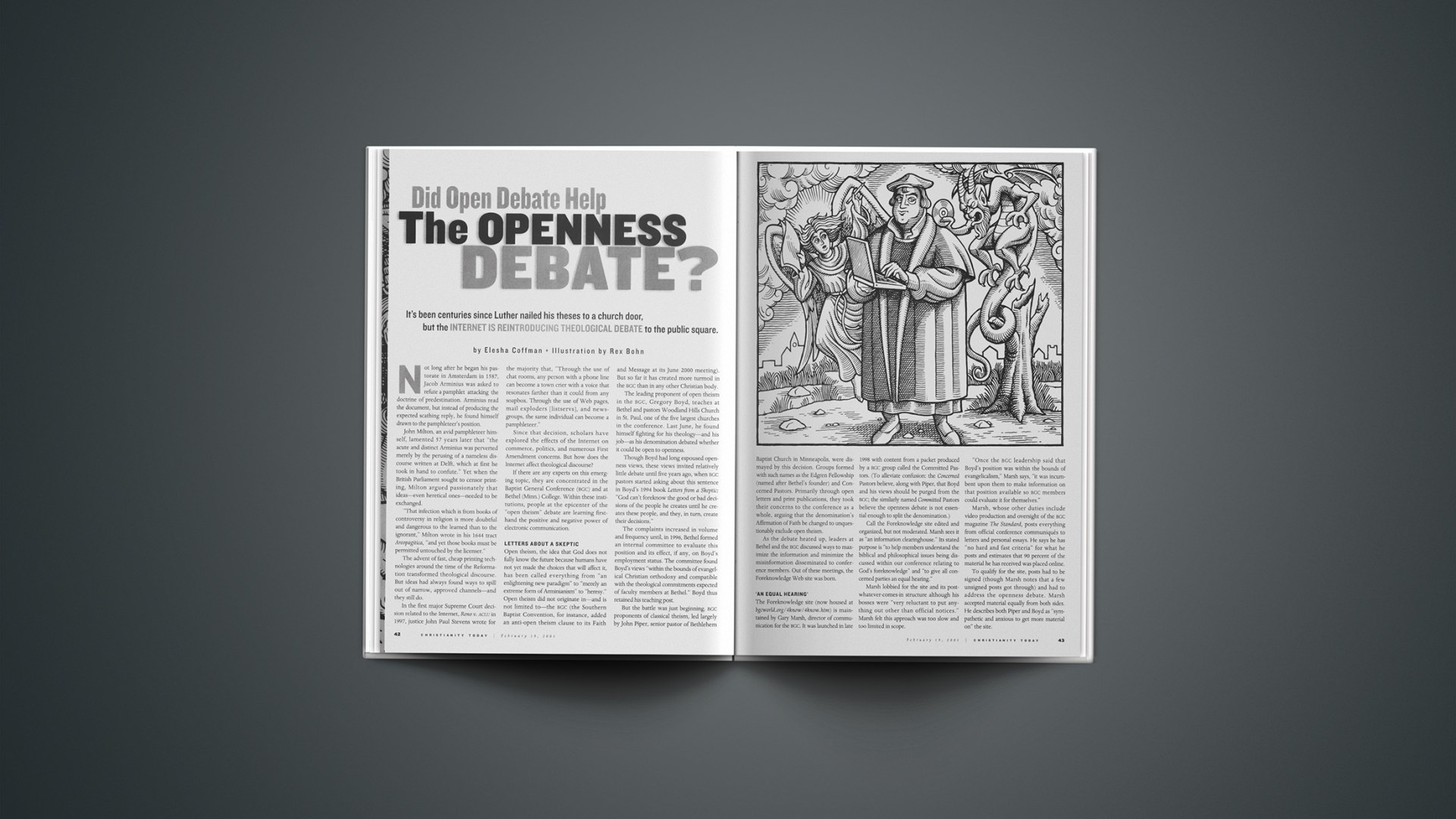
Partisans on both sides of the Reformation followed in this coarse mold. Cartoonish woodcuts depicted demons defecating in the mouths of Luther's opponents, peasants breaking wind at the pope, and Luther cooking up a devil's recipe for falsehood, unbelief, and other vices. If today's Baptists are, in Brushaber's words, "guilty of misrepresentation, exaggeration, threats, and triumphalist gloating," Luther and many of his fellow Reformers would probably have had few qualms about it.
Once the press had been unleashed in theological discourse, it was put to work for all sorts of causes. Milton campaigned fiercely for topics as diverse as church-sanctioned divorce, unlicensed printing, and the elimination of bishops. The 18th century saw an explosion of pamphleteering on political and religious topics in France, America, Ireland, and elsewhere. In the 19th century, abolition and other Civil War concerns occasioned a flood of cheaply printed, simply reasoned, and largely emotional appeals.
Though theological questions were still debated in seminaries and at conferences, these venues ceased long ago to be the only battlegrounds. This is especially true in denominations like the Baptist General Conference, in which member-delegates actually vote on doctrinal issues. Each BGC congregation sends a number of members to vote at the Annual Conference in accordance with its size—and theological educations and exposure levels vary widely. Votes come not just from the pulpits, but from the pews—something not even Reformation-era propagandists envisioned when battling for the hearts and minds of their readers.
"Soapboxes and 'bughouse squares' have always been with us," Brushaber says. "Now the Web serves those purposes."
Both ally and enemy
Was the Web a friend or a foe in the doctrinal debate? John Piper did not respond to CT's requests for an interview, but Greg Boyd, the man at the center of the BGC's battle, talked openly about the process. Boyd says he came late to the electronic discussion on open theism. "For a while, I had no idea how much people used the Internet," Boyd says. He thought of it as merely "e-mail with a megaphone."
Once he discovered all the activity at the Foreknowledge and other Web sites, however, he quickly got involved. He now sees the Web as "a powerful tool that can be used for you or against you."
On the positive side, Boyd appreciates the Web's capacity to disseminate information efficiently and effectively. This capacity was showcased at the BGC Annual Conference in 1999, where delegates were asked to vote on an amendment to the Affirmation of Faith that had been drafted specifically to exclude Boyd's views.
"It always impressed me how much people cited the Web site," he says. He was also impressed by the traffic on the site he started on his own, Gregboyd.org. "At one point, we were getting 1,000 hits a day—people coming from all over the world."
On the negative side of the Internet question, Boyd has two primary concerns: that the Web caused the debate to be so politicized, and that electronic communication can so quickly spin out of control.
Boyd likens online discussion to a conversation on which an interested third party is eavesdropping. He says this "changes the whole flavor" of the conversation as the speakers stop listening carefully to each other and start crafting their statements as sound bites for the eavesdropper.
"By virtue of mass marketing," he says, "you lose some ground in terms of thoroughness. Now the person with the best technology has the upper hand."
Boyd's second concern, the inability to control electronic communication, arose from a lesson he learned the hard way, when he "inadvertently and indiscreetly" used a phrase—safe haven—he wishes he could just "let die."
After the 1999 vote, one of Boyd's friends asked him to comment via e-mail on the results. Boyd knew that this friend maintained a Web site, but as he wrote the e-mail, he never realized that his message might be posted for a wider audience. "I wasn't literate at all," he says.
At the meeting, delegates had voted not to add the proposed phrase "that He knows infallibly all that shall come to pass" to the section in the Affirmation of Faith on what members believe about God. Boyd saw this as a huge victory because the BGC had decided "not to rule out my convictions."
In the e-mail to his friend, Boyd said that open theists who were worried about being accepted in their denominations could consider ministering in the BGC. He called the conference a "safe haven" for people who share his views. "If I would have been thinking, haven was not the word to use," he now says.
What Boyd meant, he says, is that he felt safe in the BGC. "And if it was safe for me," he says, "I thought it would be safe for others."
In Boyd's opinion, his critics have used the phrase as a "billy club" to make people nervous about open theists taking over the conference. It appears in documents from the Edgren Fellowship and in numerous other posts at the Foreknowledge site. Boyd reports that he even saw it in a footnote to a book published last November. His published apology, he says, has done little to slow the damage.
Through this experience, Boyd says he learned "how important it is to weigh your words when you put them on the Net." Once a message is posted, "you can't pull it back—they won't let you pull it back."
'It's not over'
In June 2000, delegates to the BGC Annual Conference cast two votes related to open theism. In the first, they affirmed that open theism is "contrary to our fellowship's historic understanding of God's omniscience" but decided that because the BGC is not a creedal group, its statement was necessarily nonbinding. In the second, they stated approval of the way the Bethel board had handled its evaluation of Boyd.
Traffic to the Foreknowledge site has fallen off since the vote, and few posts are dated more recently than early autumn. Marsh says he has received requests to take the site down but has decided to "let it ride" for the time being.
Brushaber says the conference has "moved beyond" the foreknowledge debate, "but it's not over." He figures the topic will be discussed in venues like the Evangelical Theological Society for another 10 to 15 years, but discussion at that level is unlikely to generate the kind of tumult that has roiled the conference for the past few years.
Brushaber does not attribute all of the turmoil to the Internet, but he feels the free-for-all nature of the new medium bears significant blame. The Web "encourages immediacy over wisdom" and is "the medium of emotion more than considered judgment," Brushaber says. "The flood which comes from the Web makes all comments, all opinions, all rumors, and all accusations of equal value by reducing them all to 'stuff.' It devalues dialogue and debate. It cheapens discourse."
Brushaber believes the Web can contribute to discussion, but as a publishing tool rather than a public square.
"The distinction must be made if electronic media are to be useful for the progress of theology," he says. "I pray we may all learn some lessons from the limitations of the media, which have now become apparent."
Author Elesha Coffman is associate editor of Christian History Corner.
Copyright © 2001 Christianity Today. Click for reprint information.
Related Elsewhere
Visit the Foreknowledge discussion site, where all of the essays by Boyd, Piper, and others are posted.
John Piper's works are readily available at DesiringGod.org. The five articles pertaining to openness include "Foreknowledge," "We Took a Good Stand and Made a Bad Mistake," "Martyn Lloyd-Jones," "What denomination is BBC a part of and why?" and "Take Heed How You Hear."
Greg Boyd's books, articles and debates are available from Boyd's Christus Victor Ministries. At this site you can order Boyd's God of the Possible or read openness materials.
Both Boyd's Woodland Hills Church and Piper's Bethlehem Baptist Church have Web sites that discuss core beliefs.
Read Roger E. Olson's "Analysis of the 'Openness of God' Theology." Olson, who claims to be "open to aspects of openness" is a professor of theology at Baylor and a member of the Baptist General Conference.
Bethel College and Seminary's President George Brushaber believes that online theological debate would benefit from more order and thoughtfulness.
Previous Christianity Today articles about openness theological debate include:
God vs. God | Two competing theologies vie for the future of evangelicalism (Feb. 7, 2000).
Do Good Fences Make Good Baptists? | The SBC's new Faith and Message brings needed clarity—but maybe at the cost of honest diversity. (Aug. 8, 2000)
The Perils of Left and Right | Evangelical theology is much bigger and richer than our two-party labels. (Aug. 10, 1998)
The Future of Evangelical Theology | Roger Olson argues that a division between traditionalists and reformists threatens to end our theological consensus. (Feb. 9, 1998)
A Pilgrim on the Way | For me, theology is like a rich feast, with many dishes to enjoy and delicacies to taste. (Feb. 9, 1998)
A Theology to Die For | Theologians are not freelance scholars of religion, but trustees of the deposit of faith. (Feb. 9, 1998)
The Real Reformers are Traditionalists | If there is no immune system to resist heresy, there will soon be nothing but the teeming infestation of heresy. (Feb. 9, 1998)