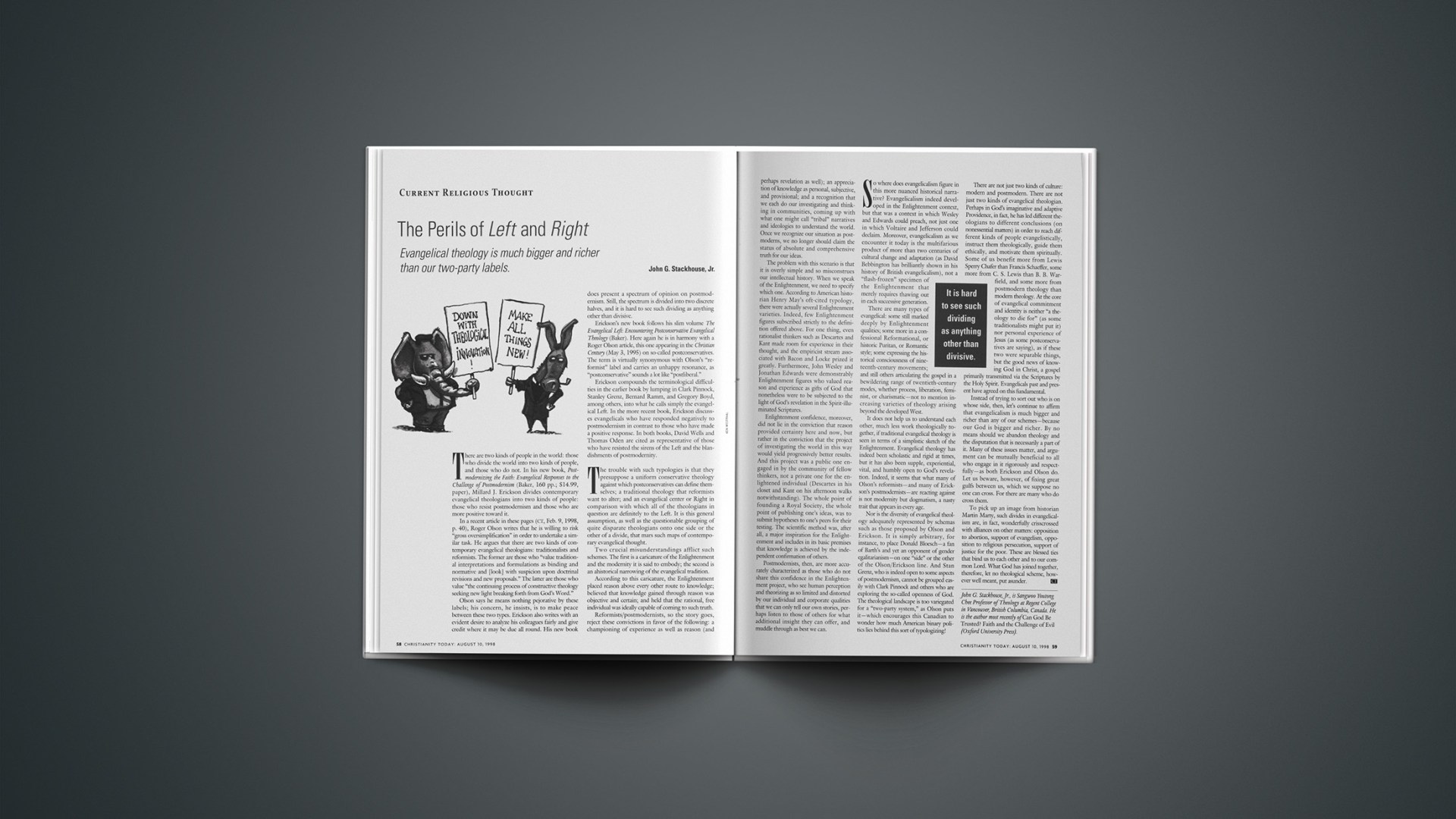

There are two kinds of people in the world: those who divide the world into two kinds of people, and those who do not. In his new book, Postmodernizing the Faith: Evangelical Responses to the Challenge of Postmodernism (Baker, 160 pp.; $14.99, paper), Millard J. Erickson divides contemporary evangelical theologians into two kinds of people: those who resist postmodernism and those who are more positive toward it.
In a recent article in these pages (CT, Feb. 9, 1998, p. 40), Roger Olson writes that he is willing to risk “gross oversimplification” in order to undertake a similar task. He argues that there are two kinds of contemporary evangelical theologians: traditionalists and reformists. The former are those who “value traditional interpretations and formulations as binding and normative and [look] with suspicion upon doctrinal revisions and new proposals.” The latter are those who value “the continuing process of constructive theology seeking new light breaking forth from God’s Word.”
Olson says he means nothing pejorative by these labels; his concern, he insists, is to make peace between these two types. Erickson also writes with an evident desire to analyze his colleagues fairly and give credit where it may be due all round. His new book does present a spectrum of opinion on postmodernism. Still, the spectrum is divided into two discrete halves, and it is hard to see such dividing as anything other than divisive.
Erickson’s new book follows his slim volume The Evangelical Left: Encountering Postconservative Evangelical Theology (Baker). Here again he is in harmony with a Roger Olson article, this one appearing in the Christian Century (May 3, 1995) on so-called postconservatives. The term is virtually synonymous with Olson’s “reformist” label and carries an unhappy resonance, as “postconservative” sounds a lot like “postliberal.”
Erickson compounds the terminological difficulties in the earlier book by lumping in Clark Pinnock, Stanley Grenz, Bernard Ramm, and Gregory Boyd, among others, into what he calls simply the evangelical Left. In the more recent book, Erickson discusses evangelicals who have responded negatively to postmodernism in contrast to those who have made a positive response. In both books, David Wells and Thomas Oden are cited as representative of those who have resisted the sirens of the Left and the blandishments of postmodernity.
The trouble with such typologies is that they presuppose a uniform conservative theology against which postconservatives can define themselves; a traditional theology that reformists want to alter; and an evangelical center or Right in comparison with which all of the theologians in question are definitely to the Left. It is this general assumption, as well as the questionable grouping of quite disparate theologians onto one side or the other of a divide, that mars such maps of contemporary evangelical thought.
Two crucial misunderstandings afflict such schemes. The first is a caricature of the Enlightenment and the modernity it is said to embody; the second is an ahistorical narrowing of the evangelical tradition.
According to this caricature, the Enlightenment placed reason above every other route to knowledge; believed that knowledge gained through reason was objective and certain; and held that the rational, free individual was ideally capable of coming to such truth.
Reformists/postmodernists, so the story goes, reject these convictions in favor of the following: a championing of experience as well as reason (and perhaps revelation as well); an appreciation of knowledge as personal, subjective, and provisional; and a recognition that we each do our investigating and thinking in communities, coming up with what one might call “tribal” narratives and ideologies to understand the world. Once we recognize our situation as postmoderns, we no longer should claim the status of absolute and comprehensive truth for our ideas.
The problem with this scenario is that it is overly simple and so misconstrues our intellectual history. When we speak of the Enlightenment, we need to specify which one. According to American historian Henry May’s oft-cited typology, there were actually several Enlightenment varieties. Indeed, few Enlightenment figures subscribed strictly to the definition offered above. For one thing, even rationalist thinkers such as Descartes and Kant made room for experience in their thought, and the empiricist stream associated with Bacon and Locke prized it greatly. Furthermore, John Wesley and Jonathan Edwards were demonstrably Enlightenment figures who valued reason and experience as gifts of God that nonetheless were to be subjected to the light of God’s revelation in the Spirit-illuminated Scriptures.
Enlightenment confidence, moreover, did not lie in the conviction that reason provided certainty here and now, but rather in the conviction that the project of investigating the world in this way would yield progressively better results. And this project was a public one engaged in by the community of fellow thinkers, not a private one for the enlightened individual (Descartes in his closet and Kant on his afternoon walks notwithstanding). The whole point of founding a Royal Society, the whole point of publishing one’s ideas, was to submit hypotheses to one’s peers for their testing. The scientific method was, after all, a major inspiration for the Enlightenment and includes in its basic premises that knowledge is achieved by the independent confirmation of others.
Postmodernists, then, are more accurately characterized as those who do not share this confidence in the Enlightenment project, who see human perception and theorizing as so limited and distorted by our individual and corporate qualities that we can only tell our own stories, perhaps listen to those of others for what additional insight they can offer, and muddle through as best we can.
So where does evangelicalism figure in this more nuanced historical narrative? Evangelicalism indeed developed in the Enlightenment context, but that was a context in which Wesley and Edwards could preach, not just one in which Voltaire and Jefferson could declaim. Moreover, evangelicalism as we encounter it today is the multifarious product of more than two centuries of cultural change and adaptation (as David Bebbington has brilliantly shown in his history of British evangelicalism), not a “flash-frozen” specimen of the Enlightenment that merely requires thawing out in each successive generation.
There are many types of evangelical: some still marked deeply by Enlightenment qualities; some more in a confessional Reformational, or historic Puritan, or Romantic style; some expressing the historical consciousness of nineteenth-century movements; and still others articulating the gospel in a bewildering range of twentieth-century modes, whether process, liberation, feminist, or charismatic—not to mention increasing varieties of theology arising beyond the developed West.
It does not help us to understand each other, much less work theologically together, if traditional evangelical theology is seen in terms of a simplistic sketch of the Enlightenment. Evangelical theology has indeed been scholastic and rigid at times, but it has also been supple, experiential, vital, and humbly open to God’s revelation. Indeed, it seems that what many of Olson’s reformists—and many of Erickson’s postmodernists—are reacting against is not modernity but dogmatism, a nasty trait that appears in every age.
It is hard to see such dividing as anything other than divisive.
Nor is the diversity of evangelical theology adequately represented by schemas such as those proposed by Olson and Erickson. It is simply arbitrary, for instance, to place Donald Bloesch—a fan of Barth’s and yet an opponent of gender egalitarianism—on one “side” or the other of the Olson/Erickson line. And Stan Grenz, who is indeed open to some aspects of postmodernism, cannot be grouped easily with Clark Pinnock and others who are exploring the so-called openness of God. The theological landscape is too variegated for a “two-party system,” as Olson puts it—which encourages this Canadian to wonder how much American binary politics lies behind this sort of typologizing!
There are not just two kinds of culture: modern and postmodern. There are not just two kinds of evangelical theologian. Perhaps in God’s imaginative and adaptive Providence, in fact, he has led different theologians to different conclusions (on nonessential matters) in order to reach different kinds of people evangelistically, instruct them theologically, guide them ethically, and motivate them spiritually. Some of us benefit more from Lewis Sperry Chafer than Francis Schaeffer, some more from C. S. Lewis than B. B. Warfield, and some more from postmodern theology than modern theology. At the core of evangelical commitment and identity is neither “a theology to die for” (as some traditionalists might put it) nor personal experience of Jesus (as some postconservatives are saying), as if these two were separable things, but the good news of knowing God in Christ, a gospel primarily transmitted via the Scriptures by the Holy Spirit. Evangelicals past and present have agreed on this fundamental.
Instead of trying to sort out who is on whose side, then, let’s continue to affirm that evangelicalism is much bigger and richer than any of our schemes—because our God is bigger and richer. By no means should we abandon theology and the disputation that is necessarily a part of it. Many of these issues matter, and argument can be mutually beneficial to all who engage in it rigorously and respectfully—as both Erickson and Olson do. Let us beware, however, of fixing great gulfs between us, which we suppose no one can cross. For there are many who do cross them.
To pick up an image from historian Martin Marty, such divides in evangelicalism are, in fact, wonderfully crisscrossed with alliances on other matters: opposition to abortion, support of evangelism, opposition to religious persecution, support of justice for the poor. These are blessed ties that bind us to each other and to our common Lord. What God has joined together, therefore, let no theological scheme, however well meant, put asunder.
John G. Stackhouse, Jr., is Sangwoo Youtong Chee Professor of Theology at Regent College in Vancouver, British Columbia, Canada. He is the author most recently of Can God Be Trusted? Faith and the Challenge of Evil (Oxford University Press).
Copyright © 1998 Christianity Today. Click for reprint information.