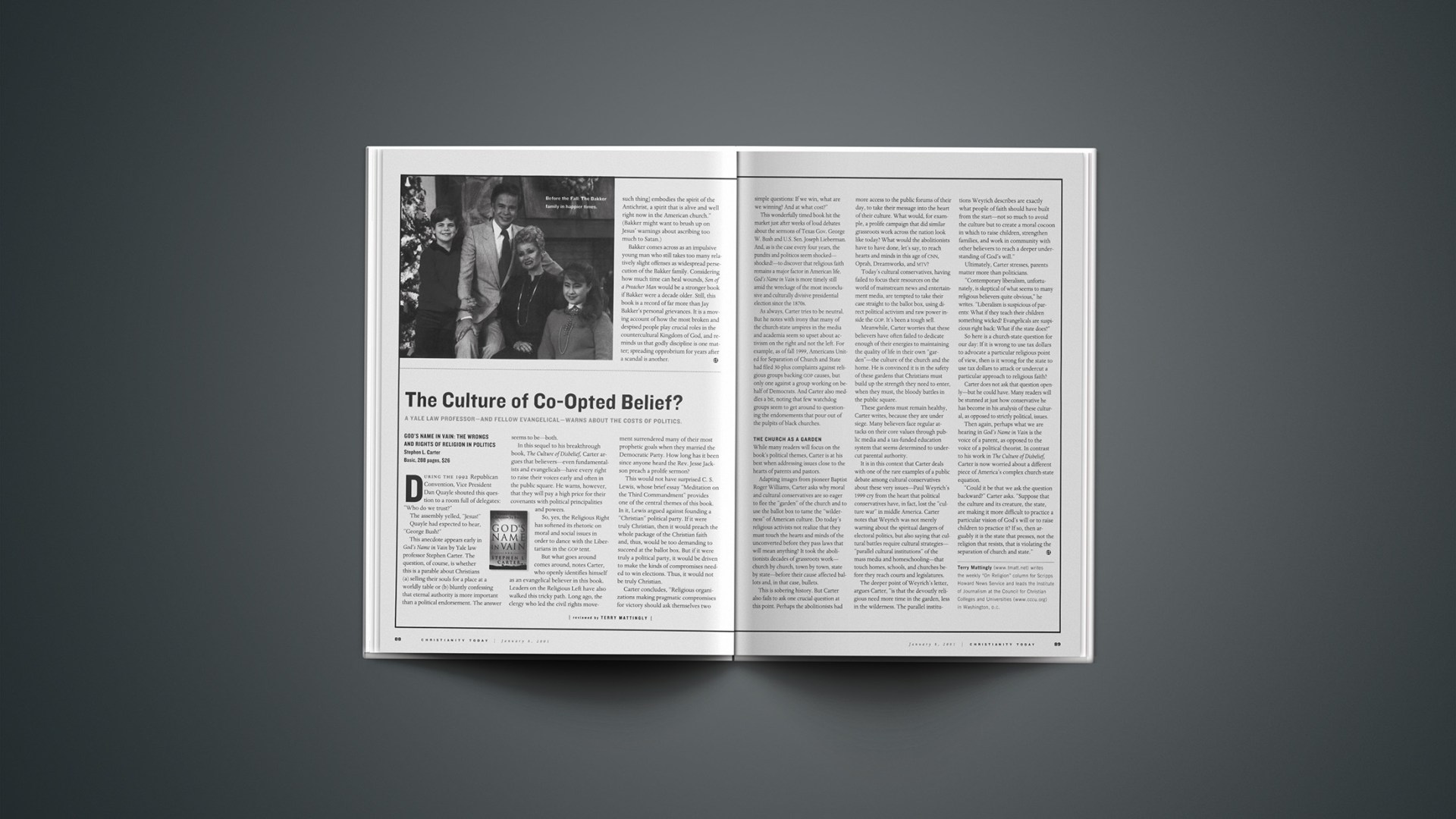

God’s Name in Vain: The Wrongs and Rights of Religion in Politics
Stephen L. Carter
Basic, 288 pages, $26
During the 1992 Republican Convention, Vice President Dan Quayle shouted this question to a room full of delegates: “Who do we trust?”
The assembly yelled, “Jesus!”
Quayle had expected to hear, “George Bush!”
This anecdote appears early in God’s Name in Vain by Yale law professor Stephen Carter. The question, of course, is whether this is a parable about Christians (a) selling their souls for a place at a worldly table or (b) bluntly confessing that eternal authority is more important than a political endorsement. The answer seems to be—both.
In this sequel to his breakthrough book, The Culture of Disbelief, Carter argues that believers—even fundamentalists and evangelicals—have every right to raise their voices early and often in the public square. He warns, however, that they will pay a high price for their covenants with political principalities and powers.
So, yes, the Religious Right has softened its rhetoric on moral and social issues in order to dance with the Libertarians in the GOP tent.
But what goes around comes around, notes Carter, who openly identifies himself as an evangelical believer in this book. Leaders on the Religious Left have also walked this tricky path. Long ago, the clergy who led the civil rights movement surrendered many of their most prophetic goals when they married the Democratic Party. How long has it been since anyone heard the Rev. Jesse Jackson preach a prolife sermon?
This would not have surprised C. S. Lewis, whose brief essay “Meditation on the Third Commandment” provides one of the central themes of this book. In it, Lewis argued against founding a “Christian” political party. If it were truly Christian, then it would preach the whole package of the Christian faith and, thus, would be too demanding to succeed at the ballot box. But if it were truly a political party, it would be driven to make the kinds of compromises needed to win elections. Thus, it would not be truly Christian.
Carter concludes, “Religious organizations making pragmatic compromises for victory should ask themselves two simple questions: If we win, what are we winning? And at what cost?”
This wonderfully timed book hit the market just after weeks of loud debates about the sermons of Texas Gov. George W. Bush and U.S. Sen. Joseph Lieberman. And, as is the case every four years, the pundits and politicos seem shocked—shocked!—to discover that religious faith remains a major factor in American life. God’s Name in Vain is more timely still amid the wreckage of the most inconclusive and culturally divisive presidential election since the 1870s.
As always, Carter tries to be neutral. But he notes with irony that many of the church-state umpires in the media and academia seem so upset about activism on the right and not the left. For example, as of fall 1999, Americans United for Separation of Church and State had filed 30-plus complaints against religious groups backing GOP causes, but only one against a group working on behalf of Democrats. And Carter also meddles a bit, noting that few watchdog groups seem to get around to questioning the endorsements that pour out of the pulpits of black churches.
The church as a garden While many readers will focus on the book’s political themes, Carter is at his best when addressing issues close to the hearts of parents and pastors.
Adapting images from pioneer Baptist Roger Williams, Carter asks why moral and cultural conservatives are so eager to flee the “garden” of the church and to use the ballot box to tame the “wilderness” of American culture. Do today’s religious activists not realize that they must touch the hearts and minds of the unconverted before they pass laws that will mean anything? It took the abolitionists decades of grassroots work—church by church, town by town, state by state—before their cause affected ballots and, in that case, bullets.
This is sobering history. But Carter also fails to ask one crucial question at this point. Perhaps the abolitionists had more access to the public forums of their day, to take their message into the heart of their culture. What would, for example, a prolife campaign that did similar grassroots work across the nation look like today? What would the abolitionists have to have done, let’s say, to reach hearts and minds in this age of CNN, Oprah, Dreamworks, and MTV?
Today’s cultural conservatives, having failed to focus their resources on the world of mainstream news and entertainment media, are tempted to take their case straight to the ballot box, using direct political activism and raw power inside the GOP. It’s been a tough sell.
Meanwhile, Carter worries that these believers have often failed to dedicate enough of their energies to maintaining the quality of life in their own “garden”—the culture of the church and the home. He is convinced it is in the safety of these gardens that Christians must build up the strength they need to enter, when they must, the bloody battles in the public square.
These gardens must remain healthy, Carter writes, because they are under siege. Many believers face regular attacks on their core values through public media and a tax-funded education system that seems determined to undercut parental authority.
It is in this context that Carter deals with one of the rare examples of a public debate among cultural conservatives about these very issues—Paul Weyrich’s 1999 cry from the heart that political conservatives have, in fact, lost the “culture war” in middle America. Carter notes that Weyrich was not merely warning about the spiritual dangers of electoral politics, but also saying that cultural battles require cultural strategies—”parallel cultural institutions” of the mass media and homeschooling—that touch homes, schools, and churches before they reach courts and legislatures.
The deeper point of Weyrich’s letter, argues Carter, “is that the devoutly religious need more time in the garden, less in the wilderness. The parallel institutions Weyrich describes are exactly what people of faith should have built from the start—not so much to avoid the culture but to create a moral cocoon in which to raise children, strengthen families, and work in community with other believers to reach a deeper understanding of God’s will.”
Ultimately, Carter stresses, parents matter more than politicians.
“Contemporary liberalism, unfortunately, is skeptical of what seems to many religious believers quite obvious,” he writes. “Liberalism is suspicious of parents: What if they teach their children something wicked? Evangelicals are suspicious right back: What if the state does?”
So here is a church-state question for our day: If it is wrong to use tax dollars to advocate a particular religious point of view, then is it wrong for the state to use tax dollars to attack or undercut a particular approach to religious faith?
Carter does not ask that question openly—but he could have. Many readers will be stunned at just how conservative he has become in his analysis of these cultural, as opposed to strictly political, issues.
Then again, perhaps what we are hearing in God’s Name in Vain is the voice of a parent, as opposed to the voice of a political theorist. In contrast to his work in The Culture of Disbelief, Carter is now worried about a different piece of America’s complex church-state equation.
“Could it be that we ask the question backward?” Carter asks. “Suppose that the culture and its creature, the state, are making it more difficult to practice a particular vision of God’s will or to raise children to practice it? If so, then arguably it is the state that presses, not the religion that resists, that is violating the separation of church and state.”
Terry Mattingly (www.tmatt.net) writes the weekly “On Religion” column for Scripps Howard News Service and leads the Institute of Journalism at the Council for Christian Colleges and Universities (www.cccu.org) in Washington, D.C.
Related Elsewhere
Stephen L. Carter has also written “The Freedom to Resist | The African-American experience teaches us that political activity is essential to the church’s identity” for Christianity Today.
Read Books & Culture editor John Wilson’s “The 10 Best Books of 2000” which includes a review of Carter’s book as one of the top picks of the year.
Carter’s profile and teaching schedule are available at the Yale Law School site.
Carter’s God’s Name In Vain and The Culture of Disbelief are available from Amazon.com
Read reviewer Terry Mattingly’s “On Religion” columns at the Scripps Howard site.