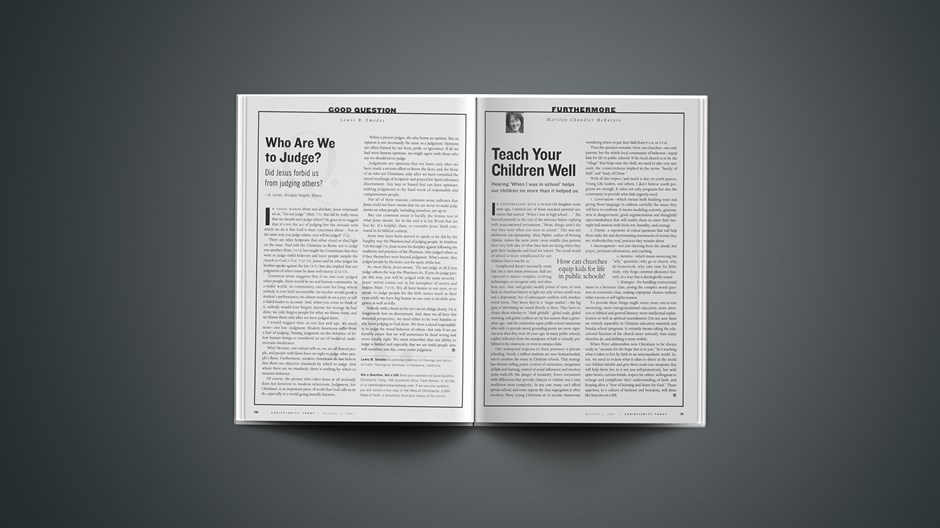
How can churches equip kids for life in public schools?
In conversation with a 16-year-old daughter some time ago, I uttered one of those standard parental sentences that started, "When I was in high school . …" She listened patiently to the end of the sentence before replying with unaccustomed seriousness, "Mom, things aren't the way they were when you were in school." This was not adolescent one-upmanship. Mary Pipher, author of Reviving Ophelia, makes the same point: most middle-class parents have very little idea of what their kids are facing when they grab their backpacks and head for school. The social world of school is more complicated for our children than it was for us.
Complicated doesn't necessarily mean bad, but it does mean strenuous. Kids are expected to master complex, evolving technologies, to recognize early and often how race, class, and gender modify points of view; to look back on American history in light not only of two world wars and a depression, but of subsequent conflicts with murkier moral terms. They know they're a "target market"—the big guns of advertising are aimed directly at them. They have no choice about whether to "think globally": global trade, global warming, and global conflicts are far less remote than a generation ago. And the constraints upon public-school instructors who wish to provide moral grounding points are more rigorous now than they were 30 years ago. In many public schools, explicit reflection from the standpoint of faith is virtually prohibited in the classroom, or even in campus clubs.
One widespread response to these pressures is private schooling. Nearly 2 million students are now homeschooled, not to mention the many in Christian schools. That strategy has obvious selling points (control of curriculum, integration of faith and learning, control of social influences) and involves some tradeoffs (the danger of insularity, fewer encounters with differences that provide chances to rethink one's own worldview more complexly). In any case, many can't afford private school, and some oppose the class segregation it often involves. Many young Christians sit in secular classrooms wondering where to put their faith from 9 a.m. to 3 p.m.
Thus the question remains: How can churches—not only parents, but the whole local community of believers—equip kids for life in public schools? If the local church is to be the "village" that helps raise the child, we need to take very seriously the connectedness implied in the terms "family of faith" and "body of Christ."
With all due respect (and much is due) to youth pastors, Young Life leaders, and others, I don't believe youth programs are enough. It takes not only programs but also the community to provide what kids urgently need:
1. Conversation—which means both building trust and giving them language to address carefully the issues they will have to confront. It means modeling curiosity, graciousness in disagreement, good argumentation and thoughtful open-mindedness that will enable them to enter their late-night bull sessions with lively wit, humility, and courage.
2. Criteria—a repertoire of critical questions that will help them make fair and discriminating assessments of movies they see, textbooks they read, practices they wonder about.
3. Encouragement—not just cheering from the stands, but prayer, pertinent information, and coaching.
4. Incentive—which means answering the "why" questions (why go to church, why do homework, why take time for Bible study, why forgo common pleasures) honestly, in a way that is theologically sound.
5. Strategies—for handling controversial issues in a literature class, posing the complex moral question in economics class, making unpopular choices without either excuse or self-righteousness.
To provide these things might mean more one-to-one mentoring, more intergenerational education; more attention to biblical and general literacy; more intellectual sophistication as well as spiritual nourishment (I'm not sure these are entirely separable) in Christian education materials and Sunday-school programs. It certainly means taking the educational function of the church more seriously than many churches do, and defining it more widely.
When Peter admonishes new Christians to be always ready to "account for the hope that is in you," he's teaching what it takes to live by faith in an unsympathetic world. So, too, we need to reckon what it takes to thrive in the world our children inhabit and give them tools (not weapons) that will help them live in it not just self-protectively, but with open hearts, curious minds, respect for others, willingness to enlarge and complicate their understanding of faith, and keeping alive a "love of learning and desire for God." Those appetites, in a culture of burnout and boredom, will shine like beacons on a hill.
More Christianity Today articles on public and private schools are available in our education area.
In May, Christianity Today looked at "Two Schools of Thought | Many parents wonder what's best for their children—Christian or public education. Two Dallas schools suggest an answer."
A 1998 Christianity Today editorial said, "Lack of adult supervision is just one deprivation that plagues our children today. Just as frightening is a lack of moral guidance."
Previous McEntyre columns for Christianity Today include:
Preaching to Preschoolers | A children's sermon is a time to feed their imaginations, not their egos. (August 9, 2001)
Resisting "Relevancy" | The church suffers when pastors confuse anecdotes with parables. (June 28, 2001)
My House, God's House | Hospitality is not merely good manners but a ministry of healing. (May 9, 2001)
Rx for Moral Fussbudgets | Good guilt entails more than repentance for merely personal sins. (Mar. 19, 2001)
Community, Not Commodity | Let us acknowledge, and even mourn, what we lose when worship meets media. (Jan. 16, 2001)
Nice Is Not the Point | Sometimes love is sharp, hard-edged, confusing, and seemingly unfair. (Nov. 29, 2000)
The Fullness of Time | I'd like life to be a series of pauses like a poem, rather than a fast-paced, page-turner airport novel. (Oct. 12, 2000)
Marilyn Chandler McEntyre has taught at Princeton University, the College of New Jersey, Mills College, Dominican University, and Westmont College. She now teaches at the UCSF/UC Berkeley Joint Medical Program and in the University Writing Program at UC Davis. Her column for Christianity Today appeared from 2000 to 2001.















 While we pray for peace, we need moral clarity about this war.
 We’ve got little information on Jesus’ appearance and personality. But that’s the way God designed it.españolFrançais
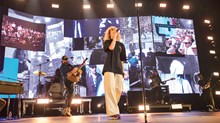 How groups like Hillsong learned to let go of the literal in favor of creative collaboration.españolPortuguês






