



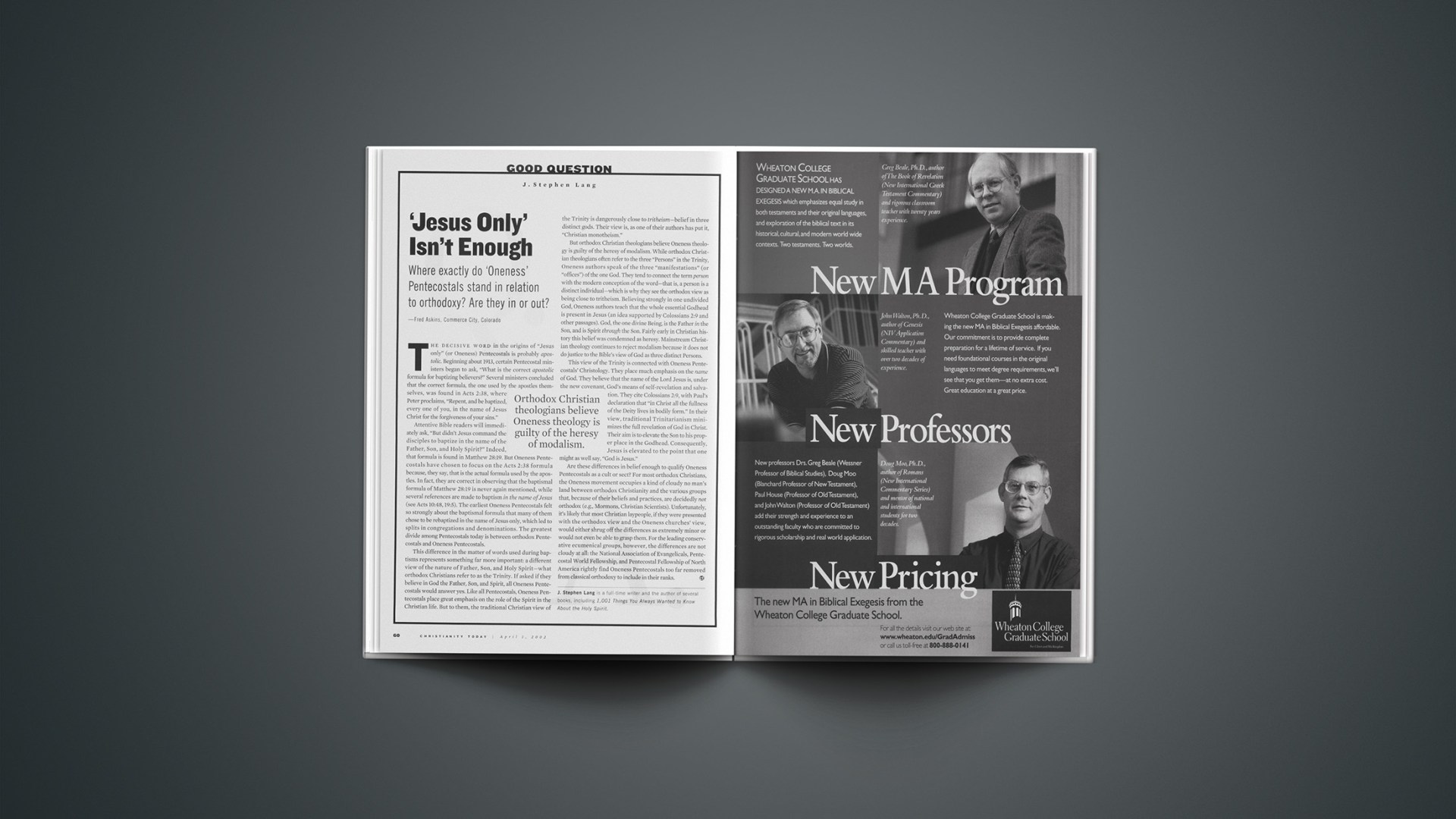

Where exactly do “Oneness” Pentecostals stand in relation to orthodoxy? Are they in or out?—Fred Askins, Commerce City, Colorado
The decisive word in the origins of “Jesus only” (or Oneness) Pentecostals is probably apostolic. Beginning about 1913, certain Pentecostal ministers began to ask, “What is the correct apostolic formula for baptizing believers?” Several ministers concluded that the correct formula, the one used by the apostles themselves, was found in Acts 2:38, where Peter proclaims, “Repent, and be baptized, every one of you, in the name of Jesus Christ for the forgiveness of your sins.”
Attentive Bible readers will immediately ask, “But didn’t Jesus command the disciples to baptize in the name of the Father, Son, and Holy Spirit?” Indeed, that formula is found in Matthew 28:19. But Oneness Pentecostals have chosen to focus on the Acts 2:38 formula because, they say, that is the actual formula used by the apostles. In fact, they are correct in observing that the baptismal formula of Matthew 28:19 is never again mentioned, while several references are made to baptism in the name of Jesus (see Acts 10:48, 19:5). The earliest Oneness Pentecostals felt so strongly about the baptismal formula that many of them chose to be rebaptized in the name of Jesus only, which led to splits in congregations and denominations. The greatest divide among Pentecostals today is between orthodox Pentecostals and Oneness Pentecostals.
This difference in the matter of words used during baptisms represents something far more important: a different view of the nature of Father, Son, and Holy Spirit—what orthodox Christians refer to as the Trinity. If asked if they believe in God the Father, Son, and Spirit, all Oneness Pentecostals would answer yes. Like all Pentecostals, Oneness Pentecostals place great emphasis on the role of the Spirit in the Christian life. But to them, the traditional Christian view of the Trinity is dangerously close to tritheism—belief in three distinct gods. Their view is, as one of their authors has put it, “Christian monotheism.”
But orthodox Christian theologians believe Oneness theology is guilty of the heresy of modalism. While orthodox Christian theologians often refer to the three “Persons” in the Trinity, Oneness authors speak of the three “manifestations” (or “offices”) of the one God. They tend to connect the term person with the modern conception of the word—that is, a person is a distinct individual—which is why they see the orthodox view as being close to tritheism. Believing strongly in one undivided God, Oneness authors teach that the whole essential Godhead is present in Jesus (an idea supported by Colossians 2:9 and other passages). God, the one divine Being, is the Father in the Son, and is Spirit through the Son. Fairly early in Christian History this belief was condemned as heresy. Mainstream Christian theology continues to reject modalism because it does not do justice to the Bible’s view of God as three distinct Persons.
This view of the Trinity is connected with Oneness Pentecostals’ Christology. They place much emphasis on the name of God. They believe that the name of the Lord Jesus is, under the new covenant, God’s means of self-revelation and salvation. They cite Colossians 2:9, with Paul’s declaration that “in Christ all the fullness of the Deity lives in bodily form.” In their view, traditional Trinitarianism minimizes the full revelation of God in Christ. Their aim is to elevate the Son to his proper place in the Godhead. Consequently, Jesus is elevated to the point that one might as well say, “God is Jesus.”
Are these differences in belief enough to qualify Oneness Pentecostals as a cult or sect? For most orthodox Christians, the Oneness movement occupies a kind of cloudy no man’s land between orthodox Christianity and the various groups that, because of their beliefs and practices, are decidedly not orthodox (e.g., Mormons, Christian Scientists). Unfortunately, it’s likely that most Christian laypeople, if they were presented with the orthodox view and the Oneness churches’ view, would either shrug off the differences as extremely minor or would not even be able to grasp them. For the leading conservative ecumenical groups, however, the differences are not cloudy at all: the National Association of Evangelicals, Pentecostal World Fellowship, and Pentecostal Fellowship of North America rightly find Oneness Pentecostals too far removed from classical orthodoxy to include in their ranks.
J. Stephen Lang is a full-time writer and the author of several books, including 1,001 Things You Always Wanted to Know About the Holy Spirit.
Copyright © 2002 Christianity Today. Click for reprint information.
Related Elsewhere
The Spring 1998 issue of Christianity Today sister publication Christian History focused on “The Rise of Pentecostalism.” The issue included an article by Kenneth Gill titled, “Dividing over Oneness.” Issue 58 can be ordered here.
Christianity Today and its sister publication Christian History have both recently reviewed Heaven Below: Early Pentecostalism and American Culture. An excerpt from the book is available on our site.
Other related Christianity Today articles include:
My Views on the GodheadJakes responds to Christianity Today article, “Apologetics Journal Criticizes Jakes.” (Feb. 21, 2000)
T. D. Jakes Feels Your PainThough critics question his theology, this fiery preacher packs arenas with a message of emotional healing. (Feb. 7, 2000)
Apologetics Journal Criticizes T.D. JakesChristian Research Institute publication questions preacher’s view of Trinity. (Feb. 7, 2000)
J. Stephen Lang’s 1,001 Things You Always Wanted to Know About the Holy Spirit is available at Christianbook.com.
Earlier Good Question columns include:
Do a man and a woman become married after having sex or after exchanging vows?
Can We Expect God to Forgive Unbelievers Who ‘Don’t Know What They’re Doing’?