When I was a young boy, my parents bought a richly illustrated children's encyclopedia. The happy event occurred about the time that I had become old enough to enjoy exploring books on my own. Those hours soaking up all that information constitute some of my warmest early memories, and I've had a tendency to think of reference books as brain candy ever since.
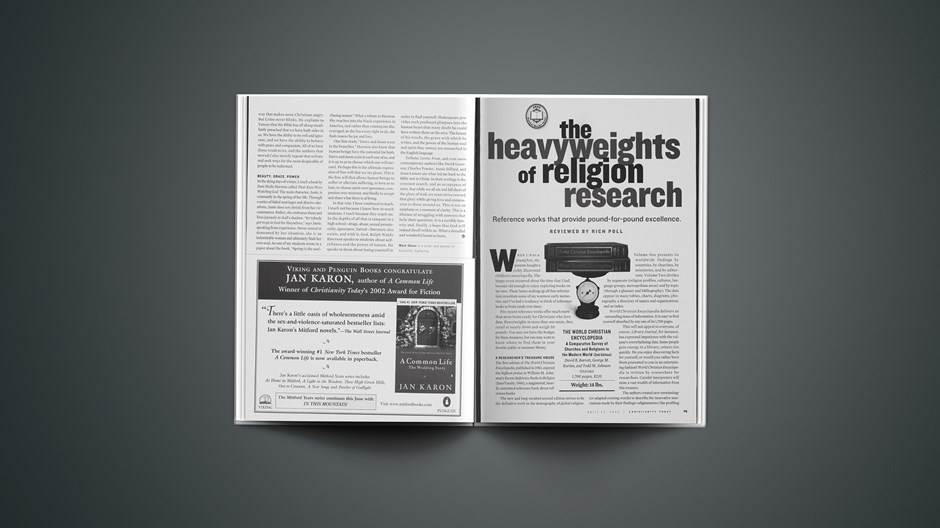
Five recent reference works offer much more than mere brain candy for Christians who love data. Heavyweights in more than one sense, they retail at nearly $660 and weigh 50 pounds. You may not have the budget for these treasures, but you may want to know where to find them in your favorite public or seminary library.
A Researcher's Treasure House
The first edition of The World Christian Encyclopedia, published in 1983, enjoyed the highest praise in William M. Johnston's Recent Reference Books in Religion (InterVarsity, 1996), a magisterial, heavily annotated reference book about reference books.
The new and long-awaited second edition strives to be the definitive work in the demography of global religion. Volume One presents its worldwide findings by countries, by churches, by ministries, and by adherents. Volume Two divides by segments (religion profiles, cultures, language groups, metropolitan areas) and by topic (through a glossary and bibliography). The data appear in many tables, charts, diagrams, photographs, a directory of names and organizations, and an index.
World Christian Encyclopedia delivers an astounding mass of information. It is easy to find yourself absorbed by any one of its 1,700 pages.
This will not appeal to everyone, of course. Library Journal, for instance, has expressed impatience with the volume's overwhelming data. Some people gain energy in a library, others tire quickly. Do you enjoy discovering facts for yourself, or would you rather have them presented to you in an entertaining fashion? World Christian Encyclopedia is written by researchers for researchers. Careful interpreters will mine a vast wealth of information from this treasure.
The authors created new terminology (or adapted existing words) to describe the innovative associations made by their findings: religiometrics (the profiling of religions); cosmochronology (the chronology of world evangelism); martyrology (the demographics of Christian martyrdom); missiometrics (the science of measuring global Christian mission work); and geostrategies (identifying 1,500 global plans to evangelize the world).
Michael Jaffarian of the World Christian Encyclopedia team says that this volume represents "the first time anyone has broken down the ethno-linguistic people groups for every country of the world and supplied the related evangelistic demographics." Consequently, World Christian Encyclopedia will help researchers answer such questions as:
Which nations send the most missionaries?—United States, 118,700; Italy, 31,500; and France and Spain, 30,500 each.
Which nations receive the most missionaries?—United States, 33,200; Brazil, 25,000; Russia, 19,000; and France, 16,000.
Which nations have the highest number of unique people groups?—Papua New Guinea, 861; Indonesia, 744; Nigeria, 491; and India, 439.
Asia and Africa now account for 96 percent of the world's Muslims. Of the ten countries with the most Muslims in 2000, the top six were in Asia (Pakistan, India, Indonesia, Bangladesh, Turkey, and Iran, in that order) and the next four were in Africa (Egypt, Nigeria, Algeria, and Morocco). Of Islam's global growth in the 1990s, 96 percent was by natural increase (high birth rate) and only 4 percent by conversion. The corresponding figures for Christianity were 90 percent and 10 percent.
Jaffarian insists on the accuracy of the figures, down to the smallest detail. World Christian Encyclopedia includes diverse measurement criteria, ranging from outreach cost-effectiveness (total personal income of Christians divided by number of baptisms) to violent crime to missions giving vs. embezzlement. Readers will discover that there are now 10,000 distinct religions and 34,000 Christian denominations. I was surprised that the encyclopedia counts 25 million Seventh-day Adventists (more than Jehovah's Witnesses and Mormons combined).
World Christian Encyclopedia offers the most comprehensive and accurate numbers for the worldwide explosion of Pentecostal/Charismatic movements—an incredible "27.7 percent of organized global Christianity." Independents ("separated from, uninterested in, and independent of historic denominationalist Christianity") have become the second-largest category of Christian adherents (at 386 million), following Roman Catholics at an even billion and displacing Protestants at 342 million.
While some may be daunted by the size and complexity of the World Christian Encyclopedia, few will be able to dig deeply enough into its vast holdings to exhaust its utility. Blessed are the careful interpreters.
Atlas of the 'Territorial Imperative'
The Atlas is a survey of America's statistical dynamics in religion and their historic geographical influence. Oxford University Press calls the Atlas "the most sweeping and authoritative survey of the American religious landscape ever undertaken."
Article continues below
It records "the decline of Episcopalians, redistribution among Lutherans, growth among the [Baha'i]," and it is said to contain "the only published maps documenting the possibility that Muslims may outnumber Jews in the new United States of the 21st century." Further, the Atlas "reveals that the number of Mormons living outside Utah make their denomination one of the three largest in fully three-fourths of the counties west of Denver."
My learning began almost immediately in the first encounter with the Atlas. Its inside back cover has a sleeve containing the wall map, "Denominational Predominance: 1990." In my first survey of this map, a single county in the Deep South stood out. The Atlas shows that the Methodists of Macom County, Alabama, are dramatically isolated by Baptists—and have been holding out in a decades-long turf battle. This map exemplifies "spatial evolutions of religious predominance," the primary story of this book, told with maps and charts.
The Atlas "depicts the leading denominational families at county-level detail and at approximately 20-year intervals throughout the nation's history from 1790 on." A "detailed narrative analysis" of the maps walks the reader through this progressive history.
The Atlas is as much history as it is geography, and it illustrates the "territorial imperative" of American religion. After two centuries, "the fact that [denominational] concentration endures … carries numerous regional and national implications." With this resource, you can easily trace the history of denominational predominance for any given location in America.
A simple photo of the cover does not convey the mass behind this 400-page, 10-pound treasure. You will need plenty of clear desk space to work with its open span of over two feet. About three of any four pages in the book will include either a map or a chart of some kind.
The general treatment appears balanced, with the exception of an emphasis on Mormonism—and justly so, given the Latter-day Saints' rapid growth. Overall, the Atlas shows commendable interest in new religious movements. As our country's religious pluralism continues to expand, documenting the growth of alternative religions becomes more important and more arduous.
One Atlas author (Barlow) is a Mormon, and funding for this project came partially from LDS sources. It appears that the Atlas is all the better for it. It is no surprise that Mormons are discussed more than the similarly sized Watchtower Bible and Tract Society; Witnesses are more difficult to study. Unlike Mormons, Witnesses are not known to have well-defined geographic clusters in America.
Article continues below
Some of my colleagues have objected to seeing Mormons lumped in with mainline Christian groups as a regular feature in statistical reporting. The Atlas makes it obvious that LDS growth requires inclusion by virtue of its present very substantial size and ongoing growth. In fact, the Atlas may have scooped everyone else in graphically documenting this important transformation of the American religious landscape.
One annoyance is the lack of page numbers on pages with graphics alone and no body copy. It is possible to open the book at one place and then pass a 20-page sequence before confirming your location. Also missing is a graphic presentation of total adherents per denomination. These minor criticisms are not substantial enough to prevent anyone from enjoying the significant learning experience that this resource offers.
King of the Hill
During the decade I was in charge of research materials at Christian Research Institute (1984-95), Melton's Encyclopedia was one of the two works consulted most frequently by staff members (the other was Walter Elwell's Evangelical Dictionary of Theology). Facing many competitors since then, it remains king of the hill.
Melton's Encyclopedia is special because it is so comprehensive. Melton presents more than 2,100 entries describing a vast spectrum of religious bodies. I am not aware of any other print resource that provides as much information about so many different groups. Of particular value to apologists is the degree of detail Melton offers on many of the most obscure belief systems for which America has lamentably gained worldwide fame.
The meat of the volume is its directory listing of religious bodies, which constitutes two-thirds of the text. Melton strives to supply the most recent available data on each group's history, beliefs, and organization, followed by bibliographic content. Details on membership, periodicals, and educational facilities are also included when available.
While there are far better sources for theological comparison among larger religious bodies, no other reference work provides as much detail on obscure groups. This alone is perhaps the greatest value of the Encyclopedia.
Article continues below
A second section (roughly 14% of the text) provides historical essays for the "20 major religious families and traditions" into which Melton has divided the religious landscape. This division is also used to organize the main directory listing. (Melton's religious family and tradition classification scheme, a study in itself, has become the de facto religious studies convention in the secular academic scene.)
Besides the Encyclopedia's indispensable master index, it offers very helpful geographic and subject indexes.
Living Theologians
According to Elwell's preface, the second edition of his Evangelical Dictionary of Theology is a "full-blown revision" that has been in the works for six years. Moving on from the 1984 first edition, Elwell "added about 215 new articles and deleted about 100 that were deemed no longer relevant. One major change was to include living theologians." The resulting physical change adds about 100 pages to the new work.
Current theological trends "that have risen in prominence since the first edition" include Canonical Criticism, Empirical Theology, and Postliberal Theology, plus topics of interest like the Jesus Seminar, Deconstructionism, and Spiritual Warfare.
Other updating applies to bibliographies and cross-references. Additional articles were contributed "where needed to balance out some of the older categories," including Cloud of Unknowing, History of Religion School, and Religious Language. Still more articles made it into this edition that should have been in the first, such as Sociology of Religion.
If you work enough with the public to field a wide range of questions about the Christian faith, few single-volume resources come close to rivaling this tool. A good complementary work worth mentioning is The Baker Encyclopedia of Christian Apologetics (1999), edited by Norman Geisler.
Charting Truth
My experience of surviving seminary bids me to mention this unique and timesaving resource. House has produced one of the most significant countercult reference works of the past decade—especially where students are concerned.
Charts of Cults addresses the key distinctives of an impressive 19 different belief systems. House provides side-by-side analyses of theological conflict between each cultic movement profiled and the historic biblical Christian tradition.
As appendices, the systematic charts of essential Christian doctrine are very helpful for students, and the inclusion of the historic creeds of the church provides an appropriate additional cross-reference. House wraps up with a well-organized and extensive bibliography.
Article continues below
Rich Poll is editor of Apologia Report (apologia.org), an online review of academic and journalistic writing that relates to Christian apologetics.
Other articles in our 2002 Annual Books Issue include:
CT Book Awards 2002Here are the books our judges—200 pastors, scholars, and church leaders—considered the worthiest this year.
No Longer Left BehindAn insider's look at how Christian books are agented, acquired, packaged, branded, and sold in today's marketplace.
Two Cultural GiantsBoth Sigmund Freud and C.S. Lewis were emotionally wounded as boys and struggled with depression as men. But a worldview can make a tremendous difference. An interview with Armand Nicholi Jr.















 While we pray for peace, we need moral clarity about this war.
 A Christian reconciliation group in Israel and Palestine warned that war would come. Now the war threatens their relevance.españolالعربيةFrançaisрусскийУкраїнська
 Do activists often invest their work with religious significance? All the more reason for Christians to be discerning co-laborers.






