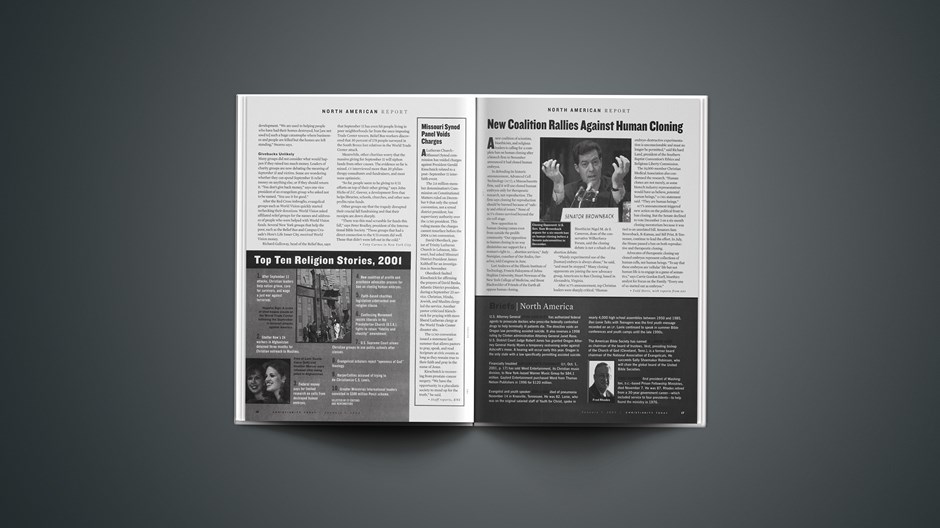
A new coalition of scientists, bioethicists, and religious leaders is calling for a complete ban on human cloning after a biotech firm in November announced it had cloned human embryos.
In defending its historic announcement, Advanced Cell Technology (ACT), a Massachusetts firm, said it will use cloned human embryos only for therapeutic research, not reproduction. The firm says cloning for reproduction should be banned because of "safety and ethical issues." None of ACT's clones survived beyond the six-cell stage.
Now opposition to human cloning comes even from outside the prolife community. "Our opposition to human cloning in no way diminishes our support for a woman's right to . …abortion services," Judy Norsigian, coauthor of Our Bodies, Ourselves, told Congress in June.
Lori Andrews of the Illinois Institute of Technology, Francis Fukuyama of Johns Hopkins University, Stuart Newman of the New York College of Medicine, and Brent Blackwelder of Friends of the Earth all oppose human cloning.
Bioethicist Nigel M. de S. Cameron, dean of the conservative Wilberforce Forum, said the cloning debate is not a rehash of the abortion debate.
"Plainly experimental use of the [human] embryo is always abuse," he said, "and must be stopped." Many cloning opponents are joining the new advocacy group, Americans to Ban Cloning, based in Alexandria, Virginia.
After ACT's announcement, top Christian leaders were sharply critical. "Human embryo-destructive experimentation is unconscionable and must no longer be permitted," said Richard Land, president of the Southern Baptist Convention's Ethics and Religious Liberty Commission.
The 14,000-member Christian Medical Association also condemned the research. "Human clones are not merely, as some biotech industry representatives would have us believe, potential human beings," a CMA statement said. "They are human beings."
ACT's announcement triggered new action on the political front to ban cloning. But the Senate declined to vote December 3 on a six-month cloning moratorium because it was tied to an unrelated bill. Senators Sam Brownback, R-Kansas, and Bill Frist, R-Tennessee, continue to lead the effort. In July, the House passed a ban on both reproductive and therapeutic cloning.
Advocates of therapeutic cloning say cloned embryos represent collections of human cells, not human beings. "To say that these embryos are 'cellular' life but not human life is to engage in a game of semantics," says Carrie Gordon Earll, bioethics analyst for Focus on the Family. "Every one of us started out as embryos."
Opinion Roundup: 'Only Cellular Life'?Christians, leaders, and bioethics watchdogs react to the announcement that human embryos have been cloned. (November 29, 2001)
Yahoo's full coverage has current news articles and opinion pieces on human cloning.
Christianity Today recommended against human cloning in a 1997 editorial, "Stop Cloning Around."
See our October cover story, "A Matter of Life and Death: Why shouldn't we use our embryos and genes to make our lives better? The world awaits a Christian answer."
Previous Christianity Today articles on cloning and human dignity include:
The New TyrannyBiotechnology threatens to turn humanity into raw material. (Oct. 5, 2001)
Article continues below
Gen-EtiquetteScientists may be mapping the genome, but it will be up to us to determine where the map will lead. (Oct. 4, 2001)
















 While we pray for peace, we need moral clarity about this war.
 Church movements need magnetic leaders. But the best leaders need more than charm.
 A dozen states could vote on the issue come November.