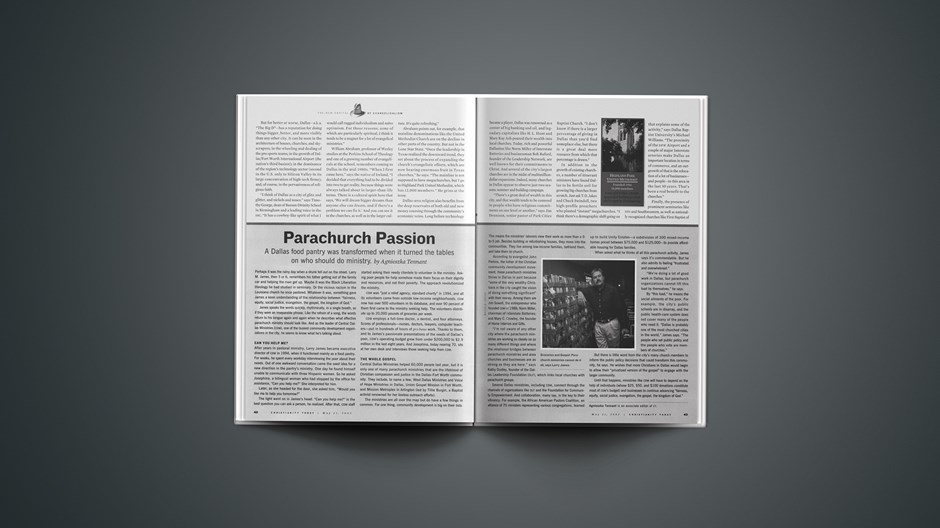
Perhaps it was the rainy day when a drunk fell out on the street. Larry M. James, then 5 or 6, remembers his father getting out of the family car and helping the man get up. Maybe it was the Black Liberation theology he had studied in seminary. Or the vicious racism in the Louisiana church he once pastored. Whatever it was, something gave James a keen understanding of the relationship between "fairness, equity, social justice, evangelism, the gospel, the kingdom of God."
James speaks the words quickly, rhythmically, in a single breath, as if they were an inseparable phrase. Like the refrain of a song, the words return to his tongue again and again when he describes what effective parachurch ministry should look like. And as the leader of Central Dallas Ministries (CDM), one of the busiest community development organizations in the city, he seems to know what he's talking about.
Can You Help Me?
After years in pastoral ministry, Larry James became executive director of CDM in 1994, when it functioned mainly as a food pantry. For weeks, he spent every workday interviewing the poor about their needs. Out of one awkward conversation came the seed idea for a new direction in the pantry's ministry. One day he found himself unable to communicate with three Hispanic women. So he asked Josephina, a bilingual woman who had stopped by the office for assistance, "Can you help me?" She interpreted for him.
Later, as she headed for the door, she asked him, "Would you like me to help you tomorrow?"
The light went on in James's head: "Can you help me?" is the best question you can ask a person, he realized. After that, CDM staff started asking their needy clientele to volunteer in the ministry. Asking poor people for help somehow made them focus on their dignity and resources, and not their poverty. The approach revolutionized the ministry.
CDM was "just a relief agency, standard charity" in 1994, and all its volunteers came from outside low-income neighborhoods. CDM now has over 500 volunteers in its database, and over 90 percent of them first came to the ministry seeking help. The volunteers distribute up to 20,000 pounds of groceries per week.
CDM employs a full-time doctor, a dentist, and four attorneys. Scores of professionals—nurses, doctors, lawyers, computer teachers—put in hundreds of hours of pro bono work. Thanks to them, and to James's passionate presentations of the needs of Dallas's poor, CDM's operating budget grew from under $200,000 to $2.9 million in the last eight years. And Josephina, today nearing 70, sits at her own desk and interviews those seeking help from CDM.
Central Dallas Ministries helped 60,000 people last year, but it is only one of many parachurch ministries that are the lifeblood of Christian compassion and justice in the Dallas-Fort Worth community. They include, to name a few, West Dallas Ministries and Voice of Hope Ministries in Dallas, Union Gospel Mission in Fort Worth, and Mission Metroplex in Arlington (led by Tillie Burgin, a Baptist activist renowned for her tireless outreach efforts).
The ministries are all over the map but do have a few things in common. For one thing, community development is big on their lists. This means the ministries' laborers view their work as more than a 9-to-5 job. Besides building or refurbishing houses, they move into the communities. They live among low-income families, befriend them, and take them to church.
According to evangelist John Perkins, the father of the Christian community development movement, these parachurch ministries thrive in Dallas in part because "some of the very wealthy Christians in the city caught the vision of doing something significant" with their money. Among them are Jim Sowell, the entrepreneur who founded CDM in 1988; Norm Miller, chairman of Interstate Batteries; and Mary C. Crowley, the founder of Home Interiors and Gifts.
"I'm not aware of any other city where the parachurch ministries are working so closely on so many different things and where the relational bridges between parachurch ministries and area churches and businesses are as strong as they are here," says Kathy Dudley, founder of the Dallas Leadership Foundation (DLF), which links local churches with parachurch groups.
Several Dallas ministries, including CDM, connect through the channels of organizations like DLF and the Foundation for Community Empowerment. And collaboration, many say, is the key to their vibrancy. For example, the African American Pastors Coalition, an alliance of 70 ministers representing various congregations, teamed up to build Unity Estates—a subdivision of 300 mixed-income homes priced between $75,000 and $125,000—to provide affordable housing for Dallas families.
When asked what he thinks of all this parachurch activity, James says it's commendable. But he also admits to feeling "frustrated and overwhelmed."
"We're doing a lot of good work in Dallas, but parachurch organizations cannot lift this load by themselves," he says.
By "this load," he means the social ailments of the poor. For example, the city's public schools are in disarray, and the public health-care system does not cover many of the people who need it. "Dallas is probably one of the most churched cities in the world," James says. "The people who set public policy and the people who vote are members of churches."
Article continues below
But there is little word from the city's many church members to inform the public policy decisions that could transform this community, he says. He wishes that more Christians in Dallas would begin to allow their "privatized version of the gospel" to engage with the larger community.
Until that happens, ministries like CDM will have to depend on the help of individuals (whose $25, $50, and $100 donations constitute most of CDM's budget) and businesses to continue advancing "fairness, equity, social justice, evangelism, the gospel, the kingdom of God."
Sunday ColorsDallas churches continue to challenge the racial divide.
Other stories in our May issue's Dallas cover package include:
The New Capital of EvangelicalismMove over, Wheaton and Colorado Springs—Dallas, Texas, has more megachurches, megaseminaries and mega-Christian activity than any other American city. (May 10, 2002)
Big City, Big MinistryHow did a top-25 list of ministries become a cover story on Dallas? (May 10, 2002)
Southwestern's PredicamentCan the biggest protestant seminary in the world be both Southern Baptist and broadly evangelical? (May 14, 2002)
Parachurch Ministries referenced in the article include:















 While we pray for peace, we need moral clarity about this war.
 A Christian reconciliation group in Israel and Palestine warned that war would come. Now the war threatens their relevance.españolالعربيةFrançaisрусскийУкраїнська
 How groups like Hillsong learned to let go of the literal in favor of creative collaboration.españolPortuguês






