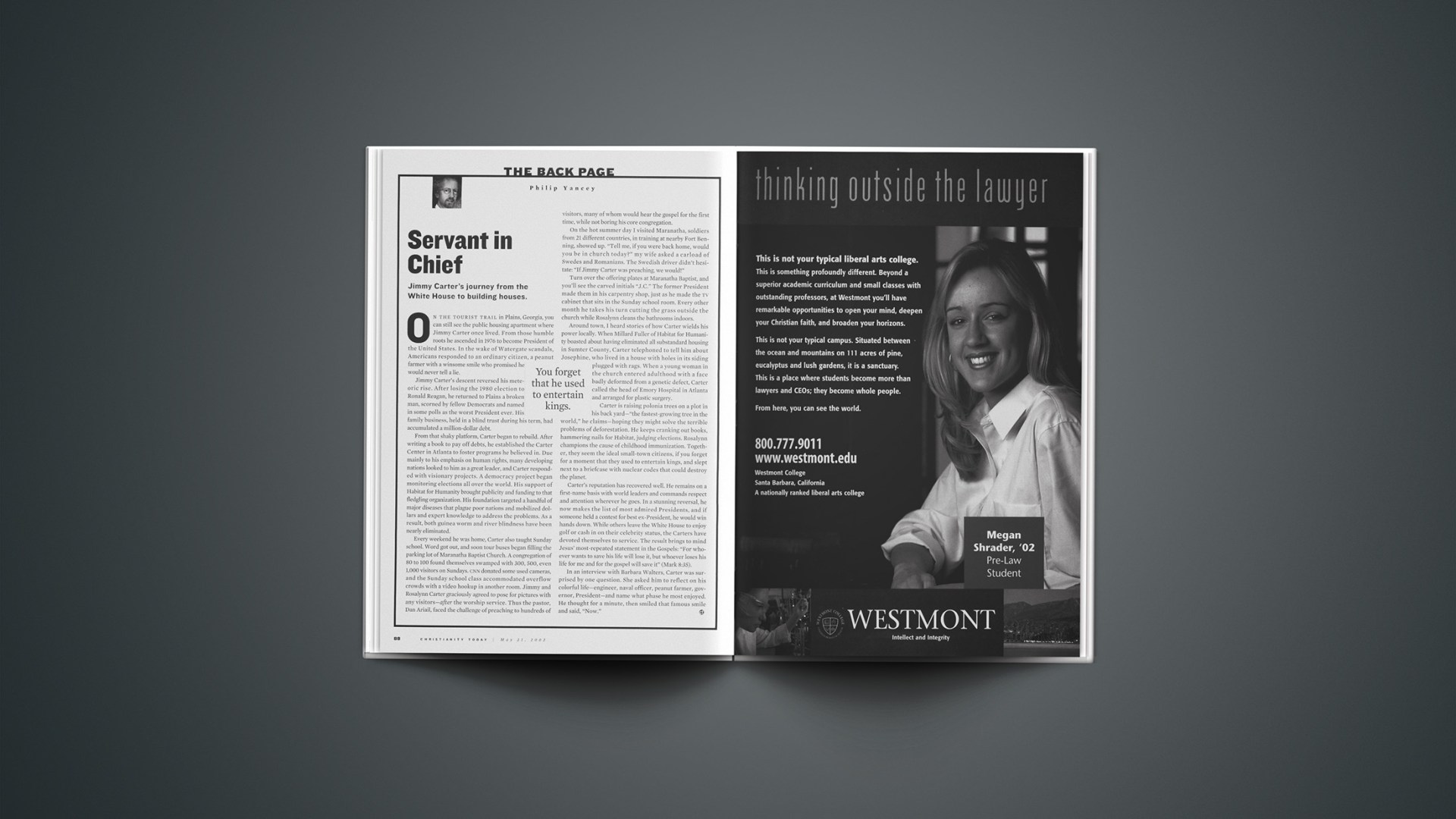

On the tourist trail in Plains, Georgia, you can still see the public housing apartment where Jimmy Carter once lived. From those humble roots he ascended in 1976 to become President of the United States. In the wake of Watergate scandals, Americans responded to an ordinary citizen, a peanut farmer with a winsome smile who promised he would never tell a lie.
Jimmy Carter’s descent reversed his meteoric rise. After losing the 1980 election to Ronald Reagan, he returned to Plains a broken man, scorned by fellow Democrats and named in some polls as the worst President ever. His family business, held in a blind trust during his term, had accumulated a million-dollar debt.
From that shaky platform, Carter began to rebuild. After writing a book to pay off debts, he established the Carter Center in Atlanta to foster programs he believed in. Due mainly to his emphasis on human rights, many developing nations looked to him as a great leader, and Carter responded with visionary projects. A democracy project began monitoring elections all over the world. His support of Habitat for Humanity brought publicity and funding to that fledgling organization. His foundation targeted a handful of major diseases that plague poor nations and mobilized dollars and expert knowledge to address the problems. As a result, both guinea worm and river blindness have been nearly eliminated.
Every weekend he was home, Carter also taught Sunday school. Word got out, and soon tour buses began filling the parking lot of Maranatha Baptist Church. A congregation of 80 to 100 found themselves swamped with 300, 500, even 1,000 visitors on Sundays. CNN donated some used cameras, and the Sunday school class accommodated overflow crowds with a video hookup in another room. Jimmy and Rosalynn Carter graciously agreed to pose for pictures with any visitors—after the worship service. Thus the pastor, Dan Ariail, faced the challenge of preaching to hundreds of visitors, many of whom would hear the gospel for the first time, while not boring his core congregation.
On the hot summer day I visited Maranatha, soldiers from 21 different countries, in training at nearby Fort Benning, showed up. “Tell me, if you were back home, would you be in church today?” my wife asked a carload of Swedes and Romanians. The Swedish driver didn’t hesitate: “If Jimmy Carter was preaching, we would!”
Turn over the offering plates at Maranatha Baptist, and you’ll see the carved initials “J.C.” The former President made them in his carpentry shop, just as he made the TV cabinet that sits in the Sunday school room. Every other month he takes his turn cutting the grass outside the church while Rosalynn cleans the bathrooms indoors.
Around town, I heard stories of how Carter wields his power locally. When Millard Fuller of Habitat for Humanity boasted about having eliminated all substandard housing in Sumter County, Carter telephoned to tell him about Josephine, who lived in a house with holes in its siding plugged with rags. When a young woman in the church entered adulthood with a face badly deformed from a genetic defect, Carter called the head of Emory Hospital in Atlanta and arranged for plastic surgery.
Carter is raising polonia trees on a plot in his back yard—“the fastest-growing tree in the world,” he claims—hoping they might solve the terrible problems of deforestation. He keeps cranking out books, hammering nails for Habitat, judging elections. Rosalynn champions the cause of childhood immunization. Together, they seem the ideal small-town citizens, if you forget for a moment that they used to entertain kings, and slept next to a briefcase with nuclear codes that could destroy the planet.
Carter’s reputation has recovered well. He remains on a first-name basis with world leaders and commands respect and attention wherever he goes. In a stunning reversal, he now makes the list of most admired Presidents, and if someone held a contest for best ex-President, he would win hands down. While others leave the White House to enjoy golf or cash in on their celebrity status, the Carters have devoted themselves to service. The result brings to mind Jesus’ most-repeated statement in the Gospels: “For whoever wants to save his life will lose it, but whoever loses his life for me and for the gospel will save it” (Mark 8:35).
In an interview with Barbara Walters, Carter was surprised by one question. She asked him to reflect on his colorful life—engineer, naval officer, peanut farmer, governor, President—and name what phase he most enjoyed. He thought for a minute, then smiled that famous smile and said, “Now.”
Copyright © 2002 Christianity Today. Click for reprint information.
Related Elsewhere
In a 1998 interview with Christianity Today's then-associate editor Richard A. Kauffman, Jimmy Carter discussed everything from Sunday school and personal faith to the Southern Baptist Convention and world politics.
Christianity Today sister publication Men of Integrity has previously published insights from Jimmy Carter on forgiveness and ministry.
See Jimmy Carter's biography at the official White House site. To learn more, also see The Jimmy Carter Library and The Carter Center.
Books by Carter include: Living Faith, An Hour Before Daylight, and Sources of Strength.
Previous Yancey columns for Christianity Today include:
Why Do They Hate Us?How to turn the Baywatch syndrome into the Jesus syndrome. (March 27, 2002)
Honest Church MarketingWe enhance our 'image' by offering the world a realistic picture of faith. (October 24, 2001)
Compassion ConfusionWe should serve the needy even when it has bad political consequences. (August 28, 2001)
Fixing Our Weakest LinkEvangelicals should be more "needful of the minds of others." (July 13, 2001)
Replenishing the Inner PastorChurches should take greater interest in their shepherds' spiritual health. (May 14, 2001)
Beyond Flesh and BloodI used to disdain biblical talk of "invisible spirits." No more. (Mar. 27, 2001)
God at LargeA look around the globe reveals a God as big as we want him to be. (Jan. 31, 2001)
Humility's Many FacesEveryone I've looked up to has shared one trait. (Dec. 4, 2000)
Getting a LifeThe most fully alive persons are those who give their lives away. (Oct. 16, 2000)
Yancey's Where is God When it Hurts, Special Edition and Soul Survivor: How My Faith Survived the Church are available on Christianbook.com.