Elaine Pagels, the famous historian of early Christianity, once told a revealing story about the social world behind the scenes of high-powered biblical scholarship. As a young up-and-coming professor at the annual meeting of the Society of Biblical Literature, she was invited to a closed-door, after-hours smoker. The men there (Pagels was the only woman) were all prominent Bible scholars. Many of them didn't even believe in God, and those who still called themselves Christian were anything but orthodox.
The liquor flowed freely, and as these men got in their cups, they began to sing old gospel songs. To her astonishment, they knew all the tunes and words by heart. Then it dawned on her—these atheist and liberal Bible scholars must have grown up in evangelical churches.
Had Pagels herself grown up in evangelicalism she might not have been so surprised. Evangelicals have long known that it is easy for individuals and institutions—especially professors and universities—to slide down the slippery slope from orthodoxy to infidelity. Once down the slope, there's usually no climbing back up. It's a one-way street from evangelicalism to liberalism, a street that many individuals and colleges, and all the mainline Protestant denominations, have gone down. This bit of evangelical folk wisdom has a counterpart in sociology's sect-to-church theory. This theory claims that orthodox religious groups in a secular environment will gradually and inevitably become more like their environment. Once secularized, they do not again become orthodox.
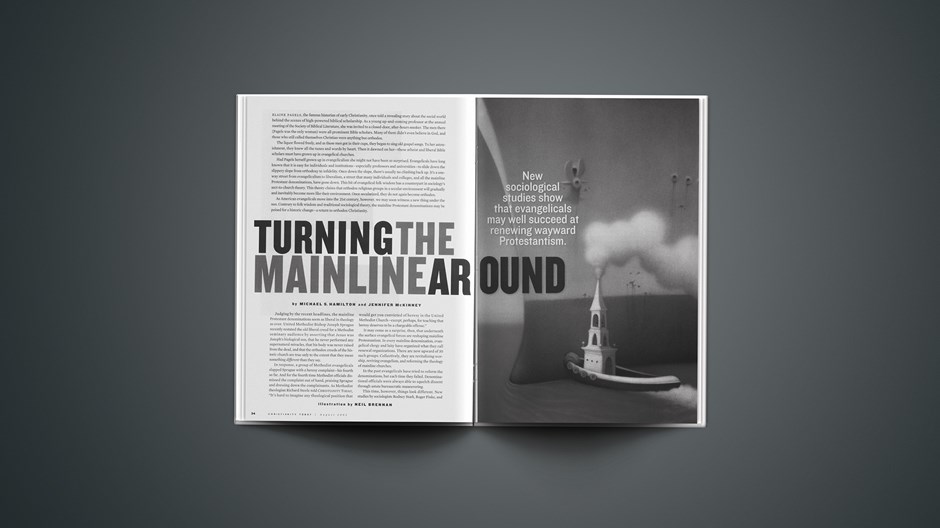
As American evangelicals move into the 21st century, however, we may soon witness a new thing under the sun. Contrary to folk wisdom and traditional sociological theory, the mainline Protestant denominations may be poised for a historic change—a return to orthodox Christianity.
Judging by the recent headlines, the mainline Protestant denominations seem as liberal in theology as ever. United Methodist Bishop Joseph Sprague recently restated the old liberal creed for a Methodist seminary audience by asserting that Jesus was Joseph's biological son, that he never performed any supernatural miracles, that his body was never raised from the dead, and that the orthodox creeds of the historic church are true only to the extent that they mean something different than they say.
In response, a group of Methodist evangelicals slapped Sprague with a heresy complaint—his fourth so far. And for the fourth time Methodist officials dismissed the complaint out of hand, praising Sprague and dressing down the complainants. As Methodist theologian Richard Steele told Christianity Today, "It's hard to imagine any theological position that would get you convicted of heresy in the United Methodist Church—except, perhaps, for teaching that heresy deserves to be a chargeable offense."
It may come as a surprise, then, that underneath the surface evangelical forces are reshaping mainline Protestantism. In every mainline denomination, evangelical clergy and laity have organized what they call renewal organizations. There are now upward of 30 such groups. Collectively, they are revitalizing worship, reviving evangelism, and reforming the theology of mainline churches.
In the past evangelicals have tried to reform the denominations, but each time they failed. Denominational officials were always able to squelch dissent through astute bureaucratic maneuvering.
This time, however, things look different. New studies by sociologists Rodney Stark, Roger Finke, and Jennifer McKinney, the coauthor of this article, show that contemporary renewal groups have greater staying power and more supporters than ever before. They are committed to remaining within their denominations rather than leaving. For the first time, the renewal movements are also cooperating with each other across denominational lines. Opposition by denominational officials, though strenuous at times, has been less consistent and less effective than in the past. Renewal clergy are actually younger than liberal clergy, raising the possibility that liberals are living on borrowed time.
Perhaps the most significant development of all is that, this time around, the renewal movements within the denominations are being fueled by evangelical parachurch movements that stand outside the denominations.
First the Good News
The current evangelical renewal began in the mid-1960s. A ministerial student named Charles Keysor, dismayed by the hostility to orthodox Christianity he encountered at his Methodist seminary, published an article in New Christian Advocate, a journal for Methodist ministers; he called on Methodist evangelicals to come out of the closet. The article drew a huge response—over 200 letters and phone calls. Most were from pastors who were frustrated at lack of contact with other evangelicals and at feeling "cut off from the leadership of the church." So to encourage, connect, and inform orthodox Methodists, Keysor founded a magazine he called Good News.
At about the same time over in the United Presbyterian Church—which became the Presbyterian Church (U.S.A.) in a 1987 merger—a group of wealthy evangelical laymen was startled into action by a proposed new confession that would declare "the Scriptures are nevertheless the words of men." They formed the Presbyterian Lay Committee, and sought to oppose the new confession through articles in denominational publications. When UPC leaders refused to print the articles, the Committee offered to buy advertising space in the magazines. Again it was rebuffed. So in order to bring its case to the church at large, the Committee resorted to buying ads in The New York Times and other major newspapers. Despite these efforts, the new confession was adopted in 1967. Then the Committee, like Keysor, took its cause to the people in the pews by founding The Layman, a magazine to rally Presbyterian evangelicals.
Article continues below
Today the largest of the renewal groups is the United Methodist Confessing Movement, with more than 630,000 members and 1,400 churches. The fastest-growing group is the Confessing Church Movement of the PCUSA. In just two years it has enrolled over 420,000 people—fully 17 percent of the denomination's membership. Evangelicals have also formed renewal groups in the American Baptist Churches, the Disciples of Christ, the Episcopal Church, the Evangelical Lutheran Church of America, and the United Church of Christ.
Common commitments and problems have led the groups to cooperate across denominational lines. The Institute for Religion and Democracy (IRD) serves as a clearinghouse for the entire movement, and it helped form the Association for Church Renewal (ACR) in 1986. The ACR quickly became the umbrella organization for the entire movement. Altogether, publications and mailings of the member organizations of the ACR reach an estimated 2.4 million mainline church members.
Renewal organizations work from within their denominations, calling for reform. Their goal is neither schism nor takeover, but to mobilize evangelicals in the pews to change their churches' mission, polity, discipline, theological education, worship and educational ministries. As the Confessing Movement proclaims, "We are United Methodists within the United Methodist Church. We intend to stay within the United Methodist Church."
Though these renewal groups have distinctive missions, they describe themselves as theological movements. Mainline church leaders have long defended the legitimacy of liberal theology by claiming that true Methodism, or Presbyterianism, or Anglicanism allows for theological pluralism. But the renewal movements see liberalism as a deviation from—and denial of—their denominations' traditional orthodox theologies. So at their core, the renewal movements want their denominations to foreswear trendy theologies of the moment and realign themselves with the longer history of Christian orthodoxy. They all affirm the authority of the Bible, the deity of Jesus Christ, and the importance of returning to each denomination's unique theological heritage.
Article continues below
"All we've ever done is try to hold the church to its own doctrine," says William Hughes, director of the Wesley Foundation at the University of Kentucky and a board member of Good News. Mark Horst, senior pastor at the inner-city Park Avenue United Methodist Church in Minneapolis and board member of the Confessing Movement, concurs, saying the renewal groups are "really attempting to nourish a church that's been theologically malnourished." This program for theological nourishment has two faces—political contests over theological issues at the national level, and constructive efforts to build orthodox faith at the congregational level.
Debates Amid Decline
Since denominational theology is always determined through the processes of denominational politics, any attempt to shift the theology of a denomination will inevitably produce a political contest. Between 1920 and 1960, the political contests over theology took place in periods when denominational membership was growing. This made it easier for theological liberals to gain control of the national offices of the denominations, and to magnify their importance at the expense of the local church.
But since 1960 the context has been one of obvious membership decline. In 1960, total mainline church membership topped over 29 million. By 2000 this number had fallen to 22 million. This represents a 21 percent drop in mainline membership—during the same period that overall church membership in the United States increased by 33 percent. Some mainline denominations have suffered even greater membership losses: the Disciples of Christ, 55 percent; the United Church of Christ, 39 percent; and the Episcopal Church, 33 percent.
Besides losing members, mainline denominations are also losing market share of adherents. (Since the definition of "church member" varies from denomination to denomination, the term adherents represents a standard definition of those who belong to a church.) More than a quarter of all religious adherents belonged to the seven major mainline denominations in 1960, but today they are only 15 percent of all adherents.
Article continues below
The overriding reality of mainline decline has shaped both the evangelical reform effort and the liberal response. The evangelical renewal movement blames liberal theology and left-wing politics for this mass exodus of church members. Presbyterian Renewal Ministries International noted that members of the PCUSA have been left "wondering how to stay in a denomination…that year after year is diverted from following Jesus Christ."
Sometimes mainline liberals wear the unpopularity of their theology and politics as a badge of prophetic honor. "We do not take opinion polls before deciding to do what is righteous," says Thom White Wolf Fassett, former general secretary of the United Methodist Board of Church and Society. Real prophets, of course, proclaim God's Word and let the chips fall where they may. But according to longtime PCUSA executive Richard G. Hutcheson Jr., the new "bureaucratic prophets" are "social activists proclaiming a new vision, but seeking to make it a reality through the manipulation of budgets, meetings, political processes, and bureaucracies." Because bureaucrats need money and legitimacy from local churches, reduced income from membership losses has weakened bureaucratic opposition to the renewal movements. The hemorrhaging of churches and members has given mainline leaders little choice but to allow evangelicals a voice within the system.
In the United Methodist Church, Good News first attempted to wield political influence in 1972, but was completely outmaneuvered. That year the General Conference declared that United Methodist doctrine was "not to be construed literally" and that "theological pluralism" was an essential characteristic of Methodism. By 1988, however, bureaucratic hesitancy induced by membership losses combined with improved evangelical political skills produced a change. The General Conference voted into the Book of Discipline a declaration avowing the "primacy of Scripture" for theology, and removed the term pluralism.
The High-Octane Fuel of Gay Activism
More than any other issue, the never-say-die efforts of liberals to normalize homosexuality have galvanized grassroots support for the political campaigns of the evangelical renewal. On March 13, 2001, a majority of the 173 Presbyteries of the PCUSA voted not to prohibit same-sex union ceremonies. That same day the session of Summit Presbyterian Church, near Pittsburgh, voted unanimously to urge other PCUSA churches to join it in forming a Confessing Church Movement.
Article continues below
The response surprised everyone. In just two years, the movement enrolled more than 400,000 members in nearly 1,300 churches, with more churches pledging support. Now the movement stakes out theological territory that extends well beyond the homosexuality issue, affirming that Jesus Christ is the only way of salvation; the Bible is the infallible rule of life and faith; and God's people are called to holiness. But frustration over denominational attempts to sanctify homosexual activity is, right now, the high-octane fuel powering the political side of the renewal movements.
Just how effective have the renewal movements been in reshaping denominational policy? The Presbyterian Lay Committee of the PCUSA has prodded the General Assembly to declare that "reimagining" God as the goddess Sophia—a shift favored by radical feminists in the denomination—is unbiblical. On homosexuality, however, the renewal movements have succeeded only in fighting normalization to a rancorous draw. The General Assembly and the presbyteries have gone back and forth in the contests over same-sex union ceremonies and ordination of active homosexuals.
Likewise with abortion. In 1972 the Methodists affirmed the "sanctity of unborn human life" while at the same time declaring that abortion should be legal. At subsequent General Conferences, conservatives persuaded delegates to include new language opposing partial-birth abortion. But—and here's the important point—these changes in wording have done nothing to diminish the national office's vigorous support for the prochoice movement. Office staff march with the prochoicers, boycott prolife demonstrations, and are working behind the scenes to eliminate the church's nominal opposition to partial-birth abortion.
Three problems have hampered the political efforts of the evangelical renewal movements. The first is that they began with limited political skills. IRD President Diane Knippers says evangelicals have been slow to "understand the importance of building relationships, putting in time on committees, and staying until the last vote is taken."
But this is changing. Just last year the ACR held its first major conference, Confessing the Faith, which drew 700 representatives from several denominations. One session focused on effective church politics. This drew worried assessments from a liberal opponent who attended incognito. "What I found in Indianapolis was a powerful, networked, dedicated learning community taking a patient, long-term strategic approach to taking back the institutions of the mainline churches," wrote Kevin Jones, an Episcopalian on the Every Voice Network website. "The more I was around them, the more I admired their ingenuity and persistence."
Article continues below
The second problem, one that runs deep in the evangelical psyche, is that many evangelicals find church politics utterly distasteful. They find it impossible to reconcile rough-and-tumble bureaucratic maneuvering for control with the spirit of Jesus Christ. One United Methodist theologian, who prefers not to be identified, says that both liberals and the renewal movement "have been too quick to turn to political issues without having done the kind of deep catechetical work that could help us achieve consensus."
The Promise of Local congregations
The third factor is that evangelicals often tend to think that what happens in the local church is more important than what happens in the national bureaucracy, while liberals tend to think the reverse. A 1995 survey of United Methodists showed that 70 percent of respondents were orthodox in theology. But the 30 percent who were liberal were substantially over-represented in national leadership positions. The implication is clear, and it applies to all the mainline denominations: Liberals tend to gravitate into denominational leadership, while evangelicals tend to gravitate into local leadership.
This is why many evangelicals believe that renewal efforts at the local church level have far more promise than political contests at the national level. Away from the headlines, most of the renewal movement's energy is being poured into the spiritual invigoration of congregational life. In the Methodist Church, the Confessing Movement has local coordinators in nearly all of the 65 conferences. The Good News organization sponsors Alpha Course conferences, and founded Bristol House publishers, which produces curriculum, confirmation resources, and a wide range of faith-building books. Across the mainline, renewal organizations evangelize, refresh congregational worship, send missionaries, encourage evangelical students and faculty in seminaries, and plant churches. They have, however, learned from their liberal opponents the necessity of social concern. They now promote racial diversity, sponsor programs for women, support anti-poverty initiatives, champion religious freedom, and defend the unborn.
Article continues below
The nonpolitical renewal programs are so popular that many of them have become part of the official structure of the denomination. The United Methodist Publishing House recently joined forces with Bristol House to publish orthodox curricula. The in-depth Disciple Bible Study strengthens local churches by developing strong Christian leaders. The program is active in more than 12,000 churches, and more than a million people in the U.S. have participated. Walk to Emmaus focuses on building strong local churches, enhancing the link between laity and clergy. This year Emmaus celebrates 25 years and more than 500,000 participants in 27 countries. Covenant Discipleship encourages "like-minded" Christians to live Christ-centered lives. These programs have been phenomenally successful, and have now begun to reach outside Methodism. The Disciple Bible Study, for example, has been used in 34 denominations.
After the fundamentalist-modernist controversies of the 1920s, the mainline denominations bet their chips on "progressive" social activism and the centralized corporate church. In the national offices, staff sizes grew, social programs dominated, liberal theology became the norm, and local churches were neglected. As a result, many evangelicals left the mainline denominations to found new ones.
Other evangelicals remained in mainline churches, but redirected their ministry efforts toward parachurch organizations. Time has shown that the parachurch entrepreneurs were very good at what they did. Starting virtually from scratch in the depths of the Great Depression, evangelicals built a network of interdenominational agencies that by the 1970s dominated Protestant evangelism, foreign missions, publishing, and broadcasting.
From one perspective, however, the parachurch ministries competed against the denominations. Every missionary for Wycliffe Bible Translators has the potential to draw funds away from the denominational missionary agencies. Every Young Life group has the potential to lower attendance at local church youth groups. For many years now, fears about this kind of competition have made denominational and local church leaders uneasy about independent ministries. Another concern is that because parachurch organizations are audience-oriented and market-driven, they will sooner or later find themselves opposed to the church and its doctrine. Michael S. Horton, president of the Alliance for Confessing Evangelicals writes, "There is no space for truth in our market-driven religious atmosphere."
Article continues below
Flying under the radar, however, is the surprising fact that parachurch ministries have for years been giving transfusions of members and energy to the mainline churches. Billy Graham, the most important parachurch figure of the 20th century, insisted in the 1950s that his crusades include mainline churches as sponsors. This took enormous courage. Many evangelicals at the time accused him of consorting with the "harlot churches" of the National Council of Churches. The payoff for the mainline was enormous. Graham encouraged countless converts to join mainline churches and countless evangelical pastors to remain in their denominations. Retired American Baptist minister Donn Ring, who had grown up in Pentecostalism, says that "the courage of Graham to see genuine faith beyond the Bible Curtain certainly erased some of my fear of working in a historic denomination."
If the parachurch has provided steady transfusions to the mainline, the blood type has been distinctly evangelical. This is one of the main reasons for the emergence of the renewal movements. Today, parachurch organizations are the prime breeding ground for the mainline's renewal activists.
McKinney's recent survey of United Methodist clergy found that 71 percent of those involved in renewal organizations had backgrounds in Athletes in Action, Campus Crusade, Campus Life, Fellowship of Christian Athletes, InterVarsity, Navigators, Young Life, or Youth for Christ. Fully 60 percent of these attended independent evangelical seminaries rather than United Methodist or other mainline seminaries. On the other hand, of clergy who did not participate in evangelical youth ministries, nearly 90 percent attended nonevangelical seminaries. These pastors are far less likely to be active in renewal movements.
The parachurch also helps sustain orthodox Christianity within mainline churches. In Ring's church it was nondenominational evangelicalism, more than Baptist church agencies, that helped the leadership shape and sustain the congregation's faith during his 17-year tenure. High school youth participated in Young Life, and college students attended Seattle Pacific and Wheaton. Every three years the church sent representatives to InterVarsity's Urbana missions conference. Adults participated in Women's Aglow and Marriage Encounter. The church bought Sunday school material from David C. Cook and its hymnals from Christian Publications Inc. It supported missionaries connected to North Africa Mission and Worldwide Evangelistic Crusade, and sent one of its own into long-term service with sim. Churches from all denominations have participated in Willow Creek Association's conferences and others like them, and this too has helped nurture evangelicalism at the local church level. As Diane Knippers noted, evangelicals in the mainline "owe a great debt to the parachurch world."
Article continues below
Mainline Christians who participate in parachurch groups tend to form friendships that later help draw them into the renewal movements. McKinney's survey found that 64 percent of pastors involved in evangelical movements had friends who were also involved. Only 10 percent of pastors with no friends in the movements participated.
Mark Horst recalls that this is how his connection to the renewal movement began. Interested in the life and theological health of the church, he and his circle of friends—which included theologian Billy Abraham—"drafted an invitation to the church to confess the orthodox Christian faith, and as a result of that invitation we organized the first meeting of the Confessing Movement. It was a wonderful chance to talk about how theology really is at the heart of what it means to be church."
Few mainline liberals understand that behind the rise of renewal activity is a genuine grassroots movement. Instead it is more comforting to imagine that a few wealthy conservative organizations—a conspiracy of outside agitators—have stirred up dissent. Jack Rogers, a recent moderator of the PCUSA (and in a former life one of the leaders of the movement to eliminate the term inerrancy from the faith statement of Fuller Theological Seminary), insists that the Confessing Church Movement "is not a grassroots movement" but "a tool of the conservative Presbyterian Lay Committee" designed to damage the denomination. The Information Project for United Methodists was founded to hunt for a conservative conspiracy in that church. Said Tex Sample, former professor at a Methodist seminary and an Information Project adviser, "I really want to know why these right-wing foundations are financing…these kind of wrongful attacks on the United Methodist Church."
A Youth Movement
All the evidence, however, indicates that the renewal movements spring not from any right-wing conspiracy of the wealthy but from widespread theological discontent among ordinary Christians. For years now, surveys have shown that the mainline laity are far more orthodox than their denominational leadership, as are the clergy in the local congregations. Because the movements spring from the sentiments of people in the pews, their impact may prove to be deeper than anyone suspects.
Article continues below
The renewal movement's effect on individual lives is impossible to gauge, but it has helped slow the losses of churches and members in the mainline denominations. Pastors who are evangelicals are more likely to introduce renewal movement programs into their congregations, and the results are showing up in indicators of congregational vigor. In Acts of Faith (University of California Press, 2000) Stark and Finke showed that United Methodist congregations with evangelical pastors had rapidly rising attendance and expenditures. Although some congregations with evangelical pastors did decline, the rate was half that of congregations without evangelical pastors. The Methodist conferences with the largest proportion of evangelical pastors and churches—those in the South and Southeast—have actually started growing.
Before the 1960s, mainline denominations acted swiftly to cut off evangelical mobilization. But this time around, the evangelical renewal movements may be here to stay. One great irony is that theological pluralism —the very thing evangelicals decry—may be what has allowed them to remain. By defending pluralism, liberals have painted themselves into a corner. To move too aggressively against evangelicals would open them to charges of hypocrisy.
Instead, anecdotal evidence suggests that in many cases mainline leaders have opted to try to control the evangelical renewal movements for their own purposes. They often encourage the movements in programs of evangelism—all the while counseling them to concentrate on local churches rather than the national organization. In this way, mainline leaders hope to see denominational membership increase without challenging their control.
This is a risky strategy. Liberals are convinced that orthodoxy is, as one United Methodist group put it, a faith of "older people" who are trying "to sanctify the dominant social attitudes of the time when they were young." The demographic river, however, runs in the opposite direction. McKinney and Finke, in their study "Reviving the Mainline" in The Journal for the Scientific Study of Religion last year, found that clergy supporting evangelical movements tend to be younger than average. The strongest support for the renewal movements is among clergy under age 40, while clergy nearing retirement are least supportive.
Article continues below
The two researchers conclude that if evangelicals remain in their denominations, time is on their side. Projected retirement patterns will only increase support for the renewal movements. Even if all else fails, the evangelical insurgents may simply outlive the liberals. For the liberals—who have always believed that orthodox Christianity could never survive in the modern world—this might turn out to be the greatest irony of all.
Michael S. Hamilton is associate professor and chairman of the history department and Jennifer McKinney is assistant professor of sociology at Seattle Pacific University.
McKinney and Finke's "Reviving the Mainline" study is available (with a free registration) as a PDF from The Journal for the Scientific Study of Religion.
Acts of Faith by Rodney Stark and Roger Finke is available at Amazon.com and other retailers.
For articles on related denominational disputes, see Christianity Today's life ethics, church life, and sexuality and gender archives. CT articles on confessing movements within mainline denominations include:
Previous Christianity Today articles by Michael S. Hamilton include:
Patrons of the Evangelical Mind | Why has evangelical scholarship soared in the last few decades? Native intellectual talent is one reason, to be sure. But an infusion of cash didn't hurt. (July 7, 2002)
We're in the Money! | How did evangelicals get so wealthy, and what has it done to us? (June 9, 2000)
The Dissatisfaction of Francis Schaeffer | Thirteen years after his death, Schaeffer's vision and frustrations continue to haunt evangelicalism. (March 3, 1997)















 While we pray for peace, we need moral clarity about this war.
 We’ve got little information on Jesus’ appearance and personality. But that’s the way God designed it.españolFrançais
 The rage of the mob is a poor substitute for real community.






