CREEDS ARE LIKE SEATBELTS. They won't do you any good unless you use them. The recent folly of the Episcopal Church, USA (ECUSA) shows what happens when a group says a creed but doesn't hold itself accountable to it.
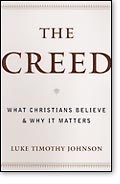
Think of Luke Timothy Johnson's The Creed as a user's manual. It is not just an excellent commentary on the content of the Nicene Creed (more properly known as the Nicene-Constantinopolitan Creed). It is a handbook to faith, and its fundamental argument is that while faith is our very personal response to God, our response must be shaped by specific beliefs about God.
Johnson is a Roman Catholic New Testament scholar, and Protestants might not expect to hear a Catholic argue that faith is fundamentally a personal response to God. But Johnson, who teaches at Emory University's Candler School of Theology, was part of the wave of Catholic thinkers that, in the wake of Vatican II, rejected the church's old emphasis on faith as merely giving assent to propositions. They revived the personal and the communal, while de-emphasizing the priestly and institutional dimensions of faith.
Johnson still holds "as strongly as ever that faith in God is an existential response of the whole person characterized by trust, obedience, and loyalty." But over the past 30 years, he has seen where an emphasis on existential response—stripped of defining content—can lead. So now, he says, he has "come to appreciate how critical the role of belief is in structuring that response." Amen.
Defined freedom
There is a popular tendency to dismiss the creeds as post-apostolic inventions that are, as Johnson writes, "instruments of politics rather than piety, of coercion rather than freedom, of philosophy more than gospel." Johnson straightens out this ecclesiastical equivalent of urban legend.
He shows how the creeds are the natural growth of seeds planted by the apostles. Already in the New Testament, there is a strong impulse to safeguard the essentials of the faith. Commenting on 1 Corinthians 15, he says, "Getting the story wrong in its essentials amounts to 'believing in vain.'" And on 1 John 2:22, he writes, "Getting Jesus wrong is also getting God wrong."
And if the Creed is couched in philosophical language, that is only because the key fourth-century challenges to the heart of the faith were framed in philosophical categories.
Positively, Johnson says the Creed defines the Christian faith in much the same way that the rulebook defines baseball. The rules of baseball distinguish "the game from other team sports played with balls, but [do] not exhaust the possibilities of excitement, valor, excellence, and failure inherent in the sport as actually played."
Likewise, the Creed establishes "boundaries for and around the Christian people," but it "does not exhaust the meaning of Christian life and practice."
The seatbelt analogy I began with appealed to me because my own denomination (ECUSA) is having a very bumpy ride theologically. But Johnson's baseball metaphor illustrates the freedom the Creed gives us. As long as you don't move first base or allow pitchers to throw bean balls, we can all have a good time. As long as theologians and pastors don't teach that Jesus was just a good man or that he didn't rise from the grave, they can engage in a lot of theological playfulness. Johnson praises the Creed's parsimony because it provides a defined freedom.
Worldview Challenge
Johnson spends a fair amount of time talking about the nature of religious language.
In the mouths of many scholars, such talk comes off as a way to distance theology from the historical events at the root of our faith. In Johnson's hands, however, talk about "myth" and "structuring the world" is a way to challenge fashionable intellectual trends.
When he says "myth," he is talking about the meaning Christian faith gives to our history. The statement "God was in Christ reconciling the world unto himself" puts a specific meaning to historical events. In also provides a framework of meaning in which we can see all other events.
Recapturing the big storyline is important in a postmodern society in which such "totalizing metanarratives" are supposed to be rejected simply because of their claims to universal significance. If there is any "one universal, unifying interpretation of the world" left in our society, Johnson writes, "it is some form of social Darwinism that reduces human life to the brutal competition to survive."
Such a nature-red-in-tooth-and-claw narrative provides the building blocks of many peoples' worldviews. Christians are (or should be) different. The power of this scriptural worldview—as crystallized in the Creed—"should not be underestimated," Johnson writes, "especially in a world whose best alternative is an endless and pointless evolution."
Neither Sheep nor Goat
Readers who are used to classifying theologians along a liberal-conservative continuum (or dividing them into sheep and goats) will have a difficult time imposing such categories on Johnson.
Article continues below
On the one hand, he does not tolerate theological nonsense. For example, in his recent Commonweal review of Elaine Pagel's latest apology for gnosticism, he called folly by its right name. In The Creed, he calls faddishly changing the "Our Father" to "Our Father-Mother" a form of "generational narcissism." And his 1996 book, The Real Jesus, was one of the most compelling responses to the silliness of the Jesus Seminar.
But Johnson is no slave to traditionalist pieties. In The Creed, he freely challenges his own church at its points of theological excess. He sees the insistence on the infallible authority accorded the bishop of Rome as "a case where the will to power has become so confused with theology that its practitioners actually think they are doing the latter when they are only exercising the former." And he treats Rome's "obsessive need to define the role of Mary" as "arbitrary and harmful."
Not all of Johnson's comments are to my liking. His passing remarks on creationism and millenarianism, for example, betray an outsider's inability to distinguish their varied forms in evangelicalism. But I found Johnson always bracing. He treats the core theological truths of the Christian faith not as abstractions but as foundations for revolutionary living.
For example, to say "Jesus is Lord" is to say that "none of us is lord over another." And to say God is the maker of all things is to learn to look to all things for what they reveal about the Creator. The Creed's distinctive way of believing is the foundation of a Christian's countercultural way of living.
Luke Timothy Johnson's The Creed: What Christians Believe and Why It Matters is this month's selection for CT's Editor's Bookshelf. Elsewhere on our site you can:
David Neff was editor in chief of Christianity Today, where he worked from 1985 until his retirement in 2013. He is also the former editor in chief of Christian History magazine, and continues to explore the intersection of history and current events in his bimonthly column, "Past Imperfect." His earlier column, "Editor's Bookshelf," ran from 2002 to 2004 and paired Neff's reviews of thought-provoking books and interviews with the authors.



















 While we pray for peace, we need moral clarity about this war.
 A Christian reconciliation group in Israel and Palestine warned that war would come. Now the war threatens their relevance.españolالعربيةFrançaisрусскийУкраїнська
 How groups like Hillsong learned to let go of the literal in favor of creative collaboration.españolPortuguês






