JOHN ELDREDGE has definitely struck a chord that resonates with men. But is this broad-ranging chord like a syrupy pop hook that pleases undiscerning ears, or a more substantive combination of notes?
Part of Eldredge's resonance stems from writing like "one of the fellas" in the midst of the spiritual battlefield of life, especially in 2001's Wild at Heart. There he aims to remedy a masculine crisis in today's church: Christian men have no vision of manhood apart from being nice and dutiful. They are unable to live deeply from within. Eldredge describes this crisis and other male "issues" masterfully, and points toward greater spiritual wholeness. The therapeutic virtues of the book, however, do not outweigh its theological and cultural vices.
For example, he says the solution for the crisis lies in men discovering the true universal desires that make their hearts come alive: to have a battle to fight, an adventure to live, and a beauty to rescue. Really? Can Eldredge mean that all men in every culture have these three core desires? This notion has little scriptural support and inadequately reflects the diverse kinds of men God has made.
Theological error emerges by page three, which asserts that man was made in the outback and then brought to Eden, and "ever since then boys have never been at home indoors, and men have had an insatiable longing to explore." He implies that God was trying to domesticate a wild Adam, as if Eden were designed primarily for women.
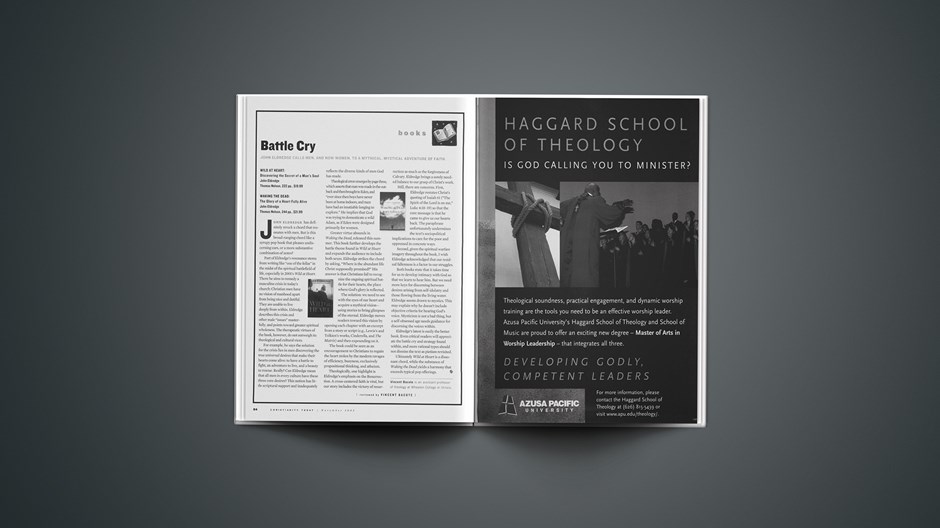
Greater virtue abounds in Waking the Dead, released this summer. This book further develops the battle theme found in Wild at Heart and expands the audience to include both sexes. Eldredge strikes the chord by asking, "Where is the abundant life Christ supposedly promised?" His answer is that Christians fail to recognize the ongoing spiritual battle for their hearts, the place where God's glory is reflected.
The solution: we need to see with the eyes of our heart and acquire a mythical vision—using stories to bring glimpses of the eternal. Eldredge moves readers toward this vision by opening each chapter with an excerpt from a story or script (e.g., Lewis's and Tolkien's works, Cinderella, and The Matrix) and then expounding on it.
The book could be seen as an encouragement to Christians to regain the heart stolen by the modern ravages of efficiency, busyness, exclusively propositional thinking, and atheism.
Theologically, one highlight is Eldredge's emphasis on the Resurrection. A cross-centered faith is vital, but our story includes the victory of resurrection as much as the forgiveness of Calvary. Eldredge brings a sorely needed balance to our grasp of Christ's work.
Still, there are concerns. First, Eldredge restates Christ's quoting of Isaiah 61 ("The Spirit of the Lord is on me," Luke 4:18-19) so that the core message is that he came to give us our hearts back. The paraphrase unfortunately undermines the text's sociopolitical implications to care for the poor and oppressed in concrete ways.
Second, given the spiritual warfare imagery throughout the book, I wish Eldredge acknowledged that our residual fallenness is a factor in our struggles.
Both books state that it takes time for us to develop intimacy with God so that we learn to hear him. But we need more keys for discerning between desires arising from self-idolatry and those flowing from the living water. Eldredge seems drawn to mystics. This may explain why he doesn't include objective criteria for hearing God's voice. Mysticism is not a bad thing, but a self-obsessed age needs guidance for discerning the voices within.
Eldredge's latest is easily the better book. Even critical readers will appreciate the battle cry and strategy found within, and more rational types should not dismiss the text as pietism revisited.
Ultimately Wild at Heart is a dissonant chord, while the substance of Waking the Dead yields a harmony that exceeds typical pop offerings.
Vincent Bacote is an assistant professor of theology at Wheaton College in Illinois.

















 While we pray for peace, we need moral clarity about this war.
 A Christian reconciliation group in Israel and Palestine warned that war would come. Now the war threatens their relevance.españolالعربيةFrançaisрусскийУкраїнська
 The government plans to close its porous border with Myanmar to boost security, separating ethnic groups that straddle the boundary.