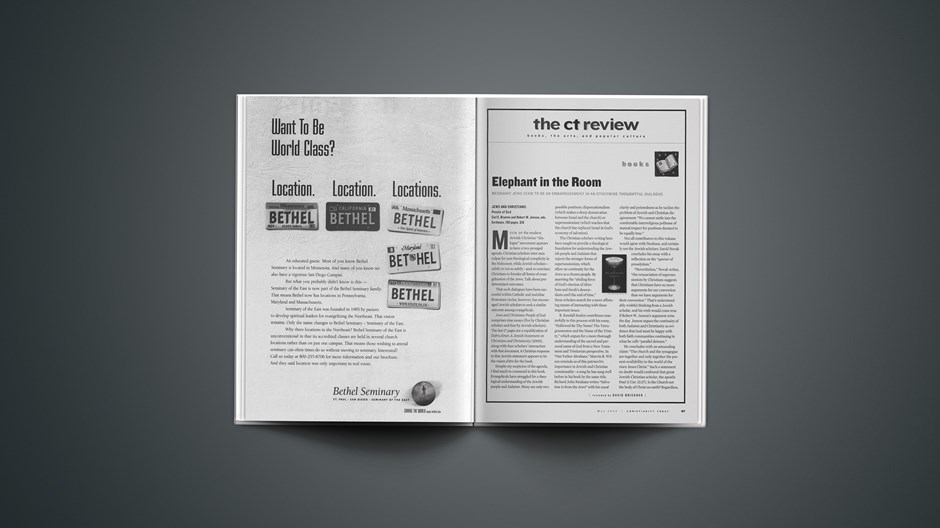
Much of the modern Jewish-Christian "dialogue" movement appears to have a two-pronged agenda. Christian scholars utter mea culpas for past theological complicity in the Holocaust, while Jewish scholars—subtly or not so subtly—seek to convince Christians to forsake all forms of evangelization of the Jews. Talk about predetermined outcomes.
That such dialogues have been successful within Catholic and mainline Protestant circles, however, has encouraged Jewish scholars to seek a similar outcome among evangelicals.
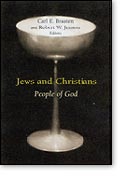
Jews and Christians: People of God comprises nine essays (five by Christian scholars and four by Jewish scholars). The last 17 pages are a republication of Dabru Emet: A Jewish Statement on Christians and Christianity (2000), along with four scholars' interaction with that document. A Christian response to that Jewish statement appears to be the raison d'être for the book.
Despite my suspicion of the agenda, I find much to commend in this book. Evangelicals have struggled for a theological understanding of the Jewish people and Judaism. Many see only two possible positions: dispensationalism (which makes a sharp demarcation between Israel and the church) or supersessionism (which teaches that the church has replaced Israel in God's economy of salvation).
The Christian scholars writing here have sought to provide a theological foundation for understanding the Jewish people and Judaism that rejects the stronger forms of supersessionism, which allow no continuity for the Jews as a chosen people. By asserting the "abiding force of God's election of Abraham and Sarah's descendants until the end of time," these scholars search for a more affirming means of interacting with these important issues.
R. Kendall Soulen contributes masterfully to this process with his essay, "Hallowed Be Thy Name! The Tetragrammaton and the Name of the Trinity," which argues for a more thorough understanding of the sacred and personal name of God from a New Testament and Trinitarian perspective. In "Our Father Abraham," Marvin R. Wilson reminds us of this patriarch's importance to Jewish and Christian commonality—a song he has sung well before in his book by the same title. Richard John Neuhaus writes "Salvation Is from the Jews" with his usual clarity and pointedness as he tackles the problem of Jewish and Christian disagreement: "We cannot settle into the comfortable interreligious politesse of mutual respect for positions deemed to be equally true."
Not all contributors to this volume would agree with Neuhaus, and certainly not the Jewish scholars. David Novak concludes his essay with a reflection on the "specter of proselytism."
"Nevertheless," Novak writes, "the renunciation of supersessionism by Christians suggests that Christians have no more arguments for our conversion than we have arguments for their conversion." That's understandably wishful thinking from a Jewish scholar, and his wish would come true if Robert W. Jenson's argument wins the day. Jenson argues the continuity of both Judaism and Christianity as evidence that God must be happy with both faith communities continuing in what he calls "parallel detours."
He concludes with an astounding claim: "The church and the synagogue are together and only together the present availability to the world of the risen Jesus Christ." Such a statement no doubt would confound that great Jewish Christian scholar, the apostle Paul (1 Cor. 12:27). Is the Church not the body of Christ on earth? Regardless, I am quite certain the synagogue has no desire to contribute to the present availability of Jesus Christ to the world.
Addressing the thorny problem of Jewish followers of Christ (such as Paul), Jenson writes, "Perhaps Jewish thinkers must view the baptism of Jews as apostasy, but the church must—even if she does not conduct any sort of 'mission' to achieve this—greet those that do occur as gifts of God." Pardon me if I am not grateful for such kindness. If the church "does not conduct any sort of mission" to my Jewish people, she fails to follow the Great Commission in a most foundational sense. If Jesus is not the Jewish Messiah, he cannot be the Savior of the world.
Moreover, what about the problem of Jewish continuity? Should this not concern Christians who reject supersessionism yet hold to the uniqueness of Christ for the salvation of all people, including the Jews? Jenson argues against Jewish evangelism by stating that "identifiable Jewishness does not long survive within the gentile-dominated church." As I come from five generations of Messianic Jews, this is strange to my ears indeed. It is also strange to the growing and vibrant Messianic Jewish community around the world.
Thankfully, Wolfhart Pannenberg, in his comments on Dabru Emet, notes, "The 'messianic Jews' intend to remain Jews while professing Jesus to be the Messiah. Sooner or later Christian-Jewish dialogue will have to take notice of this fact …" But Rabbi Barry Cytron is quick to reject Pannenberg's suggestion, and so the debate continues. We Messianic Jews continue to be the elephant in the room. That we are excluded from forums such as this points to the predetermined agenda that Jews do not need Jesus and should not be evangelized.
Article continues below
The dialogue represented by Jews and Christians: People of God may have some benefit, but it is deficient insofar as it excludes certain important voices. Moreover, for the evangelical, such dialogue can never become a substitute for direct evangelism.
David Brickner is executive director of Jews for Jesus.
Kosher Cooperation | Jewish elites broker new relations with evangelicals. (Oct. 2003)
CT Classic: Do Jews Really Need Jesus? | What evangelicals believe about evangelization of the Jews—and whether the Holocaust makes a difference in that task. (Aug. 16, 2002)
The Return of the Jewish Church | In 1967, there were no Messianic Jewish congregations in the world. Today there are 350. Who are these believers? (CTLibrary, sub. req.)
To the Jew First? | Southern Baptists defend new outreach effort. (CTLibrary, sub. req.)
Have something to add about this? See something we missed? Share your feedback here.
Our digital archives are a work in progress. Let us know if corrections need to be made.














 While we pray for peace, we need moral clarity about this war.
 A Christian reconciliation group in Israel and Palestine warned that war would come. Now the war threatens their relevance.españolالعربيةFrançaisрусскийУкраїнська
 The plan would organize UMC churches in four global regions, with each given more leeway around same-sex marriage and other theological issues.






