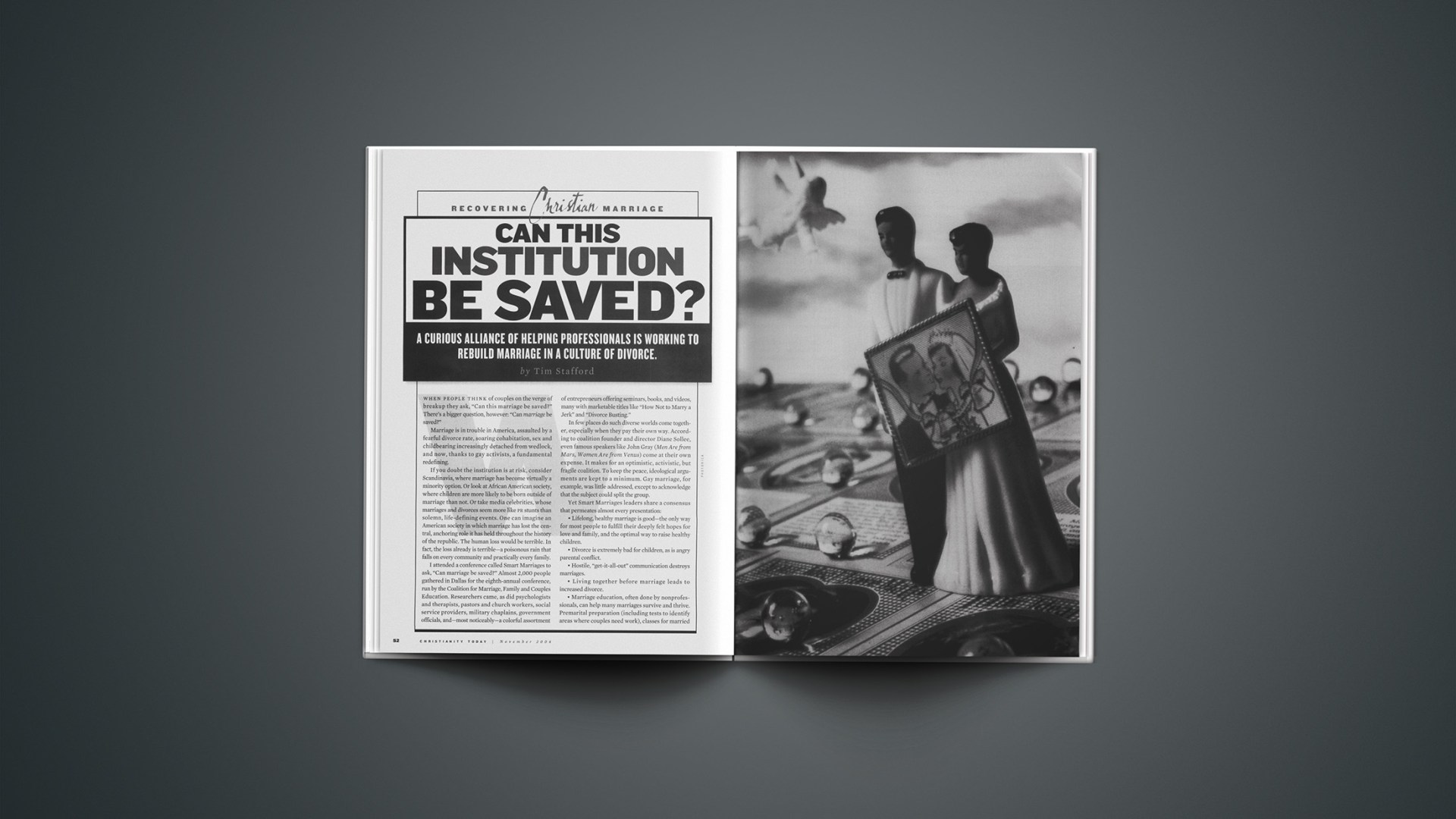
When people think of couples on the verge of breakup they ask, “Can this marriage be saved?” There’s a bigger question, however: “Can marriage be saved?”
Marriage is in trouble in America, assaulted by a fearful divorce rate, soaring cohabitation, sex and childbearing increasingly detached from wedlock, and now, thanks to gay activists, a fundamental redefining.
If you doubt the institution is at risk, consider Scandinavia, where marriage has become virtually a minority option. Or look at African American society, where children are more likely to be born outside of marriage than not. Or take media celebrities, whose marriages and divorces seem more like PR stunts than solemn, life-defining events. One can imagine an American society in which marriage has lost the central, anchoring role it has held throughout the history of the republic. The human loss would be terrible. In fact, the loss already is terrible—a poisonous rain that falls on every community and practically every family.
I attended a conference called Smart Marriages to ask, “Can marriage be saved?” Almost 2,000 people gathered in Dallas for the eighth-annual conference, run by the Coalition for Marriage, Family and Couples Education. Researchers came, as did psychologists and therapists, pastors and church workers, social service providers, military chaplains, government officials, and—most noticeably—a colorful assortment of entrepreneurs offering seminars, books, and videos, many with marketable titles like “How Not to Marry a Jerk” and “Divorce Busting.”
In few places do such diverse worlds come together, especially when they pay their own way. According to coalition founder and director Diane Sollee, even famous speakers like John Gray (Men Are from Mars, Women Are from Venus) come at their own expense. It makes for an optimistic, activistic, but fragile coalition. To keep the peace, ideological arguments are kept to a minimum. Gay marriage, for example, was little addressed, except to acknowledge that the subject could split the group.
Yet Smart Marriages leaders share a consensus that permeates almost every presentation:
- Lifelong, healthy marriage is good—the only way for most people to fulfill their deeply felt hopes for love and family, and the optimal way to raise healthy children.
- Divorce is extremely bad for children, as is angry parental conflict.
- Hostile, “get-it-all-out” communication destroys marriages.
- Living together before marriage leads to increased divorce.
- Marriage education, often done by nonprofessionals, can help many marriages survive and thrive. Premarital preparation (including tests to identify areas where couples need work), classes for married couples, and marriage mentoring are some of the many practical approaches offered.
The good news from Smart Marriages is that Christians are not alone in caring about marriage. A broad coalition recognizes that the church makes a natural vehicle for marriage education, since most marriages still begin in church. Many Smart Marriages leaders have taken their lumps for supporting marriage in psychological, social-service, or academic settings. They’re eager to join forces.
Doubting the Approach
One friend, having perused the Smart Marriages program, wrote me a thoughtful rant questioning its value. Some excerpts:
I have limited confidence in the ability of education to help marriages. Most couples enter into marriage so much more relationally savvy than ever before in history. … All of my close friends who have been divorced—some of them psychologists and trained marriage counselors!—every one of them knew a great deal about the ins and outs of relationships. They all bailed because they were no longer getting fulfilled in marriage. I fail to see how a little more education is going to help.
This is not to say that education is pointless. All of us have learned a technique or two that helps. But to assume that education is THE KEY to saving marriage in the United States—I see no evidence that this is true, and much evidence to the contrary.
Whether education can save marriage is a good question, I thought. So on my first day I posed it to Scott Stanley, cofounder of the leading marriage education course, PREP (Prevention and Relationship Enhancement Program). Stanley is a well-known researcher and a committed Christian. Slight and mild-mannered, he could pass for the quintessential research nerd. He jokes that his bumper sticker reads, “So much data, so little time.”
The question seemed to faintly annoy him. People have an irritating habit, he said, of assuming that what you do reflects what you consider most significant. “If I had to choose between education and changing the culture,” he answered, “I’d take the culture.” Stanley went on to say, however, that the choice isn’t so black and white. When churches, schools, the military, and the government get involved in teaching people how to stay married, they affect the culture. They make a statement: “Marriage is important.”
The bottom line, Stanley was saying, is that educational programs contribute to the welfare of marriages. You can moan about individualism and hedonism, but what matters is doing something to help.
Take PREP. “Research is overwhelmingly clear that the ’60s were wrong,” Stanley tells a training seminar for Christian PREP, a variant of PREP that integrates scriptural teaching. “It’s bad to ‘get it all out.'”
Couples inevitably have differences, and angry, escalating arguments only make matters worse. PREP teaches couples to get to the heart of their issues via a technique called “speaker-listener,” in which one partner holds the floor while the other can speak only to paraphrase what he or she hears. When one partner has had an uninterrupted say, the other partner gets his or her turn. The idea is to slow down communication and minimize emotional escalation.
Since this is Christian PREP, Stanley brings out James 1:19: “Everyone should be quick to listen, slow to speak, and slow to become angry.” What researchers see is exactly what Scripture says, Stanley claims, pointing out the many Bible verses that warn against angry, hurtful speech.
A therapist in the audience is troubled. “It seems to me you are assuming that the couple wants the marriage to work. Sometimes couples don’t have that commitment.”
Stanley agrees, but points out that you can’t tell in advance. “Some have checked out; they are already in another relationship. Others have checked out, but they would come back in if they had any reason to believe it could really work.” If couples experience real communication with their spouses through PREP, he says, their willingness to commit may be rekindled.
Doubting the Goals
My friend also questioned the goal of marriage education. Could it be, he wrote, that marriage counseling that begins with the assumption that it is really important to make couples happy, fulfilled, and so on, will simply exacerbate the problem? If you enter marriage assuming/hoping/wishing that it will make you happier, and then you find that it doesn’t, what option do you have but to assume it was a mistake and that your true love awaits you somewhere else?
What if marriage were conceived as a way to love and serve God and/or others (depending on one’s faith)? he wrote. What if marriage were not about happiness and self-fulfillment but about contributing something to society and the world, like children and good works? What if, instead of better communication, better sex, better conflict resolution, husbands and wives began forgiving one another, forbearing one another, having patience with one another? What if marital fulfillment were a byproduct of something much more profound?
I thought of this when I lunched with Barbara Dafoe Whitehead, a social scientist best known for her blockbuster 1994 Atlantic cover story, “Dan Quayle Was Right.” That article, and her subsequent book The Divorce Culture (Vintage Books, 1998), decisively changed the terms of discussion about divorce. She made the case, based on statistical studies, that divorce is bad for children.
The evidence was so overwhelming that a rough consensus has since emerged, though only over the anguished screams of radical feminists and others determined to see divorce as benign. Whitehead and her colleague, David Popenoe of Rutgers University, also have led the way in pointing out the destructive consequences of living together before marriage. The two produce an annual report called “The State of Our Unions” (at http://marriage.Rutgers.edu), perhaps the best source of statistical information on marriage and family.
She spoke of the poverty of language in contemporary debate about marriage. “What are the big ideas that are behind that word commitment? What does it tell you about a life that’s worth living? I myself struggle sometimes to make it as rich and deep as I’d like to make it when I’m talking even to my own children.” Faith communities could help deepen that language and understanding of what marriage means, she said.
A frequent speaker to religious and other groups, Whitehead related how one audience member later told her that people talk of marriage either in highly romanticized or highly industrial terms. “It’s either your soul mate, with whom you’re bonded in every possible way, or it’s this big slog, where every day you’re working at it, you’re doing your exercises,” she said. “Marriage isn’t either one of those things. What is the in-between? It’s a vacant space in the conversation.”
Smart Marriages is only a tiny piece of the much bigger answer that is needed, Whitehead said—a good starting point for a self-help nation characterized by its optimism. “Some big ideology wouldn’t work,” she said. “I think this works.”
A decade ago, it would have been difficult to get 20 people to come across the country to discuss marriage, she said. “Two-thousand people,” she mused. “The phenomenon of people gathering and being committed to this is important.”
Help from Babies
John Gottman, professor emeritus of psychology at the University of Washington, is a renowned figure in the study of marriage. With a thick gray beard, glasses, and sporting a yarmulke, he introduced a new educational program aimed at prospective parents called “Bringing Baby Home.”
Research has shown, he explained, that a baby’s well-being depends on the state of the couple’s marriage. Just by observing parents’ communication, he said, “we can predict the baby’s crying before the baby is even born.”
It is a new wrinkle on a typical Smart Marriages approach: focusing on the welfare of children as a motive for improving marriage; using carefully documented studies to define practical improvements; and searching for new venues to reach young couples (in this case, the hospital or prenatal clinic). The course offers tips on baby care, as well as emphasizing the stresses on marriage that a baby brings. Marriage and divorce are seen as pediatric public-health issues —about as demoralized an approach as is possible. I was rolling along in this train of thought when Gottman put on a video. It was not artful—a stationary camera recorded three young couples discussing their issues. Nevertheless, it stopped me dead.
In one, a young man—though he looked like a boy—wearing baggy shorts slumps in his chair, wanting so badly to escape. His partner is an equally young African American girl; she leans away from him and looks off into the distance.
They are discussing money, of which they have little. The boy wants to own a nice car. The girl wants him to be realistic; they will be fortunate to afford any car at all. He knows she is right, but he hates it. She hates his unwillingness to get real. They are both utterly miserable—it is written all over their bodies—and trapped by each other. The boy wants his fantasies, which the girl disrupts with her grim practicality. The girl wants a fighting chance to get out of this dead-end life without being pulled down by this dreamer who throws away money they need for the baby.
In a second video, a young white woman leans toward her African American partner, trying to make contact. In her eagerness she is talking too much. The man leans away. She leans farther toward him, trying to get close; he leans farther away.
In the third video, a young white couple discusses the young man’s unwillingness to clean up after himself. The wife feels overwhelmed by the baby, and she has asked him, time and again, to pick up in the kitchen. He doesn’t do it. Why? At first the man diverts the conversation, but she brings it back. She isn’t accusing so much as seeking to understand: Why can’t he clean up? It’s such a small thing. She is almost pleading for understanding, but he can’t give it. He says he doesn’t know why.
Before the camera’s unblinking eye, their conversation comes to a complete halt. They break down to silence: unnerving misery that goes on and on, so we long to turn off the camera. Of course, in the wretchedness of this young couple’s life, nothing can turn off the camera. The emptiness at the heart of their conversation will continue endlessly.
Watching these unadorned film clips, I am struck dumb by the sheer misery of failing marriages. These are not bad people. They have not made a philosophical choice to pursue their own fulfillment instead of staying married. They are just weak, misery-prone human beings. Unless somebody can help these couples they will be divorced in six months—that seems an absolute certainty. While moral and teleological questions certainly touch their lives, they do not need a new sense of moral purpose in marriage, any more than a drowning man needs to understand the principle of buoyancy.
They need a rope. They need a shred of hope. Somebody needs to give them some tools, or they don’t stand a chance.
Spring Thaw
How bad is the state of marriage in America? Wade Horn, assistant secretary for children and families in the U.S. Department of Health and Human Services, gave an optimistic talk in which he spoke of a “springtime of hope” for marriage—or “at least an early winter thaw.”
Horn administers the federal government’s Healthy Marriage Initiative, which pushes some welfare money into marriage education in cooperating states. Oklahoma leads with an aggressive program (using PREP, both Christian and secular versions) that officials estimate has already reached 1 percent of the state’s population.
Researcher David Popenoe, however, said in an interview that he saw no signs of spring. The divorce rate is down from its historic peak in 1980, he said, but that is largely because fewer Americans choose to marry. (It is a truism that if people don’t marry, they won’t divorce.) Cohabitation is “up, up, up.”
“I think the only real hope is religious revival,” Popenoe said.
Indeed, statistics from “The State of Our Unions” are almost uniformly discouraging:
- The number of people getting married has declined 40 percent from 1970 to 2002.
- The American divorce rate today is more than double that of 1960, though it has declined slightly since hitting the all-time high in the early 1980s. “For the average couple marrying in recent years, the lifetime probability of divorce or separation remains close to 50 percent,” the report says.
- “Over half of all first marriages are now preceded by living together, compared to virtually none 50 years ago.” The more partners people live with, and the longer the time they live together, the more likely they will eventually divorce.
- Twenty-seven percent of all children are raised in single-parent families, triple the rate in 1960. And increasingly, children pose no impediment to divorce. Meanwhile, Americans have fewer children. The fertility rate has again fallen below replacement levels.
- While high-school seniors are increasingly likely to express a desire for lifelong marriage and family, only about a third agreed that “most people will have fuller and happier lives if they choose legal marriage rather than staying single or just living with someone.” More than half agreed that “having a child without being married is experimenting with a worthwhile lifestyle or is not affecting anyone else.”
When it comes to Christian marriages, there seems to be hope. Many people claim that Christians are just as likely as non-Christians to divorce, so I was surprised to find marriage scholars seeing faith as an important, positive factor. They seemed quite confident that Christians do not divorce so often as non-Christians. Furthermore, they indicated that the more active the faith, the better for lowering divorce rates.
Scott Stanley explained. Divorce rates, he said, are driven by demographics. People who marry in their teens, who have limited education and low income, have high divorce rates. It happens that Christians are numerous in early marrying, low-income, low-education communities. Hence they have high divorce rates—as high or higher than those who are irreligious. (Atheists have an extremely low divorce rate—presumably because they are well-educated and well-paid.)
If you isolate religious commitment from other factors, however, you find it is a very positive factor. That is to say, if you take two couples with similar education and background, both marrying at the same age, one couple religious and one not, the religious couple will have a significantly greater likelihood of making their marriage last. That is another reason why Smart Marriages welcomes Christians: Scholars know that faith is a positive factor in saving marriages.
Popenoe related my favorite finding. What group, Popenoe asked, has the lowest rate of domestic violence? Answer: church-attending evangelical Christians. Next question: what group has the highest rate of domestic violence? Answer: non-church-attending evangelical Christians. Many evangelicals come from economic classes that are prone to domestic troubles. But practicing faith makes a decisive difference.
Optimistic Signs
“I’m more optimistic than ever that marriage can be turned around,” Seattle Pacific University’s Les Parrott said. He and his wife, Leslie, teach marriage preparation classes, as well as sponsor marriage mentoring for newlywed couples. When Oklahoma launched its marriage initiative, the Parrotts moved to the state for 12 months to join in the cause.
“In our profession, we know more now than we ever have known about what it takes,” Parrott said. “There’s also a huge grassroots movement, like nothing we have ever seen. I think the church is waking up and recognizing that we can do something.”
Others are not so sure. Mike McManus, a craggy journalist who has devoted his professional life to getting churches involved, says, “Marriage is the last thing pastors are thinking of. When you say marriage, they think wedding.”
McManus and his wife, Harriet, advocate “marriage-saving congregations” and “community marriage policies.” He told of a couple in Chattanooga, Tennessee, determined to get married in a month. The couple was disappointed when their church required extensive premarital preparation. The couple went to another church down the block. That church, they found, had the same policy. The couple went to a third church, and a fourth—only to find no variance in policy. Chattanooga churches have signed a community marriage policy.
The couple finally gave up and returned to their home church, agreeing to premarital preparation.
“That [couple],” McManus said, “has been driving the process in every community in America. It is time for the church to take a stand.”
Research shows that counties with a community marriage policy reduce divorce, sometimes by a lot. Compelling stories also come from congregations that have adopted comprehensive marriage ministries. Richard Albertson told of his home church, Killearn United Methodist in Tallahassee, Florida. The 2,300-member congregation has seen just two divorces since 1999—none among couples that actually completed the mentoring program.
Can marriage be saved? Such stories suggest that it can. The growth of the Smart Marriages coalition demonstrates a vigorous, multisector response to the plague of divorce.
Yet, clearly, marriage remains deeply troubled.
The Reign of Self
The rise of gay marriage is a lightning bolt from a long-gathering storm. And as divorce and cohabitation have grown to become normal behavior in America, marriage has become increasingly defined by sexual self-fulfillment—not by vows, not by children, not by community expectations. The church’s reaction has generally been weak and late.
Ironically, social scientists have responded with greater clarity. It’s unclear whether the Smart Marriages coalition’s pragmatic, educational approach can challenge the powerful cultural forces of individualism and self-fulfillment. Can you overturn the divorce culture without taking on its presuppositions, such as the inevitability of sex outside marriage or the supreme reign of the individual’s will?
Nevertheless, Smart Marriages shows that allies are available, cobelligerents in support of marriage. They have gone against the stream in their professional lives. They offer tools that have been tested and proved. They respect people of faith and are eager to work with them. If the institution of marriage can be saved, it surely needs support on all fronts. Reluctant partners should ask themselves: What are we doing to turn the divorce culture around? And can we win this fight alone?
Tim Stafford is a senior writer for CT.
Copyright © 2004 Christianity Today. Click for reprint information.
Related Elsewhere:
Smart Marriages has more information on healthy marriage as well as articles, links, stats on marriage, and marriage resources in your area.
Marriage Savers has more information about saving your marriage and Mike McManus’s efforts on their website.
State of Our Unions has the 2004 report, The Marrying Kind: Which Men Marry and Why.
The government’s Healthy Marriage Initiative has information about healthy marriages and ways to get involved.
Other articles in our ongoing series on marriage includes:
Pick Your Shibboleths Wisely | Do we really want to be known as the generation who gave marriage over to the government? (Sept. 20, 2004)
A Crumbling Institution | How social revolutions cracked the pillars of marriage. (Aug. 24, 2004)
What God Hath Not Joined | Why marriage was designed for male and female. (Aug. 20, 2004)
Our Marriage in America Hot Topic has more Christianity Today articles and editorials about marriage today.
For help and encouragement in a Christian marriage, our sister publication, Marriage Partnership, has articles and advise.
Focus on the Family’s Husbands & Wives section on their website has articles about building a strong marriage.