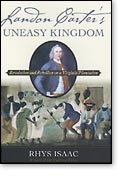
Paving-stone-sized, hardbound books devoted to particular founding fathers of the American republic have inexhaustibly flooded bookstores over the last two years. Rhys Isaac's Landon Carter's Uneasy Kingdom is the joker in the pack. We call them "founding fathers," yet we don't think about the fatherly ways in which they worried about their own parenting skills and the future of both their actual and metaphorical offspring. They could be, and often were, very proud of their national fatherhood, but they often were apprehensive when contemplating their offspring's future. As Isaac beautifully reveals, no one expressed this uneasy mixture of pride and worry as well as Landon Carter of Virginia.
It is a measure of Isaac's achievement that after you read Landon Carter's Uneasy Kingdom you wonder why you have never before heard of the old gentleman. Jack Greene published a meticulous edition of his diaries in the 1960s and wrote a slim biography of Carter as its introduction. Yet neither Greene nor all of us who have pored through the green-bound volumes have taken Landon seriously as a person. We instead troll his diary for social customs, cultural ideas, and anecdotes of his unbounded rage to fill our dissertations.
In our ceaseless search for good material, we never read the diary as the vast sprawling literary masterwork that Isaac convinces us it is: a great gift of America to English literature. Here are Carter's frequent, furious rages against his son; his agrarian obsession with weather; his meticulous chronicle of his equally obsessive doctoring of the sick; his cryptic comments on some nonsense encountered in Herodotus ("Whiptwang! A lie to be sure!" the planter wrote).
Isaac often lets us read Carter directly, setting his words in italics, interjecting editorial explanations in regular type. Here is a wonderful example from late in Carter's life (he died December 22, 1778), when his thoughts were particularly bleak and contemplative:
August 30, 1778 …
A Surprise to some people happened here last week. A humming bird catcht sheltering itself from the weather was kept in a cage for more than a fortnight on honey and water from a wooden sender spoon. At last it got out & went away.
After much labour to catch it in vain, I saidgreat Chance but it comes tomorrow to the cage.
Lord how the improbability was laughed at by the greatest Ass—my son—in sacrifice to his cursed Malice and revenge.
But the next dayas I saidit came, was catched & fed voraciously indeedand continues in confinement by hunger, the only passion every Man is subject to, that must inevitably enslave.
Aside from the tone, three topics evident in this passage form the bulk of Isaac's interpretation of Landon Carter: nature, and the alterations to it called agriculture; patriarchy, as understood particularly in the duty and loyalty that sons ought to give their fathers; and slavery, which was the basis not simply of Carter's fortune but of his very way of life. Isaac weaves these topics throughout Landon Carter's Uneasy Kingdom, but at times he forces the reader to pay direct attention to them.
Isaac highlights slavery in his discussion of the most fascinating passages in Carter's diary: an exodus of eight slaves from servitude under Carter to freedom on the fleet of the Royal Governor of Virginia. Slavery's inextricable relation to patriarchy is a theme throughout the book, but patriarchy becomes the focus in considering Carter's relations with his son and Carter's son-like relations with his King-father across the Atlantic. Carter's violent anger at his son's acts of insubordination, both real and (most often, it seems) imagined, mirrors the violent unease with which Carter contemplated independence from the Crown.
Isaac also identifies genres of Carter's nature and agriculture writing. There are "observation pieces," in which Carter noted and mused upon some natural phenomenon; "plantation tableaus," which depicted some striking aspect of Carter's domain; "planning reviews," a sort of project analysis; and "construction projects," which Isaac describes as "cherished flights of fancy that deeply expressed the desired persona of the diarist … very expressive of this age of the Enlightenment, when improvement was identified as the immediate goal of philosophy."
Landon is not in the highest pantheon of founding fathers. But because of his diaries, he is much more immediate to us, and he has more to teach us about our common humanity than his better-known compatriots. Nothing better expresses this than his entry for his 69th birthday, in August 1778, neither a very happy year for him nor for the Revolution.
… I thank God I have lived so long as to experience the hopes I have placed in the father of Goodness through the merits of my dear saviour his only Son—are not in vain. Therefore I will be as cheerful with my friends as Society, decency, Justice, and a reverence to God … will let me.
Article continues below
Though last night—between the hours of 10 and 12—I could not promise myself life—much less ease with it
And do thou God preserve me in this resolution.
If for nothing else, we should read Landon Carter because he was an honest man, and Rhys Isaac's Landon Carter's Uneasy Kingdom because it is a skilled and honest depiction of the man, his place, and his age.
Albert Louis Zambone, D.Phil Candidate in early American history at Oxford, is often found working upon an oversized biography (tentatively titled Founding General: Nathanael Greene and the American Way of War) when he should be writing a dissertation on Anglicanism and intellectual culture in 18th century Virginia.
The Colonial Williamsburg Foundation site has a few excerpts from Carter's diaries.
Books & Culture Corner appears every Tuesday. Earlier editions of Books & Culture Corner and Book of the Week include:
The Great American Hustle | The first volume of an ambitious new history of America highlights the engine of "worldly ideals"—and the role of evangelical religion in creating a distinctive American identity. (Sept. 14, 2004)
The Poet Who Remembered | Poland (mostly) honors Czeslaw Milosz upon his death. (Sept. 07, 2004)
Be Careful What You Pray For | The strange tale of the controversial Bishop Pike and his fatal quest for relevance. (Aug. 31, 2004)
Book 'Em! | The concluding installment of our three-part midyear book roundup (Aug. 24, 2004)












 While we pray for peace, we need moral clarity about this war.
 As my doubts about his teachings grew, so did a secret fascination with Jesus.
 How groups like Hillsong learned to let go of the literal in favor of creative collaboration.españolPortuguês





