Books & Culture's Book of the Week: The Great American Hustle
The first volume of an ambitious new history of America highlights the engine of worldly ideals—and the role of evangelical religion in creating a distinctive American identity.
On April 1, 1857, Herman Melville's The Confidence-Man: His Masquerade appeared. Though its ending intimates a sequel, it was the last novel he would publish, and the reviews, though not all damning, partly explain why. Fitz-James O'Brien, writing in Putnam's, said it belonged to "the metaphysical and Rabelaistical class of Mr. Melville's works," and entreated the author thus: "Give up metaphysics." Later in the same month, O'Brien added, "Mr. Melville's Confidence Man is almost as ambiguous an apparition as his Pierre, who was altogether an impossible and ununderstandable creature." The Leader slammed the book, divining that a reader looking for "stirring fiction … will be tolerably sure to lay it down ere long with an uncomfortable sensation of dizziness in the head." The Leader went on, "A novel it is not, unless a novel means forty-five conversations held on board a steamer, conducted by personages who might pass for the errata of creation." Mrs. Stephens' New Monthly warned that, with such a book, "Mr. Melville seems to be bent upon obliterating his early successes." And even Melville's brother-in-law, Lemuel Shaw, Jr., apparently summed up much public opinion in this judgment from a private letter: "It belongs to that horribly uninteresting class of nonsensical books he is given to writing."
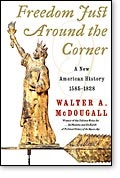
Walter McDougall published Freedom Just Around the Corner 147 years later, almost to the day, and he begins this new history (the first of a promised three volumes) with a summary and discussion of Melville's Confidence-Man. Later in the volume, while discussing the first popular American novelist, James Fenimore Cooper, McDougall observes that every book about America, whether fictional or historical, narrates a drama: perhaps a comedy (in which, after reverses, everything turns out right in the end), or a tragedy, or some mixture of the two. It is the ambiguous Confidence-Man rather than Cooper's redemptive tales that animate McDougall's book. Thankfully, his reviews seem much more promising than Melville's.
Some of those reviews, it must be added, have complained about McDougall's thesis—that the history of America is a history of "hustling," in both the good and the bad sense of that word—and have treated it as an extraneous bit of metaphysics that ill-dresses an otherwise solid history. But though at times it does appear ornamental, this thesis transforms McDougall's book from a well-written collection of information into an arresting reflection on what America is and what it is worth.
Religion plays a large role in McDougall's story. Following Samuel Huntington—"America is not a lie; it is a disappointment. But it can be a disappointment only because it is also a hope"—McDougall explains hustling's energies this way: "Only free people can disappoint and be disappointed by the discovery that worldly ideals cannot be advanced except by worldly means." In the rest of the book, McDougall emphasizes American freedom and the great expectations that wide-open spaces excite. But though a hustler may stare acquisitively at a continent, space alone doesn't create the hustling attitude. The key resides in the hope, in what Max Weber called "worldly ideals," among which freedom finds its place, a goal rather than a condition.
The trick to understanding hustling thus lies in understanding the American fascination with "worldly ideals." Why did the early Americans turn to such ideals—and away from the "other-worldly"? Why do their descendants, from Ben Franklin and Jay Gatsby to the present, continue to pursue them, even after generations of disappointment? What's lost and what's gained in worshiping the world?
McDougall surveys a variety of answers through a vast field of times and trials. He observes James Herrington's early defense of revolution on the basis of "virtue and property." He relates the struggle between "Old" and "New Lights" in 18th-century Congregationalism. He particularly emphasizes the role of George Whitefield in energizing the first Great Awakening by appealing to his listeners' sense of free will: "Liberty under God and before men." Whitefield's listeners, McDougall claims, "were, if only subconsciously, thrusting their clutches skyward to pull down heaven itself—down to America. You can't help but do well and feel good about it, in heaven."
This account of terrestrializing the ideal also decidedly influences McDougall's treatment of the American Revolution. As if to prove his case, he picks what some would see as an unlikely Gospel, Tom Paine's Common Sense. And McDougall's careful reading of the book's conflicts yields surprising results:
Paine's remarkable pamphlet cemented the alliance between the Awakened and the Enlightened, summoned them to a just war, and promised a kind of heaven on earth if they won. That is why some historians miss the point when they denigrate the role of religion in the American rebellion. … The American cause was profoundly religious for Protestants and Deists alike because both identified America's future with a Providential design and both entertained millenarian hopes.
Article continues below
In short, the evangelical attitude provided the spiritual engine for both camps. And, in McDougall's view, this enlightened evangelism continued to hold sway long after the revolution:
Traditional, orthodox Christians thought death a passage from the Church Militant to the Church Expectant. But Americans were already expectant, believing heaven on earth just a matter of time and deeming moral progress, like material progress, a matter of will.
Cooper and others might give progress its tragic due, but even then the shadows throw in relief the brightness of the hope.
Now, one does not have to wait until The Last of the Mohicans to sense the danger of worldly ideals; but in this respect, for all his edginess in making "hustling" his theme, McDougall seems rather coy. He does narrate Cotton Mather's complaint that "Religion brought forth prosperity, and the daughter destroyed the mother." But his treatment of Mather's successors and the Great Awakening proves a bit puzzling. McDougall makes Jonathan Edwards, who deeply criticized libertarianism, a simple proponent of the free will, and he pronounces, "Thus did Edwards sweep away all the Puritan pother about predestination, Arminianism, and Half-Way Covenants." A pretty odd judgment, considering that Edwards (who joyfully embraced predestination and the rest of Calvin's doctrine as a young man) rejected his grandfather Solomon Stoddard's practice of "open communion" and even the "Half-Way Covenant"—with the result that his congregation eventually fired him! Indeed, Edwards and later "Separates" combined evangelism with a strictness about church membership that limited choice rather than celebrated it. Nor, in all the attention he gives to Whitefield's evangelism, does McDougall acknowledge the great impression made by Universalist Hosea Ballou and "New Light" Samuel Hopkins, perhaps because the first preached strict determinism and the latter "disinterested benevolence." Concerns over selfishness, benevolence, and duty occupied center-stage in 18th- and early 19th- century religious discourse, but an indeterminate and unadorned "free will" hardly emerged as the most worthy idol of popular worship until much later.
To some degree, McDougall's understanding of the Puritans and the first Great Awakening seems decidedly influenced by his understanding of the second. But it's a long way from the beginning to the end of this book, as McDougall reveals in this discussion of 1820s and 30s Presbyterian revivalist Charles Finney:
Article continues below
[Finney's] watchword was community, not individualism. Personal sin was not only a blight on one's soul, it was a curse on one's family, neighbors, and nation. Finney defined sin as selfishness pure and simple, challenging men and women to be 'useful in the highest degree possible' and 'make the world a fit place for the imminent return of Christ.' In effect, what Finney called Perfectionism or Religious Ultraism reversed John Winthrop's 'Citee on a Hill' sermon. Winthrop told Puritans that falling back into sin once in America would be an offense against God. Finney told disciples that wallowing in sin once a Christian would be an offense against America, an offense that risked its Providential destiny.
This is a wonderful comparative insight, one that, among other things, makes one realize that later adapters of Winthrop's words—from Abraham Lincoln to Ronald Reagan—consistently speak them more in the spirit of Finney than Winthrop. But it also reveals starkly the transformation: Is America for God, or God for America? And if the latter, how can we reasonably expect to combat the carnality that such men as Edwards, Hopkins, Channing, or Finney sought to repulse, albeit in very different ways? Heaven on earth might mean no escaping man's earthy ways.
For a helpful contrast, return for a moment to Melville's Confidence-Man. Melville never allows his reader to stop wondering who the confidence-man is, or rather, what he is. Is he only a man? Something worse?—Or something better? Thus, for example, in the first line of the book Melville likens him to "Manco Capac at the Lake Titicaca," a pagan god, but a god nonetheless, indeed the greatest god in his pantheon, the sun. This possible deity then changes shape and even color a number of times, but retains for most of the novel the appearance of a "philanthropist," a lover of mankind, whose universal embrace recalls his Titanic predecessor, if not God himself. And then there is this strange being's charmed ability to master every conversation, or the author's identifying him as "Quite an Original" (like the "God of Genesis"). Melville makes his last encounter one with a pious old man whom he likens to "good Simeon," waiting to meet "the Master of Faith." The con-man may then lead this old man into the darkness to take him for all he's worth. Or he just may be a God. Which scenario we choose depends upon who or what we trust. In other words, certain unchosen possibilities frame our every choice. In McDougall's account, the unchosen frame seems to dissolve into the celebration of choice. That may be the case for late 20th-century Americans and their intellectual heirs, but it hardly seems true for much of the rest of the country's history, and, in any event, if true, this lesson would undercut the "disappointment" that McDougall rightly diagnoses as a constant spur to American hustling.
Article continues below
To put this same problem a different way, early in his book McDougall emphasizes that American English contains well over 100 words that connote a swindle. But he then proceeds to try fit American history into one (albeit flexible) word, "to hustle." If one has the words, why not use them? After all, there seems a real difference between hustle and such words as cream, milk, and salt (on the one hand) and ream, shaft, defraud, and victimize (on the other). To embrace Edwards and Finney, Washington and Burr under the term "hustler" denudes that word of much meaning besides "energetic" or even "alive." Also, it means cramming the varieties of vice within a narrow compass that may look rather harmless, and hence distort vice's true shape. So, for example, McDougall describes Francis Cabot Lowell's mills without mentioning his family's privateering. He treats Stephen Girard—a voracious and atheistic merchant who found his start in fraud and directed the notoriously corrupt United States Bank—as a hard-working patriot. He nary mentions John Jacob Astor's lawless treatment of Indians (and whites) in the American west, nor his and others' bribing of New York City for the land grants that propelled their fortunes. And even Cornelius Vanderbilt appears as Supreme Court-blessed friend of competition and opponent of monopolies. These men all may have been agents of "creative corruption" as McDougall calls it. But to see only the creativity (the ends) and ignore the corruption (the means) hardly does justice to reality.
Melville himself comments in The Confidence-Man that "in new countries, where the wolves are killed off, the foxes increase." As numberless children's books make clear, foxes have their charms. But they cannot be the only denizens of the forest. To say nothing of their woodland prey, there are nobler beasts out there: men and even perhaps (to some tastes) the odd wolf. If McDougall (unlike Melville) continues his promised masquerade, he may do well to reflect further on the riches in the story that he has chosen for his guide. As in reading American history, the more one reads The Confidence-Man, the more varied the Mississippi travelers upon the Fidele appear. There are would-be con-men who fail in interesting ways. There are seemingly decent folk, whose desires for gain get the better of them. There are even people who want so little that they cannot be conned. And, contrasted with all these types, the confidence-man himself deepens in his mystery. He could be a god. He could be a man. Or he could be a devil, who tempts others and destroys them, precisely by appeal to their "worldly ideals."
Article continues below
Albert Keith Whitaker is Research Fellow at Boston College's Center on Wealth and Philanthropy and a Planner/Specialist at Tanager Financial Services. He can be reached at whitakal@bc.edu.












 While we pray for peace, we need moral clarity about this war.
 A Christian reconciliation group in Israel and Palestine warned that war would come. Now the war threatens their relevance.españolالعربيةFrançaisрусскийУкраїнська
 The rage of the mob is a poor substitute for real community.





