



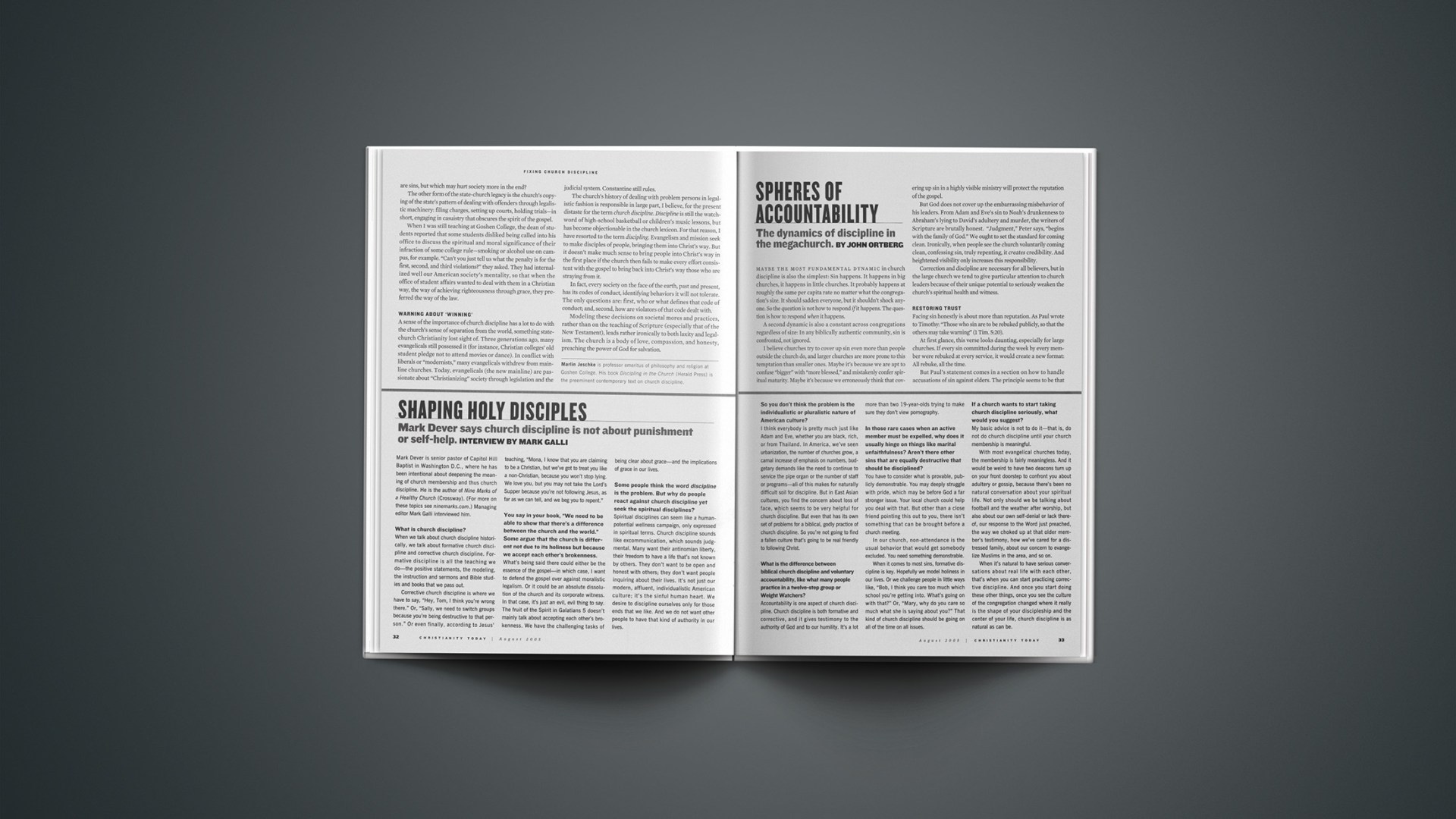
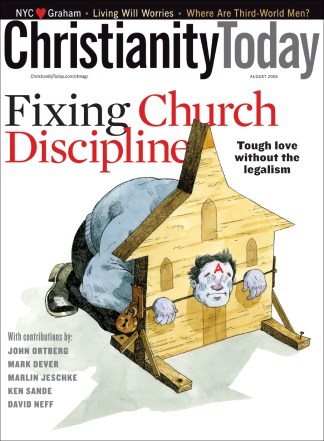
The Protestant reformers named three “marks by which the true church is known”: the preaching of the pure doctrine of the gospel, the pure administration of the sacraments, and the exercise of church discipline to correct faults. Today, church discipline is feared as the mark of a false church, bringing to mind images of witch trials, scarlet letters, public humiliations, and damning excommunications. Does discipline itself need correction and redemption in order to be readmitted into the body of Christ? We have asked several experts from different (and sometimes contrasting) professional and theological backgrounds to explain how church discipline fell into disrepair and how it can be revived, so that the true church can fully embody the pure doctrine of the gospel once again.
Day One | Day Two | Day Three | Day Four | Day Five | Day Six
Mark Dever is senior pastor of Capitol Hill Baptist in Washington D.C., where he has been intentional about deepening the meaning of church membership and thus church discipline. He is the author of Nine Marks of a Healthy Church (Crossway). (For more on these topics see ninemarks.com.) Managing editor Mark Galli interviewed him.
What is church discipline?
When we talk about church discipline historically, we talk about formative church discipline and corrective church discipline. Formative discipline is all the teaching we do—the positive statements, the modeling, the instruction and sermons and Bible studies and books that we pass out.
Corrective church discipline is where we have to say, “Hey, Tom, I think you’re wrong there.” Or, “Sally, we need to switch groups because you’re being destructive to that person.” Or even finally, according to Jesus’ teaching, “Mona, I know that you are claiming to be a Christian, but we’ve got to treat you like a non-Christian, because you won’t stop lying. We love you, but you may not take the Lord’s Supper because you’re not following Jesus, as far as we can tell, and we beg you to repent.”
You say in your book, “We need to be able to show that there’s a difference between the church and the world.” Some argue that the church is different not due to its holiness but because we accept each other’s brokenness.
What’s being said there could either be the essence of the gospel—in which case, I want to defend the gospel over against moralistic legalism. Or it could be an absolute dissolution of the church and its corporate witness. In that case, it’s just an evil, evil thing to say. The fruit of the Spirit in Galatians 5 doesn’t mainly talk about accepting each other’s brokenness. We have the challenging tasks of being clear about grace—and the implications of grace in our lives.
Some people think the word discipline is the problem. But why do people react against church discipline yet seek the spiritual disciplines?
Spiritual disciplines can seem like a human-potential wellness campaign, only expressed in spiritual terms. Church discipline sounds like excommunication, which sounds judgmental. Many want their antinomian liberty, their freedom to have a life that’s not known by others. They don’t want to be open and honest with others; they don’t want people inquiring about their lives. It’s not just our modern, affluent, individualistic American culture; it’s the sinful human heart. We desire to discipline ourselves only for those ends that we like. And we do not want other people to have that kind of authority in our lives.
So you don’t think the problem is the individualistic or pluralistic nature of American culture?
I think everybody is pretty much just like Adam and Eve, whether you are black, rich, or from Thailand. In America, we’ve seen urbanization, the number of churches grow, a carnal increase of emphasis on numbers, budgetary demands like the need to continue to service the pipe organ or the number of staff or programs—all of this makes for naturally difficult soil for discipline. But in East Asian cultures, you find the concern about loss of face, which seems to be very helpful for church discipline. But even that has its own set of problems for a biblical, godly practice of church discipline. So you’re not going to find a fallen culture that’s going to be real friendly to following Christ.
What is the difference between biblical church discipline and voluntary accountability, like what many people practice in a twelve-step group or Weight Watchers?
Accountability is one aspect of church discipline. Church discipline is both formative and corrective, and it gives testimony to the authority of God and to our humility. It’s a lot more than two 19-year-olds trying to make sure they don’t view pornography.
In those rare cases when an active member must be expelled, why does it usually hinge on things like marital unfaithfulness? Aren’t there other sins that are equally destructive that should be disciplined?
You have to consider what is provable, publicly demonstrable. You may deeply struggle with pride, which may be before God a far stronger issue. Your local church could help you deal with that. But other than a close friend pointing this out to you, there isn’t something that can be brought before a church meeting.
In our church, non-attendance is the usual behavior that would get somebody excluded. You need something demonstrable.
When it comes to most sins, formative discipline is key. Hopefully we model holiness in our lives. Or we challenge people in little ways like, “Bob, I think you care too much which school you’re getting into. What’s going on with that?” Or, “Mary, why do you care so much what she is saying about you?” That kind of church discipline should be going on all of the time on all issues.
If a church wants to start taking church discipline seriously, what would you suggest?
My basic advice is not to do it—that is, do not do church discipline until your church membership is meaningful.
With most evangelical churches today, the membership is fairly meaningless. And it would be weird to have two deacons turn up on your front doorstep to confront you about adultery or gossip, because there’s been no natural conversation about your spiritual life. Not only should we be talking about football and the weather after worship, but also about our own self-denial or lack thereof, our response to the Word just preached, the way we choked up at that older member’s testimony, how we’ve cared for a distressed family, about our concern to evangelize Muslims in the area, and so on.
When it’s natural to have serious conversations about real life with each other, that’s when you can start practicing corrective discipline. And once you start doing these other things, once you see the culture of the congregation changed where it really is the shape of your discipleship and the center of your life, church discipline is as natural as can be.
Copyright © 2005 Christianity Today. Click for reprint information.
Related Elsewhere:
Previous articles in this series include:
How Discipline Died | The church should stop taking its cues from the state.
Mark Dever’s Nine Marks site has a section on church discipline.
More articles on church discipline or the need for it from CT includes:
To Judge, or Not to Judge | Christ commanded us not to judge others, but aren’t there times when common sense or prudence requires it? (June 29, 2005)
The Evangelical Scandal | Ron Sider says the movement is riddled with hypocrisy, and that it’s time for serious change. (April 13, 2005)
Canterbury Crackup | Eschewing church discipline has come back to haunt Anglicans. A Christianity Today editorial (Dec. 03, 2004)
Weblog: Debates on Debates on Church Discipline | Catholic bishops will issue statement on Communion as a Matthew 18 lawsuit is reinstated against a Texas Bible church. (June 18, 2004)
Articles from our sister publication, Leadership Journal, include:
Taking Church Membership Seriously | Why it’s time to raise the bar. (April 18, 2005)
Church Discipline Really Works (pt. 1) | When you make it loving and redemptive. (Jan. 24, 2005)
Church Discipline Really Works (pt. 2) | How to find courage (and avoid lawsuits) when confronting sinning believers. (Jan. 31, 2005)
Albert Mohler, president of Southern Theological Seminary, wrote a series on church disciple. It is available on his website:
Should a Church Discipline Members Over Politics? | None of us wants to see churches identified as “Republican Baptists” and “Democratic Baptists.” Such partisan identifications violate the autonomy of the church as the Body of Christ.
Mohler also covered this topic on his radio show.
The Disappearance of Church Discipline—How Can We Recover? Part One | The decline of church discipline is perhaps the most visible failure of the contemporary church.
The Disappearance of Church Discipline—How Can We Recover? Part Two | The disappearance of church discipline has weakened the church and compromised Christian witness.
The Disappearance of Church Discipline—How Can We Recover? Part Three | Spiritual leaders of the church are to confront a sinning member with a spirit of humility and gentleness, and with the goal of restoration.
The Disappearance of Church Discipline—How Can We Recover? Part Four | When should the church exercise church discipline?