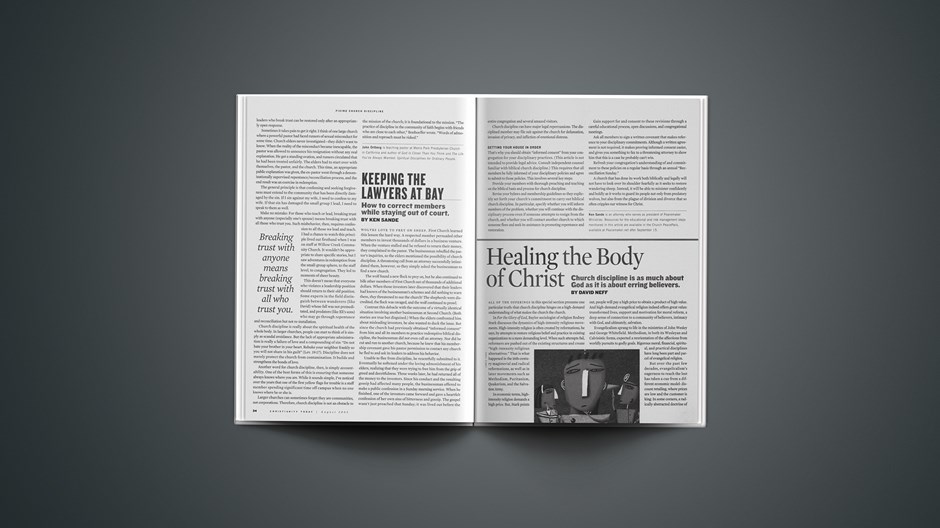
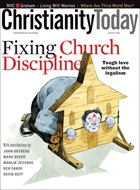
The Protestant reformers named three "marks by which the true church is known": the preaching of the pure doctrine of the gospel, the pure administration of the sacraments, and the exercise of church discipline to correct faults. Today, church discipline is feared as the mark of a false church, bringing to mind images of witch trials, scarlet letters, public humiliations, and damning excommunications. Does discipline itself need correction and redemption in order to be readmitted into the body of Christ? We have asked several experts from different (and sometimes contrasting) professional and theological backgrounds to explain how church discipline fell into disrepair and how it can be revived, so that the true church can fully embody the pure doctrine of the gospel once again.
All of the offerings in this special section presume one particular truth: that church discipline hinges on a high-demand understanding of what makes the church the church.
In For the Glory of God, Baylor sociologist of religion Rodney Stark discusses the dynamics of high-intensity religious movements. High-intensity religion is often created by reformations, he says, by attempts to restore religious belief and practice in existing organizations to a more demanding level. When such attempts fail, reformers are pushed out of the existing structures and create "high-intensity religious alternatives." That is what happened in the 16th-century magisterial and radical reformations, as well as in later movements such as Methodism, Puritanism, Quakerism, and the Salvation Army.
In economic terms, high-intensity religion demands a high price. But, Stark points out, people will pay a high price to obtain a product of high value. And high-demand evangelical religion indeed offers great value: transformed lives, support and motivation for moral reform, a deep sense of connection to a community of believers, intimacy with God, and ultimately, salvation.
Evangelicalism sprang to life in the ministries of John Wesley and George Whitefield. Methodism, in both its Wesleyan and Calvinistic forms, expected a reorientation of the affections from worldly pursuits to godly goals. Rigorous moral, financial, spiritual, and practical disciplines have long been part and parcel of evangelical religion.
But over the past few decades, evangelicalism's eagerness to reach the lost has taken a cue from a different economic model: discount retailing, where prices are low and the customer is king. In some corners, a radically abstracted doctrine of justification by faith has been used to marginalize any concern for renewed and reoriented lives. Dietrich Bonhoeffer called this "cheap grace."
In the beginning, things were not so. The religion of Yahweh was distinct from other religions of the ancient Near East because it emphasized the ethical imitation of its god: "Be holy, because I am holy" (Lev. 11:44, CF. Lev. 19:2, 1 Pet. 1:15-16). The prophet Moses taught that choosing and living the right and good leads to health for individuals, families, and society. Choosing the wrong and corrupt leads to death. These themes run through the final chapters of Deuteronomy and come to a climax in 30:15ff: "See, I set before you today life and prosperity, death and destruction. … This day I call heaven and earth as witnesses against you that I have set before you life and death, blessings and curses. Now choose life…"
The followers of Jesus understood their calling in similar terms. They called their movement "The Way." And The Teaching of the Twelve Apostles, one of the earliest and most highly esteemed Christian documents that almost made it into the New Testament (and written while some of the apostles were still alive), begins, "There are two ways, one of life and one of death, but a great difference between the two ways." The book goes on to exhort readers to love God and neighbor, forgive enemies, and avoid adultery, fornication, and idolatry.
Reconciling the Brother
This early ethical focus arose from the theological. God's saving action brought with it the demand that our lives mirror his character. Church discipline was (and is) one of the key ways of manifesting the intersection of the horizontal and vertical dimensions of our faith.
The classic text for discussing church discipline is Matthew 18:15-20. Despite the way we often use the text, it is not about procedure. Jesus is teaching first about reconciliation between "brothers"—that is, fellow followers of Jesus. "If your brother sins against you," Jesus begins, "go and show him his fault, just between the two of you. If he listens to you, you have won your brother over." Reconciliation is the goal. The church gets involved only when the offending brother refuses to reconcile. And if that brother remains unrepentant, the church should "treat him as you would a pagan or a tax collector."
Though the focus is on the horizontal, Matthew does not omit the vertical dimension. For Jesus concludes by saying, "Whatever you bind on earth will be bound in heaven, and whatever you loose on earth will be loosed in heaven." God affirms the results of both failure and success in reconciliation. (Heaven was often used as a metonym for God.)
Article continues below
Likewise, when in the same chapter Jesus tells Peter to forgive "seventy times seven," seemingly without limit, he adds a warning in the form of a parable. He tells about a servant who begged his king to cancel his debts, but who then turned around and threw another man who owed him money into debtor's prison. "This is how my heavenly Father will treat each of you," Jesus said, "unless you forgive your brother from your heart." This is a matter of simple congruity: Receiving forgiveness from God requires giving forgiveness to brothers and sisters.
We see the vertical and the horizontal intersect in Romans 6, as well. Paul categorically rejects the idea that God's grace abounding unto sinners means that we may continue in sin. "By no means!" he exclaims. To continue in sin would be incongruous.
He writes in startling terms: "We have been buried with [Christ] by baptism into death, so that just as Christ was raised from the dead by the glory of the Father, so we too might walk in newness of life." He goes on to unpack these ideas: Our old selves were crucified so that we might be freed from our enslavement to sin and made alive to God, just as the resurrected Christ is alive to God. We no longer "present our members as slaves to impurity and to greater and greater iniquity," but we "now present [our] members as slaves to righteousness for sanctification."
The Divine Family
All of this turns on the idea that we are "in Christ." We are made "alive to God in Christ Jesus." In 1 Corinthians 15, Paul teaches us to think of Christ as the second Adam, that is, the head of a new human race. And as reborn people, we belong to that new humanity of which Christ Jesus is the head.
So when we talk about the church, we are not talking about a voluntary society of people who share compatible religious views or similar religious experiences. We are instead talking about those who are related by (re)birth into a new family. We are talking about the body parts of Christ. Our relationships to each other (the horizontal) do not exist apart from our relationship with God in Christ (the vertical). Indeed, it is our vertical relationship with Christ that makes possible our horizontal relationships with each other. The vertical constitutes the horizontal.
Article continues below
Now we are ready to understand why alienation and sin in the church must be dealt with, why accountability is essential, why reconciliation is not optional. It is inconceivable that Christ should be at war with himself. Alienation between followers of Jesus is tantamount to slicing open the body of Christ. Reconciliation between followers is the healing of that wound.
It is also inconceivable that Christ should sin. That is why Paul recommends that a flagrant sinner be separated from the church and handed over to Satan "so that the sinful nature may be destroyed and his spirit saved on the day of the Lord" (1 Cor. 5:5). Christ cannot ignore the sin or division in his body any more than you or I can ignore a growing, cancerous tumor.
Then again, reconciliation between followers or restoration of a sinner is as if a wound is healed, a cancer cured, and full health and vitality restored to the body, Christ's body.
Albert Mohler, president of Southern Theological Seminary, wrote a series on church disciple. It is available on his website:
Should a Church Discipline Members Over Politics? | None of us wants to see churches identified as "Republican Baptists" and "Democratic Baptists." Such partisan identifications violate the autonomy of the church as the Body of Christ. Mohler also covered this topic on his radio show.

















 While we pray for peace, we need moral clarity about this war.
 We’ve got little information on Jesus’ appearance and personality. But that’s the way God designed it.españolFrançais
 How groups like Hillsong learned to let go of the literal in favor of creative collaboration.españolPortuguês






