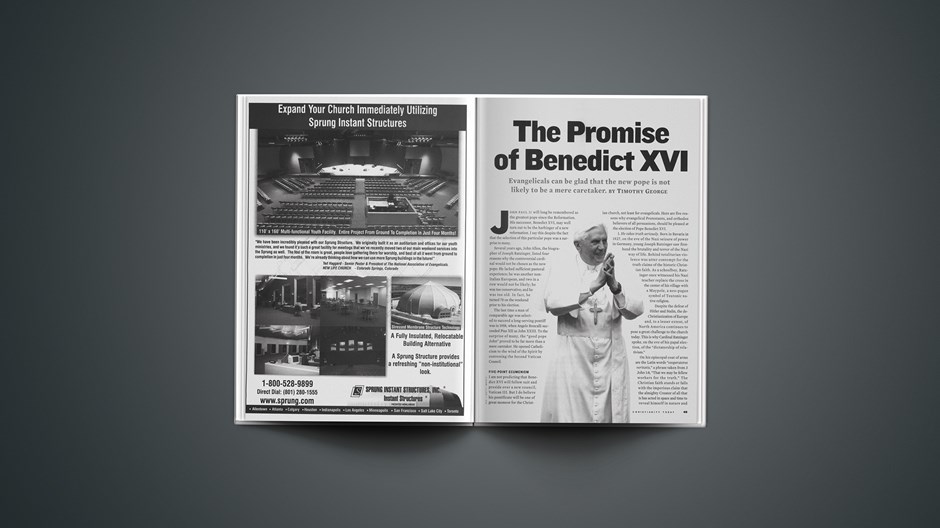
John Paul II will long be remembered as the greatest pope since the Reformation. His successor, Benedict XVI, may well turn out to be the harbinger of a new reformation. I say this despite the fact that the selection of this particular pope was a surprise to many.
Several years ago, John Allen, the biographer of Joseph Ratzinger, listed four reasons why the controversial cardinal would not be chosen as the new pope: He lacked sufficient pastoral experience; he was another non-Italian European, and two in a row would not be likely; he was too conservative; and he was too old. In fact, he turned 78 on the weekend prior to his election.
The last time a man of comparable age was selected to succeed a long-serving pontiff was in 1958, when Angelo Roncalli succeeded Pius XII as John XXIII. To the surprise of many, the "good pope John" proved to be far more than a mere caretaker. He opened Catholicism to the wind of the Spirit by convening the Second Vatican Council.
Five-Point Ecumenism
I am not predicting that Benedict XVI will follow suit and preside over a new council, Vatican III. But I do believe his pontificate will be one of great moment for the Christian church, not least for evangelicals. Here are five reasons why evangelical Protestants, and orthodox believers of all persuasions, should be pleased at the election of Pope Benedict XVI.
1. He takes truth seriously. Born in Bavaria in 1927, on the eve of the Nazi seizure of power in Germany, young Joseph Ratzinger saw firsthand the brutality and terror of the Nazi way of life. Behind totalitarian violence was utter contempt for the truth claims of the historic Christian faith. As a schoolboy, Ratzinger once witnessed his Nazi teacher replace the cross in the center of his village with a Maypole, a neo-pagan symbol of Teutonic native religion.
Despite the defeat of Hitler and Stalin, the de-Christianization of Europe and, to a lesser extent, of North America continues to pose a great challenge to the church today. This is why Cardinal Ratzinger spoke, on the eve of his papal election, of the "dictatorship of relativism."
On his episcopal coat of arms are the Latin words "cooperatores veritatis," a phrase taken from 3 John 1:8, "That we may be fellow workers for the truth." The Christian faith stands or falls with the imperious claim that the almighty Creator of all that is has acted in space and time to reveal himself in nature and history and to redeem the world through the death and resurrection of Jesus Christ. This is a statement about the way things are, not merely about what is "true for me." Although Simone Weil never received Christian baptism, I believe the new pope would agree with her statement that "Christ likes us to prefer truth to him because, before being Christ, he is truth. If one turns aside from him to go toward the truth, one will not go far before falling into his arms."
2. His theology is Bible-focused. As a young theologian in his early 30s, Ratzinger played a pivotal role at Vatican II. This council declared that "easy access to sacred Scripture should be provided for all the Christian faithful." This "trend to the Bible" has continued to enrich Catholic devotional life and has allowed many Roman Catholics and evangelical believers to find common ground in reading and studying the Bible together. Benedict XVI's theological work is marked by an evident love and devotion to the Scriptures. "Exegesis," he has said, "has always remained for me the center of my theological work." While serious issues related to Scripture and tradition remain to be resolved, we can rejoice that this new pope honors the Bible as the divinely inspired and authoritative written revelation of God.
3. His message is Christocentric. As prefect of the Congregation for the Doctrine of the Faith, Ratzinger was widely criticized for his statement Dominus Iesus, released in 2000, because of its alleged anti-ecumenical claims. However, the main point of the document was the clear assertion that Jesus Christ was the divine Son of God and the only Redeemer of the world. While evangelicals and Roman Catholics have very different understandings of church life, the ministry, and sacraments, we stand together with the new pope in his unambiguous commitment to the Trinitarian and Christological faith of the Bible and the early church.
4. He is Augustinian in perspective. As a young theologian, Ratzinger delved deeply into Confessions and other writings of Augustine. "I have developed my theology in a dialogue with Augustine," he admits. As a doctoral student, his major research project was on the great medieval Augustinian, Bonaventura, whose theology he found more agreeable than that of Thomas Aquinas. This Augustinian orientation has made the new pope more sensitive to issues of spirituality in the life of faith. It has also given him a keen appreciation for another great German theologian, the Augustinian monk and church reformer Martin Luther. This enabled Ratzinger to play a key role in the historic Joint Declaration on the Doctrine of Justification, an important agreement between Lutherans and Roman Catholics.
Article continues below
5. He champions the culture of life. On many of the pressing moral issues of the day, Benedict XVI will continue to support "the culture of life," a phrase coined by his predecessor to call Christians to stand and work together for the sanctity of human life, the sacredness of marriage bonds, and social justice for all persons made in the image of God. "A society without God will eventually destroy itself," he has said.
John Paul II was trained as a philosopher, but Benedict XVI is a theologian par excellence. He has spoken of "the ecclesial vocation of the theologian," emphasizing the fact that theology should be done in the service of the church, not as a freelance activity addressed and accountable only to the academic guild.
Without sacrificing the proper role of academic freedom and open inquiry, evangelicals can learn a lot about the importance of doing theology in the great tradition of "faith seeking understanding." Protestant liberals and Catholic progressives frequently share a common disdain for "the simple believers," the ones Benedict is so concerned to support and defend against secular ideologies, whether they come in theological garb or not.
Worship and Evangelism
On other matters, Benedict may move in some unexpected directions. Those who want women admitted to the Catholic priesthood will have to wait for another pope. However, Benedict may well expand the role of women in the life and even leadership of the church, in keeping with John Paul II's emphasis on the dignity and giftedness of women of faith. Also, the issue of required clerical celibacy could be revisited. As Luther and other reformers pointed out in the 16th century, the practice of not allowing priests to get married was a medieval invention—a matter of church discipline, not apostolic doctrine. Faced by dwindling seminary enrollments and an acute shortage of priests in many places, this issue may come to the fore sooner than expected.
Benedict has indicated that one of the major concerns of his pontificate will be the unity of all Christians. While evangelicals and Roman Catholics share much, there are also major flashpoints of conflict, especially in Africa and Latin America, where both communities of faith are thriving—and often competing for the same souls. As a professor at Tübingen during the turbulent '60s, Ratzinger forged an alliance with Peter Beyerhaus and other evangelical leaders to stand together against the forces of unchecked secularism and unbelief.
Article continues below
"We saw," Benedict said, "that the confessional controversies we had previously engaged in were small indeed in the face of the challenge we now confronted, which put us in a position of having, together, to bear witness to our common faith in the living God and in Christ, the incarnate Word." Though the battlefronts have shifted, the same kind of cooperation between faithful evangelicals and believing Roman Catholics is no less urgent today.
Roman Catholicism is not a cult, and the pope is not the Antichrist. Just so, evangelicals are not a sect, and the gospel call for all people to repent and turn to Jesus is not proselytism. When we come closer to Christ, we come closer to one another, and such stereotypes are overcome. Though he does not often quote John Calvin, I believe Benedict would agree with these words from the great Protestant pastor about the way we express our common Christian convictions: "That we acknowledge no unity except in Christ; no charity of which he is not the bond, and that, therefore, the chief point in preserving charity is to maintain faith, sacred and entire."
Why was the papal name of Benedict chosen? Benedict XV, who was pope from 1914 to 1922, tried unsuccessfully to bring peace to the warring nations of Europe. No doubt the new pope will seek to be a peacemaker as well. He will face a new and virulent challenge with the rise of militant Islam. But I rather think the pope had in mind two earlier Benedicts in the history of the church.
Benedict of Aniane was a monastic reformer who lived at the time of Charlemagne. He brought beauty and order to the worship of God, providing a system of liturgical prayer for the Christians of Europe during the so-called Dark Ages. The prayer life of the church sustained Christians, and kept the light of faith burning when Rome was in ashes and memories of the saints and martyrs grew dim.
Benedict of Aniane was building upon the work of an even earlier Benedict, Benedict of Nursia, the founder of Western monasticism. His rule for living together in Christian community is still followed by many monks today. Benedict of Nursia was known for his kindness, charity, and humility—well-attested traits of the present pope as well.
But the movement he began fanned out across Europe, as Benedictine monks carried the Bible and message of Christ to the most pagan corners of Europe. These two themes—the renewal of the church through the worship of God, and the evangelization of the world through the power of the gospel—may well mark the legacy of this present pontificate: a new Benedictine moment in the history of the church.
Timothy George is dean of Beeson Divinity School of Samford University and an executive editor of CT.















 While we pray for peace, we need moral clarity about this war.
 A Christian reconciliation group in Israel and Palestine warned that war would come. Now the war threatens their relevance.españolالعربيةFrançaisрусскийУкраїнська
 The rage of the mob is a poor substitute for real community.






