Fresh help for Africa is on the way. When evangelicals joined U2's Bono this past summer in lobbying the political leaders of the world's richest nations for more trade, aid, and debt relief for Africa, the movement's heavy hitters signed on: John Stott, Billy Graham, and Rick Warren.
Jesus said, "The poor you will always have with you" (Matt. 26:11a). But he might also have cited corruption as another ever-present human condition. In Africa, neither the poor nor the corrupt have been transformed by the $1 trillion in foreign assistance poured over the last 50 years on that continent of 57 nations with 11.7 million square miles of land and 906 million people.
An International Monetary Fund (IMF) study released in June, shortly before the Group of 8 summit, found that there is no correlation between aid and prosperity in sub-Saharan Africa.
But in September at the United Nations in New York City, Bread for the World, the One Campaign, and Bono's DATA organization were scheduled to pool their advocacy resources to keep global poverty on the front burner of policymakers. Top government leaders would be examining the so-called Millennium Development Goals.
This broad-brush, eight-point program aims to eradicate poverty, achieve universal primary education, promote gender equality, reduce child mortality, improve maternal health, fight killer diseases, protect the environment, and partner globally for economic development.
The focal point is Africa. But the tragic reality of Africa's history is that help from the outside often doesn't. Will billions of dollars of new help, promised by the world's wealthiest nations, make a difference or make things worse?
William Easterly, a disaffected former World Bank economist, has nothing but doubts and lots of examples of rosy projections that were dreadfully wrong. In the central African nation of Zambia, heavily evangelized by Christians for decades, one such forecast predicted the nation would have a per capita income of $20,000 at this point in its history.
Instead, Zambians languish at an average of $500 per year. The country is as poor and corrupt as ever.
Nigeria is even more shocking. Awash in billions of oil and gas dollars and $3.5 billion in aid between 1980 and 2000, Nigeria remains a field of destitution, with open sewers, foul tap water, garbage-strewn roads, tribal violence, and corruption in both state and church. One former general stole $20 billion from government coffers, according to testimony before the U.S. Senate. In the central Nigerian city of Jos, Anglican Bishop Benjamin Kwashi told Christianity Today, "The only way the church can stamp out corruption is to begin from within. In our diocese, we are mercilessly insisting on accountability to the last penny."
Also, Westerners have been trying to fix West Africa's Sierra Leone since the early days of independence in 1961. Today, Sierra Leone's teachers routinely go for months without salaries, which officials have stolen. One big batch of medicine was imported at the rate of a $1 bribe for each $1 of medicine.
Fundamental change in Africa, experts say, is going to take more time, talent, and treasure than anyone can possibly imagine.
Three-Pronged Attack
That enormous challenge doesn't seem to discourage this new coalition of Christians. Rock star Bono has issued a public challenge to Christians: "If the church doesn't respond to the plagues afflicting Africa, who will?"
The presence of evangelicals in the fight against global poverty, many note, brings fresh talent and resources to the table, which are being noticed in high places.
Advisers to British Prime Minister Tony Blair's Africa commission wrote, "From the start, ideas about development generally overlooked the role of religion … in Africa." However, "Africa's development in the 21st century will be shaped largely by religion."
The One Campaign is an outgrowth of Bono's successful 2002 Heart of America tour that took him to Wheaton College, among other places. The One Campaign takes its name from its goal for the United States to spend an additional 1 percent of the federal budget on non-military overseas aid. Right now, non-military overseas aid represents about 0.75 percent of the federal budget. The goal is 1.75 percent.
At June's G8 meeting, the antipoverty campaigners won commitments to wipe out $40 billion of debt for 18 nations, alongside promises of more aid. In coming months, there will be renewed focus on these three areas:
1. More debt relief. Most poor nations are unable to pay back decades-old debts. These debts prevent governments from funding education, building new roads, or improving drinking water supplies. If bad debts are forgiven, the argument goes, the countries gain a fresh start and will borrow money more wisely and use it better.
For example, in exchange for $6 billion of debt relief, Zambian officials promised that they will no longer imprudently take out loans. However, in August the finance minister told Zambia's parliament that the nation is now out from under tight loan restrictions. This speech hints at trouble ahead if more borrowing is done recklessly.
Article continues below
2. New aid. Loans are not enough to jump-start all African economies. Economist Jeffrey Sachs, a Bono adviser, says new aid will help poor African countries escape the "poverty trap," moving their economies from subsistence to prosperity with carefully targeted grants.
"In many places in rural Africa," Sachs said, "the farm households live pretty much in economic isolation. There are no roads to the villages."
The massive new aid for medical relief is the easiest to deliver and has immediate impact. The typical rate of infant mortality in the richest one-fifth of countries is four out of every 1,000 births. In the poorest one-fifth of countries it is 200 out of every 1,000 births. Mali is one of the poorest nations on earth, and 41 percent of its children do not live past age five.
3. Fairer trade. Many think the long-term answer is freer trade between rich and poor nations. African farmers are shut out of many export markets because of farm subsidies in the United States and Europe. Developed nations also limit the import of refined goods. Africa can export raw cotton, cocoa, and coffee to America, but faces high tariffs if those goods are processed.
Continent-wide Corruption
Despite evangelical enthusiasm, critics say that corruption will undermine all these new efforts.
After British forces saved Sierra Leone from the terror of machete-hacking rulers, they took nearly full control of the country. Today, England is the largest donor to the nation. But corruption is so rife that 95 percent of donated medicine is stolen. A satire on corrupt, greedy officials, the song "Fat Belly Boys" ("Bor Bor Belleh") is popular on radio broadcasts.
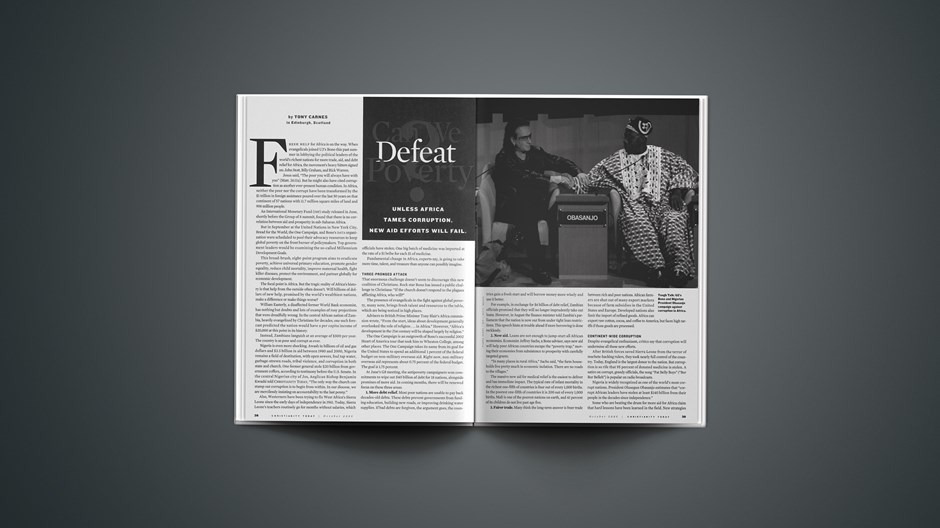
Nigeria is widely recognized as one of the world's most corrupt nations. President Olusegun Obasanjo estimates that "corrupt African leaders have stolen at least $140 billion from their people in the decades since independence."
Some who are beating the drum for more aid for Africa claim that hard lessons have been learned in the field. New strategies will help in beating corruption. Others question that optimism.
A favorite sermon topic in Africa's churches is the story of Jezebel and Ahab stealing Naboth's vineyard (1 Kings 21). Philip Jenkins, who is preparing a book on the use of the Bible in the global south, says, "I could write a whole book just on the African sermons on this story." African Christians preach a lot about corruption. Solutions have been slow to come.
Article continues below
Take one example. If any place in Africa could benefit from American evangelical efforts, Zambia would seem to be it. The English-speaking country has a vast number of evangelicals and a constitution that states it is "a Christian nation." World Vision has made Zambia the focus of a national relief plan. Other mission groups like Opportunity International and African Inland Mission have also been very active.
In 2001, the evangelical Christian president of Zambia, Frederick Chiluba, left office after two terms. He now faces criminal prosecution for corruption in Zambia. In a civil court, authorities in Europe have frozen $23 million of his allegedly ill-gotten gains that Zambia hopes to recover. Perceptions of corruption in Zambia also extend downward. A 2005 survey of residents in Lusaka, Zambia, found that they ranked their own police force as the nation's most corrupt institution.
What is the reason for the failure of Christians to end corruption, maintain good government, and reduce poverty in Africa? Certainly, one reason is that Christians tend to individualize the issue.
Paul Freston, an authority on Christian politics around the world, says, "The failures [in fighting corruption] are attributed by African preachers to personal failures. They also claim that because the politicians had distanced themselves from church leaders, they fell into corruption."
Freston also says that the churches actually lay the groundwork for failure by never openly dealing with corruption in their midst. "You have scandals of running churches. They are small scandals in small closed worlds with authoritarian leaders. So they are not seen."
The Christian public never learns how to deal with a corrupt leader except to either go along with his cover-up or angrily leave him for another leader who more often than not practices the same methods that allowed the problem to flourish in the first place.
When a Christian becomes a high official, he or she follows a pattern of anticorruption rhetoric, followed by tolerance of corruption. It's not that the official has suddenly become corrupt. In fact, the official endures tremendous social pressure-now that he has become "successful"-to help his family and friends with the fruit of his power and prestige. Clan, tribal, and family ties make prosecution of corruption in Africa difficult. Political patronage systems share jobs and contracts with insiders. Many African nations need stronger and more independent judges and more aggressive prosecutors.
Article continues below
Hope, Not Optimism
Despite their massive problems, African nations are growing economically. Urban Africa is sprouting skylines like never before. Overall growth of gross national income for 2005 is expected to be 5.4 percent.
In addition, African Christians are integrating faith and politics in new ways. Thirty years ago, Africa had only three elected heads of state. Today there are 30. In democratic states like Nigeria, South Africa, Kenya, and Zambia, corrupt officials are thrown out, often after massive church agitation.
In his autobiography, Nigeria's Obasanjo recalls how the Holy Spirit came to him while he was jailed as a political prisoner. The Spirit convicted him that he would be elected president to fight corruption. (A U.S. Department of State official points out that Zambia's Chiluba proclaimed a similar dream years ago.)
But Obasanjo has partly backed up his words by becoming a founding supporter of the anticorruption organization Transparency International and appointing a feisty anticorruption czar. Recently, the Nigerian government fired the housing minister and arrested the education minister and police inspector general-all for corruption.
World Bank president Paul Wolfowitz told ct that he saw a harbinger of a new era in South Africa when President Thabo Mbeki approved of the arrest and trial of his closest political associate for corruption.
Small steps for Africa, to be sure, but they may turn into giant leaps for the continent. But unless this dimension of poverty is dealt with, the admirable efforts of a new crop of evangelicals will be for naught.
Tony Carnes is a senior writer for Christianity Today. Additional reporting by Deann Alford in Jos, Nigeria.
Bono's American Prayer | The world's biggest rock star tours the heartland, talking more openly about his faith as he recruits Christians in the fight against AIDS in Africa. (Feb. 21, 2003)
Bono's Thin Ecclesiology | Any person can stand outside the church and critique its obedience to the gospel. A Christianity Today editorial (Feb. 21, 2003)
Article continues below
Previous CT coverage of development in Africa includes:
Jesus at G8 | Christian advocacy for Africa gains notice at top meetings. (July 6, 2005)
Raising the Compassion Bar | How 575 suburban teens underwrote a medical clinic, schoolhouse, and a year's supply of food for a village in Zambia—with money to spare. (Aug. 10, 2005)
One African Nation Under God | Zambia is missionary David Livingstone's greatest legacy. But this Christian nation isn't always heaven on earth. (February 4, 2002)
Other Christianity Today articles on combating corruption include:
Church Leaders Refocus on Ethics | For the past two years, Nigeria has ranked as the world's most corrupt place to do business, according to an independent survey of global business executives. But recently, thousands of church leaders gathered to take aim at the country's corruption problems and agreed to stop shifting blame to political leaders for society's problems. (March 2, 1998)
Have something to add about this? See something we missed? Share your feedback here.
Our digital archives are a work in progress. Let us know if corrections need to be made.















 While we pray for peace, we need moral clarity about this war.
 A Christian reconciliation group in Israel and Palestine warned that war would come. Now the war threatens their relevance.españolالعربيةFrançaisрусскийУкраїнська
 How groups like Hillsong learned to let go of the literal in favor of creative collaboration.españolPortuguês






