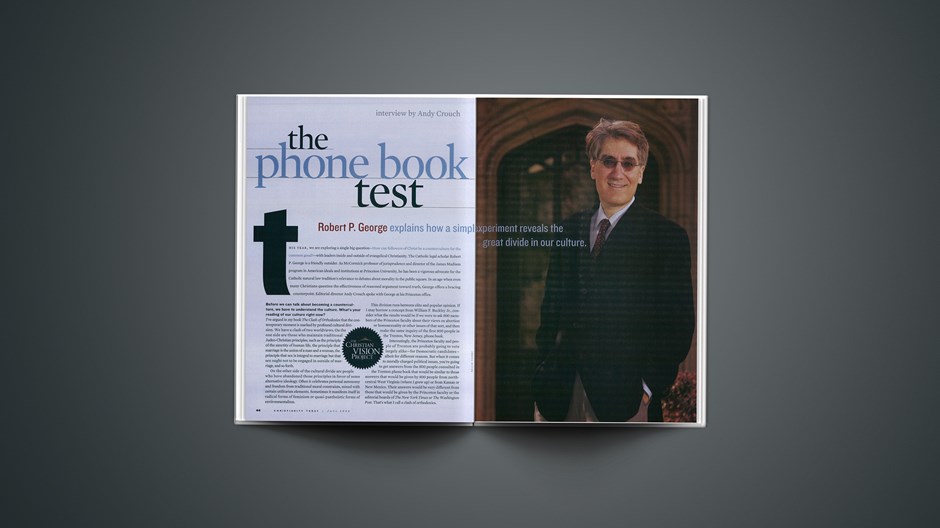
This year, we are exploring a single big question—How can followers of Christ be a counterculture for the common good?—with leaders inside and outside of evangelical Christianity. The Catholic legal scholar Robert P. George is a friendly outsider. As McCormick professor of jurisprudence and director of the James Madison program in American ideals and institutions at Princeton University, he has been a vigorous advocate for the Catholic natural law tradition's relevance to debates about morality in the public square. In an age when even many Christians question the effectiveness of reasoned argument toward truth, George offers a bracing counterpoint. Editorial director Andy Crouch spoke with George at his Princeton office.
Before we can talk about becoming a counterculture, we have to understand the culture. What's your reading of our culture right now?
I've argued in my book The Clash of Orthodoxies that the contemporary moment is marked by profound cultural division. We have a clash of two worldviews. On the one side are those who maintain traditional Judeo-Christian principles, such as the principle of the sanctity of human life, the principle that marriage is the union of a man and a woman, the principle that sex is integral to marriage but that sex ought not to be engaged in outside of marriage, and so forth.
On the other side of the cultural divide are people who have abandoned those principles in favor of some alternative ideology. Often it celebrates personal autonomy and freedom from traditional moral constraints, mixed with certain utilitarian elements. Sometimes it manifests itself in radical forms of feminism or quasi-pantheistic forms of environmentalism.
This division runs between elite and popular opinion. If I may borrow a concept from William F. Buckley Jr., consider what the results would be if we were to ask 800 members of the Princeton faculty about their views on abortion or homosexuality or other issues of that sort, and then make the same inquiry of the first 800 people in the Trenton, New Jersey, phone book.
Interestingly, the Princeton faculty and people of Trenton are probably going to vote largely alike—for Democratic candidates—albeit for different reasons. But when it comes to morally charged political issues, you're going to get answers from the 800 people consulted in the Trenton phone book that would be similar to those answers that would be given by 800 people from north-central West Virginia (where I grew up) or from Kansas or New Mexico. Their answers would be very different from those that would be given by the Princeton faculty or the editorial boards of The New York Times or The Washington Post. That's what I call a clash of orthodoxies.
It's a clash of two faiths. The folks on the elite side of the divide often try to depict this as a clash between religious believers—people who, they suppose, do not honor reason as having a role in moral decision making—and "reasonable people," that is, people like themselves who allegedly act purely on the basis of reason and do not rely on or appeal to faith. But I think the reality is that in the elite sector of the culture, people hold the views they do as a matter of faith every bit as much, perhaps even more, than do people in the broader culture.
For example?
The belief that autonomy is such a high value that it trumps the sanctity of human life. For example, secularist elites widely believe that we ought to create human embryos by cloning or other means to be destroyed in biomedical research. Implicit in that belief is the proposition that the human embryo is either not a human being or not a human being with value. Now, the belief that the human embryo is something other than a human being in the earliest stages of his or her development flies in the face of reason. It can only be defended by appeal to some sort of faith that allegedly justifies ignoring the established facts of science. Of course, there are people who acknowledge that human embryos are human beings, but maintain that not all human beings are "persons." Human beings at early developmental stages—embryos, fetuses, and even infants—are not yet persons and can, therefore, rightly be killed to benefit others.
When these arguments are advanced by people like Princeton University philosopher Peter Singer, they lead to such radical conclusions as the endorsement of infanticide on a massive scale to produce transplantable organs. Singer is logically consistent. He is true to his faith. But most liberals are not willing to go there and haven't seen (or refuse to face up to) the implications of their view.
In most cases, support for the destruction of human life by abortion or for embryonic research is not carefully researched. Such views are held as a matter of faith. They're the convictions of "our kind of people," the convictions of people who consider themselves to be sophisticated and bright.
Daniel Dennett, a philosopher, even has a name for people who share the secularist orthodoxy. He calls them, and he includes himself in this, the Brights. And the implication of that is the others are the Dumbs or the Stupids.
Article continues below
The Dims.
That's a better word, the Dims.
Is it one orthodoxy versus another? Or is it a Judeo-Christian tradition versus a variety of orthodoxies?
Just as within the larger community of people who hold Judeo-Christian values and beliefs there are people who emphasize different things, there is a variety on the secular liberal side. There are people who emphasize different issues—some who emphasize environmentalism or animal rights, some who press for what they insist on calling "abortion rights," and some who push for the redefinition of marriage to include persons of the same sex or even "marriages" of three or more people.
But there's a family of views. They hang together on the basis of certain assumptions about human meaning, dignity, and destiny. In one perspective, the dignity of the human being depends on the human being's autonomy being strictly respected when it comes to issues that they regard as being of an intimate and personal nature. So, we are told, not only must we accept homosexual conduct and polyamorous relations, we must honor them and even accord them the status of marriage where that is desired, and so forth. Abortion has to be permitted, and not only permitted but paid for with public money, and there must be no stigma attached to it.
So, as I say, it's a family of views, but the rejection of Judeo-Christian principles is central to everything on the secular Left that marks it as distinctive.
What do you think of Alan Wolfe's thesis that most Americans really are not radically devoted to one orthodoxy or another but are a muddled, moderate middle and would rather just get along?
I don't think he's right. My understanding of his method is that he has taken a couple of hundred people, perhaps on more than one occasion, perhaps different people on different occasions, and done extensive interviews with them. I don't know how much that reveals, because I don't know the details of the discussions that he had with them.
I think there's a lot to be learned from the phone book test. It's clear that on a wide range of issues, everything from abortion and embryo research to sexuality, marriage, and the family, any 800 people in Trenton are going to give answers very different from the 800 members of the Princeton faculty.
If we look at things in a national perspective (instead of focusing on just two nearby towns in New Jersey), the best predictor of how you're going to vote in the next presidential election is whether you've been in a church or synagogue in the last week. If you're a regular religious practitioner of any faith, you are more likely to vote Republican; if you're not, if you're a secularist, you're more likely to vote Democrat.
Article continues below
What can those of us in the Judeo-Christian tradition learn from the secular orthodoxy?
Its promoters are our opponents. One might even say, at the risk of misleading, that they are our enemies. And if we do use the term enemies, it has to be holding fully in mind Christ's command that we love our enemies. We are seeking their conversion of heart, a change of mind. I'm not necessarily speaking about religious conversion. I'm talking about persuading people to adopt a better understanding of justice and the common good. The means that we use must be pure. They must be truthful; they must not be manipulative. We must employ just means in the pursuit of just ends.
I think there is a perception, particularly in minority communities and most especially in the black community, that conservatives are not their friends and that liberals, while they may be widely off-base on some moral and religious questions, nevertheless are more trustworthy when it comes to issues such as decent wages, housing, nondiscrimination, and a societal safety net. That perception needs to be addressed.
What ought the church to do in response to this polarized contest?
The church must first and above all preach the gospel of Jesus Christ. For some of us that will be a quite explicitly religious mission, but for all of us it must involve not merely proclamation but also living out the gospel in prayer and action.
This has many dimensions. It's not exclusively political, but how we conduct ourselves politically is part of how we live out a Christian life. And the way we are called to conduct ourselves politically is with an eye to the common good, to justice, and to the protection of the vulnerable.
I think that authentic Christian faith rejects the extremes of libertarianism on one side and collectivism on the other side. The trouble with libertarianism is that it fails to do justice to our connectedness and to the obligations we have in solidarity with each other as brothers and sisters. But on the other side, there's a collectivism that also must be rejected—the idea that the individual human being is simply a cog in a larger social wheel.
Article continues below
What do you think of those Christians who believe that government's main role is to create a context in which individuals can practice their faith freely?
see people like Chuck Colson and James Dobson fighting against this way of thinking all the time. They're trying hard to reform it so that Christians see their social responsibilities to do justice, to pursue the common good, to defend the vulnerable, and to uphold marriage and the family.
I have noticed some evangelicals availing themselves of the riches of the Catholic tradition of social thought on these issues. They have become experts on Catholic social thought and have integrated it into their own teaching . The clash of orthodoxies has united Catholics and evangelicals in a marvelous way. Catholics have learned a great deal from their evangelical friends about the power of Scripture to speak to the heart of the believer; evangelicals have gained from Catholics an appreciation of the value of philosophical reflection and "natural law" arguments in debating contested moral issues in the public square.
Are there risks that we Christians run when working for justice, human rights, and the common good?
I'm always concerned that we would get another wave of what sometimes is called pietism or quietism, where out of frustration with the failure to achieve some elements of justice and the common good, there might be a collapse back into the view that we should just take care of ourselves, practice our faith in our churches, and turn over the world of politics to the secularists. So I would strongly encourage all Christians to avoid any temptation to go in that direction.
The Conservative Humanist | Those who are pro-life and pro-family should have no problem being pro-human. By Glenn Stanton. (April 21, 2006)
Loving the Storm-Drenched | We can no more change the culture than we can the weather. Fortunately, we've got more important things to do. By Frederica Mathewes-Green (March 3, 2006)
How the Kingdom Comes | The church becomes countercultural by sinking its roots ever deeper into God's heavenly gifts. By Michael S. Horton (Jan. 13, 2006)
Inside CT Better Than a Cigar | Introducing the Christian Vision Project. By David Neff (Jan. 13, 2006)


















 While we pray for peace, we need moral clarity about this war.
 A Christian reconciliation group in Israel and Palestine warned that war would come. Now the war threatens their relevance.españolالعربيةFrançaisрусскийУкраїнська
 The government plans to close its porous border with Myanmar to boost security, separating ethnic groups that straddle the boundary.






