All scripture is inspired, but some of it is electric. The power of the Holy Spirit hums in the lines so thrillingly that you hardly dare to touch them. For me, the first chapters of Ephesians and Colossians spring to mind, especially the verses where Paul shows us Jesus Christ in his supremacy. God gave his one and only Son as "the atoning sacrifice for our sins" (1 John 4:10). But Paul sets that mighty work inside a mightier one. With trumpets sounding in his soul, he exclaims that through Jesus' sacrifice, God was pleased "to reconcile to himself all things" (Col. 1:20) as part of a still mightier plan for the ages when God will at last "gather up all things in him, things in heaven and things on earth" (Eph. 1:10).
As the Father rescues his people from the powers of darkness and resettles them inside the kingdom of his Son, they revel in his grace and sing about it in church. They take satisfaction in believing right doctrine and teach it in seminary. There they plan on going to heaven by and by and talk about it on tv. And, in the process, they experience some high-quality religious feelings.
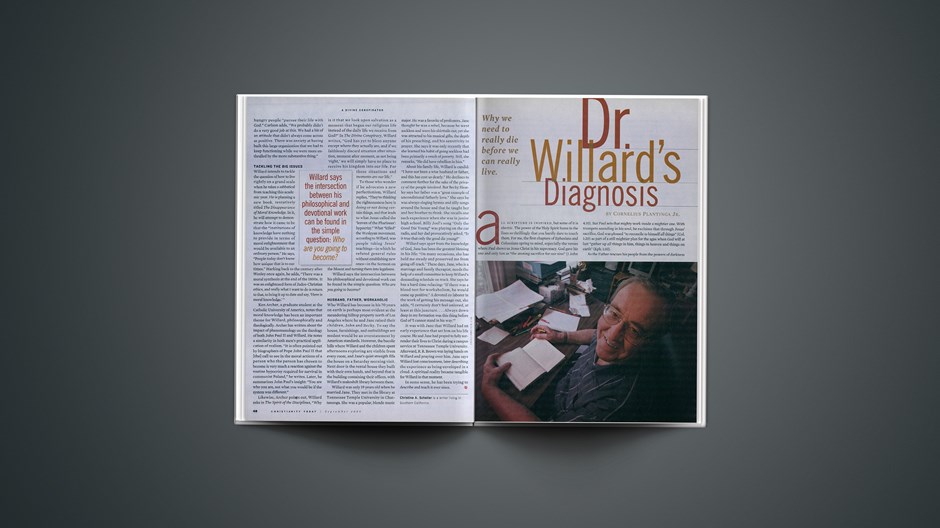
Dallas Willard writes to say there's something missing in the last part of this picture. Extending a line of thought that runs through such Christian writers as Teresa of Avila, William Law, Jonathan Edwards, C. S. Lewis, and Richard Foster, Willard calls us to want and to plan for something much more ambitious, namely "thoroughgoing inner transformation through Christ" to "clean the inside of the cup." To rejoice in our forgiveness, teach right doctrine, and yearn for heaven are wonderful things. But, as Willard testifies in his classics The Divine Conspiracy and The Spirit of the Disciplines, and most recently in The Great Omission (HarperSanFrancisco, 2006), God has much bigger things in mind for us.
He wants us to join his mighty project. That's a main reason we need thoroughgoing transformation. He wants people like us to become fit enough to follow Jesus inside "the infinite rule of God," becoming searchers for his kingdom, agents within it, witnesses to it, and models of it. We now have little kingdoms of our own, just as God intended. Depending on our age and level of responsibility, we have a small realm "where our choice determines what happens." God wants us "to mesh our kingdoms with the kingdoms of others," all inside his master kingdom, "which pervades and governs the whole of the physical universe."
What else are all these glad biblical instructions for?
Put on the full armor of God.
Seek his kingdom first.
Fill the earth and subdue it and have dominion.
Heal the sick.
Stir one another up to good works.
Take my yoke upon you and learn from me.
Teach everybody to obey everything I have commanded you.
Let your light shine before others.
Diagnosis
According to Willard, the problem is that a lot of us nod amiably at these instructions for a big Christian life in God's kingdom. Then we ignore them. For one thing, the instructions look like they're beyond us. For another, they are. The reason is that many of us are out of shape, spiritually speaking. God doesn't seem real to us, so we don't pray. And then God doesn't seem so real to us. When our own kingdom has a good year, we quit longing for the kingdom of God. We divert God's kingdom resources to our own side-projects and then lament when God doesn't bless them. (I'd like to see a cartoon of a Christian, palms up, complaining: "I stepped out in faith to build a Jesus Wins gaming casino that would employ hundreds, with a gospel singer lying on the King David Lounge piano and everything. But the casino went belly up. Where was God in my tragedy?")
Dr. Willard's diagnosis: A lot of us are doing Christianity at a putt-putt level. We want to be forgiven without following Jesus.
We're afraid to follow Jesus, because then we'd have to die and rise with him. We'd have to mortify our old self with its "fondest lusts," as Jonathan Edwards described them. Then we'd have to vivify Jesus' excellent virtues in their place. The truth is, we're mildly attracted to his virtues, but we're strongly attracted to our vices. We wouldn't like to lose them because they please us, and the prospect of a significant life with Jesus doesn't so much. Do we expect a new Christian life will just happen without our having to make inconvenient changes in how we live Monday to Sunday? If so, we are like people who want to be solvent and who also max out their credit cards. Or people who want to be sexually pure and who also bookmark porn sites. Or people who want to speak Japanese without all the tiresome study that's normally required. Here's Willard's devastating summary:
The general human failing is to want what is right and important, but at the same time not to commit to the kind of life that will produce the action we know to be right and the condition we want to enjoy. This is the feature of human character that explains why the road to hell is paved with good intentions.
Article continues below
Prescription
So what to do?
The first thing to do is to trust our Christian friends who have died with Jesus Christ when they tell us it's going to be okay if we do it, too. This, in my judgment, is one of the greatest services offered to the church by our Christian friend Dallas Willard. He is a brilliant, modest, immensely experienced Christian older brother, calling to us from the Resurrection side of things. His books all call out, in one way or another: Come on over. It's going to be okay to die first. You have to do it, and you can do it. Not even Jesus got a resurrection without a death, and he'll be at your side when you surrender your old life. Trust me on this. If you die with Jesus Christ, God will walk you out of your tomb into a life of incomparable joy and purpose inside his boundless and competent love.
Willard shows us how to get this life—eloquently and enduringly. He tells us that learning to enjoy God forever and to participate in his big project is entirely like learning competitive baseball or the violin or Italian. God has put joy inside sports, music-making, and cross-cultural conversation, but the only way to get joy out of them is to work at them. You've got to listen to your teacher, imitate him or her, and then practice a lot. The disciple is not greater than his master. If Jesus needed to learn obedience, so will Jesus' disciples. We will need to train our brain, heart, hand, eye, and tongue to get us in shape for robust Christian living. Eyebrows, too, when they still have a haughty spirit. Fortunately, says Willard, the essential disciplines for Jesus' disciples have been taught and learned for centuries, including by our Lord himself.
What are they? Here's a sampling from Willard's The Spirit of the Disciplines.
Solitude and, within it, silence to expose ourselves to ourselves ("What if there turns out to be very little between 'just us and God'?") and to provide a natural context in which to listen to God.
Fasting and, within it, meditating upon God's Word. Fasting is "prime self-denial," a way to expose "how much of our peace depends upon the pleasures of eating." Superficial peace, too. Meditating secures in our lived experience the conviction that "we have meat to eat that the world does not know."
Article continues below
Chastity to train the eyes and the imagination—the eyes of the heart—to see God's sons and daughters as our brothers and sisters.
Secrecy about doing good and being good in order to mortify pride, vivify humility, and relieve ourselves of the need to be hot stuff at Bible study. Willard helpfully adds that Christian speakers should pray for other speakers on the program, asking that these others will speak better and attract more praise than oneself. (I know that my gracious friend Dallas does this. I also know from speaking on a program with him that the prayer doesn't seem to work.)
Study of God's Word in order, as Calvin put it, "to dig up the treasures buried there" and live off them. God has put the Bible in our hands as a kind of owners' manual for tuning and running a healthy life in the kingdom. It's always wise to read the manual.
Worship and, within it, celebration—feasting, dancing, singing at God's glad invitation—in order to mortify despair and to draw us into joyful repose in the household of God. Because we all become like the one we worship, blessed are those whose God is the Lord!
Deliberate consciousness that the first heaven is the air around us, that God is alive in it, and that, bidden or unbidden, God is awfully present there. All prayer, including short prayer ("Help, Lord!"), is inescapably and gloriously local.
Confession of our sins to each other as well as to God. This mortification of the old self is, of course, open to terrible abuse. Who but God can bear to know not only what I said, but also what I almost said? Still, if you confess to a friend that you lied to him, says Willard, your confession will "marvelously enhance" your ability to get it straight the next time.
It's important to see that this program of renewal has nothing to do with "works righteousness" as the Reformers used that term. In the wonderful world of Willard's theology of Christian living, justification is still entirely by grace alone, through faith alone, in Christ alone. But sanctification is another story. Mortification of the old self and vivification of the new one take not only God's gift, but also our effort. No theologian should try to get us off the hook here. Patience, for example, is not only a fruit of the Spirit in Galatians 5; it's also our calling in Colossians 3. And nobody ever became patient without the daily exercise of self-control, especially in the left lane behind a poky driver.
Article continues below
The disciplined life will cost us. But, as Willard notes, the undisciplined life will cost us far more, now and forever.
Cornelius Plantinga Jr. is president of Calvin Theological Seminary.















 While we pray for peace, we need moral clarity about this war.
 A Christian reconciliation group in Israel and Palestine warned that war would come. Now the war threatens their relevance.españolالعربيةFrançaisрусскийУкраїнська
 Beyoncé’s right. Whether listening to Cowboy Carter or reading theology, diversity is a good thing.






