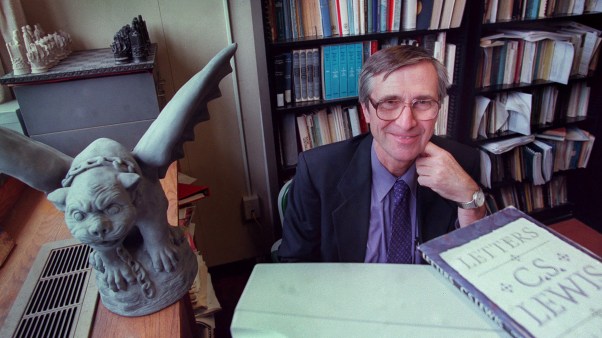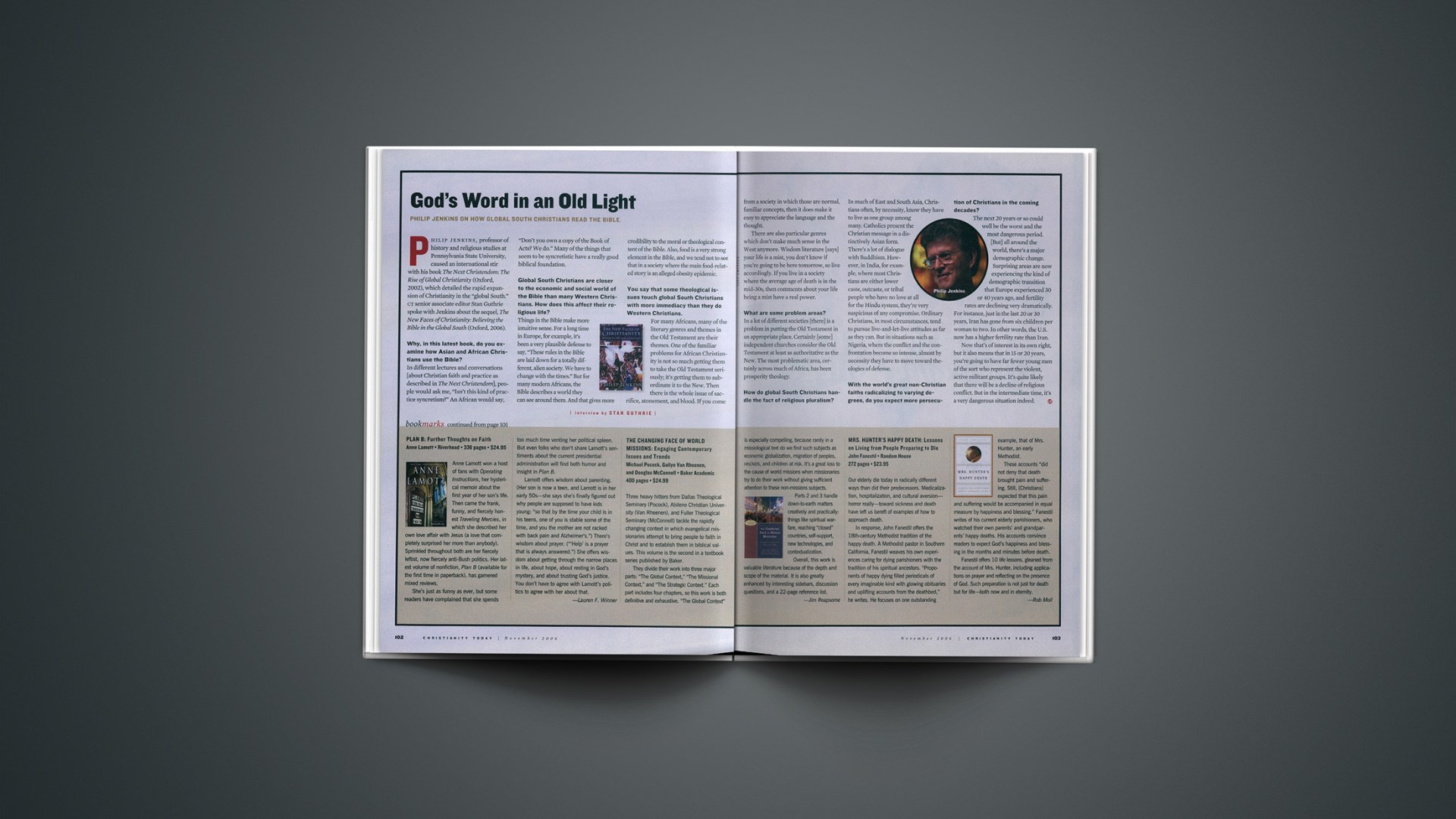

Philip Jenkins, professor of history and religious studies at Pennsylvania State University, caused an international stir with his book The Next Christendom: The Rise of Global Christianity (Oxford, 2002), which detailed the rapid expansion of Christianity in the “global South.” CT senior associate editor Stan Guthrie spoke with Jenkins about the sequel, The New Faces of Christianity: Believing the Bible in the Global South (Oxford, 2006).
Why, in this latest book, do you examine how Asian and African Christians use the Bible?
In different lectures and conversations [about Christian faith and practice as described in The Next Christendom], people would ask me, “Isn’t this kind of practice syncretism?” An African would say, “Don’t you own a copy of the Book of Acts? We do.” Many of the things that seem to be syncretistic have a really good biblical foundation.
Global South Christians are closer to the economic and social world of the Bible than many Western Christians. How does this affect their religious life?
Things in the Bible make more intuitive sense. For a long time in Europe, for example, it’s been a very plausible defense to say, “These rules in the Bible are laid down for a totally different, alien society. We have to change with the times.” But for many modern Africans, the Bible describes a world they can see around them. And that gives more credibility to the moral or theological content of the Bible. Also, food is a very strong element in the Bible, and we tend not to see that in a society where the main food-related story is an alleged obesity epidemic.
You say that some theological issues touch global South Christians with more immediacy than they do Western Christians.
For many Africans, many of the literary genres and themes in the Old Testament are their themes. One of the familiar problems for African Christianity is not so much getting them to take the Old Testament seriously; it’s getting them to subordinate it to the New. Then there is the whole issue of sacrifice, atonement, and blood. If you come from a society in which those are normal, familiar concepts, then it does make it easy to appreciate the language and the thought.
There are also particular genres which don’t make much sense in the West anymore. Wisdom literature [says] your life is a mist, you don’t know if you’re going to be here tomorrow, so live accordingly. If you live in a society where the average age of death is in the mid-30s, then comments about your life being a mist have a real power.
What are some problem areas?
In a lot of different societies [there] is a problem in putting the Old Testament in an appropriate place. Certainly [some] independent churches consider the Old Testament at least as authoritative as the New. The most problematic area, certainly across much of Africa, has been prosperity theology.
How do global South Christians handle the fact of religious pluralism?
In much of East and South Asia, Christians often, by necessity, know they have to live as one group among many. Catholics present the Christian message in a distinctively Asian form. There’s a lot of dialogue with Buddhism. However, in India, for example, where most Christians are either lower caste, outcaste, or tribal people who have no love at all for the Hindu system, they’re very suspicious of any compromise. Ordinary Christians, in most circumstances, tend to pursue live-and-let-live attitudes as far as they can. But in situations such as Nigeria, where the conflict and the confrontation become so intense, almost by necessity they have to move toward theologies of defense.
With the world’s great non-Christian faiths radicalizing to varying degrees, do you expect more persecution of Christians in the coming decades?
The next 20 years or so could well be the worst and the most dangerous period. [But] all around the world, there’s a major demographic change. Surprising areas are now experiencing the kind of demographic transition that Europe experienced 30 or 40 years ago, and fertility rates are declining very dramatically. For instance, just in the last 20 or 30 years, Iran has gone from six children per woman to two. In other words, the U.S. now has a higher fertility rate than Iran.
Now that’s of interest in its own right, but it also means that in 15 or 20 years, you’re going to have far fewer young men of the sort who represent the violent, active militant groups. It’s quite likely that there will be a decline of religious conflict. But in the intermediate time, it’s a very dangerous situation indeed.
Copyright © 2006 Christianity Today. Click for reprint information.
Related Elsewhere:
The first chapter of The New Faces of Christianity is available on our site.
The New Faces of Christianity: Believing in the Bible in the Global South and Jenkins’s earlier book, The Next Christendom: The Rise of Global Christianity are available at ChristianBook.com and other retailers.
Oxford University Press has more information on the book.
Other Christianity Today articles on the Global South include:
Out of Africa | The leader of nearly 18 million Nigerian Anglicans challenges the West’s theology and control. (July 2005)
It’s a Small Church After All | Globalization is changing how Christians do ministry.(November 6, 1998)
Turning the World Upside Down | The coming of global Christianity. (March 1, 2002)
Other Christianity Today articles by Philip Jenkins include:
The Real Story of Secularization | Is Europe a special case? Philip Jenkins (November 1, 2002) books and culture
Downward, Outward, Later | A superb new history of Christianity. By Philip Jenkins (September/October 2006)
Other interviews with Philip Jenkins are available at NPR’s Fresh Air , The Milwaukee Journal-Sentinel , and The Atlantic Monthly (subscription required)
Jenkins’ article, “The Next Christianity,” appeared in The Atlantic Monthly.