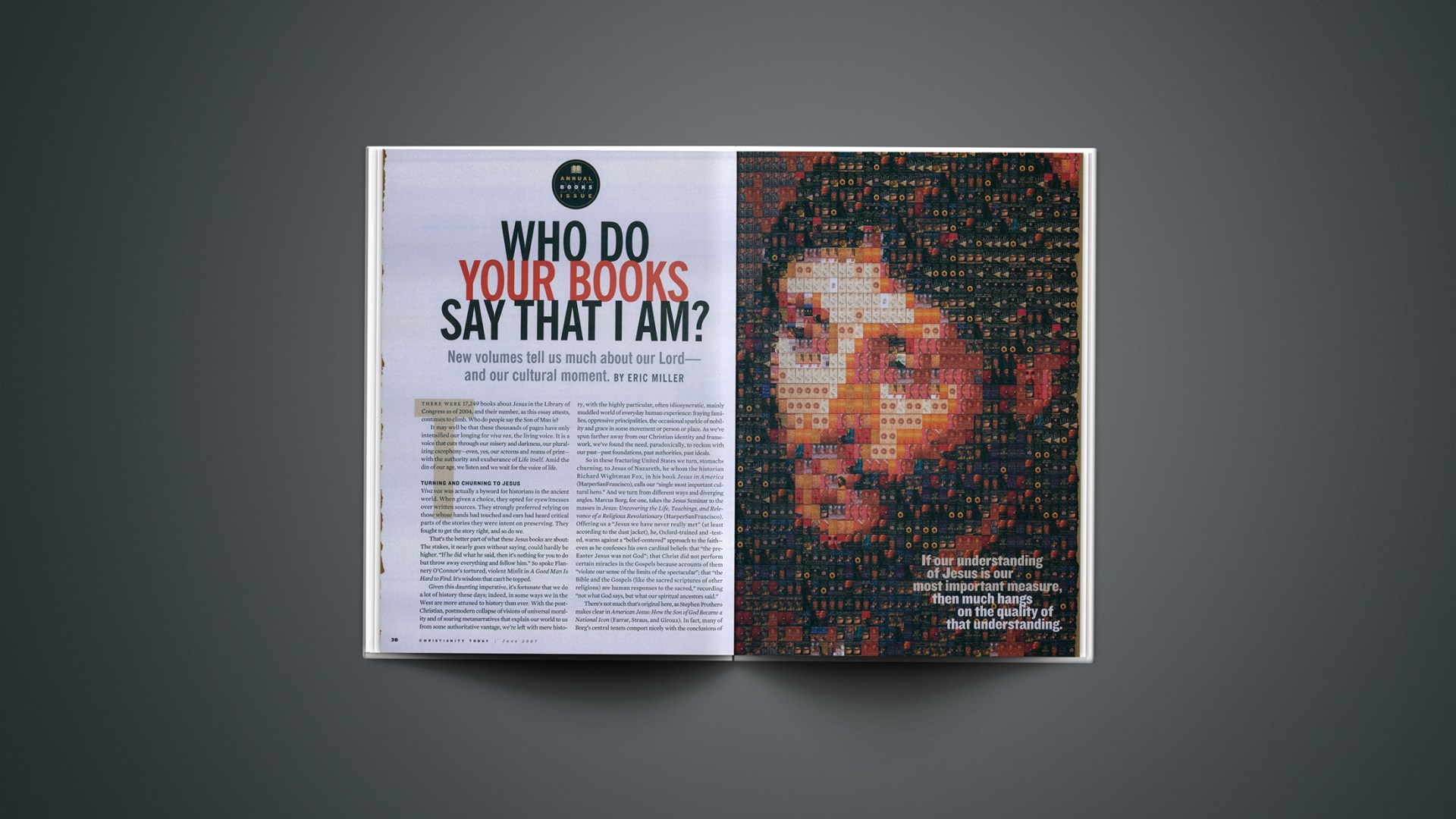

There were 17,249 books about Jesus in the Library of Congress as of 2004, and their number, as this essay attests, continues to climb. Who do people say the Son of Man is?
It may well be that these thousands of pages have only intensified our longing for viva vox, the living voice. It is a voice that cuts through our misery and darkness, our pluralizing cacophony—even, yes, our screens and reams of print—with the authority and exuberance of Life itself. Amid the din of our age, we listen and we wait for the voice of life.
Turning and Churning to Jesus
Viva vox was actually a byword for historians in the ancient world. When given a choice, they opted for eyewitnesses over written sources. They strongly preferred relying on those whose hands had touched and ears had heard critical parts of the stories they were intent on preserving. They fought to get the story right, and so do we.
That’s the better part of what these Jesus books are about: The stakes, it nearly goes without saying, could hardly be higher. “If he did what he said, then it’s nothing for you to do but throw away everything and follow him.” So spoke Flannery O’Connor’s tortured, violent Misfit in A Good Man Is Hard to Find. It’s wisdom that can’t be topped.
Given this daunting imperative, it’s fortunate that we do a lot of history these days; indeed, in some ways we in the West are more attuned to history than ever. With the post-Christian, postmodern collapse of visions of universal morality and of soaring metanarratives that explain our world to us from some authoritative vantage, we’re left with mere history, with the highly particular, often idiosyncratic, mainly muddled world of everyday human experience: fraying families, oppressive principalities, the occasional sparkle of nobility and grace in some movement or person or place. As we’ve spun farther away from our Christian identity and framework, we’ve found the need, paradoxically, to reckon with our past—past foundations, past authorities, past ideals.
So in these fracturing United States we turn, stomachs churning, to Jesus of Nazareth, he whom the historian Richard Wightman Fox, in his book Jesus in America (HarperSanFrancisco), calls our “single most important cultural hero.” And we turn from different ways and diverging angles. Marcus Borg, for one, takes the Jesus Seminar to the masses in Jesus: Uncovering the Life, Teachings, and Relevance of a Religious Revolutionary (HarperSanFrancisco). Offering us a “Jesus we have never really met” (at least according to the dust jacket), he, Oxford-trained and -tested, warns against a “belief-centered” approach to the faith—even as he confesses his own cardinal beliefs: that “the pre-Easter Jesus was not God”; that Christ did not perform certain miracles in the Gospels because accounts of them “violate our sense of the limits of the spectacular”; that “the Bible and the Gospels (like the sacred scriptures of other religions) are human responses to the sacred,” recording “not what God says, but what our spiritual ancestors said.”
There’s not much that’s original here, as Stephen Prothero makes clear in American Jesus: How the Son of God Became a National Icon (Farrar, Straus, and Giroux). In fact, many of Borg’s central tenets comport nicely with the conclusions of the man Prothero deems the father of the American Jesus: Thomas Jefferson. On lonely evenings in the White House, he clipped away (literally) any hint of the supernatural from copies of the Gospels, while reverentially seeking to preserve the true identity and significance of Jesus (he called him, among other things, “the most perfect model of republicanism in the universe”). Jefferson’s genealogical connection to today’s Jesus Seminar, where skeptical scholars meet to cast votes on the historical authenticity of the Gospels, couldn’t be clearer. “Its method is democratic, its goal is freedom, and its obsession is Jesus,” Prothero notes.
If Jesus and freedom have a profound, if complex, relationship, Jesus and democracy are considerably more problematic. In the hands of democrats, Jesus has taken on form after ever-expanding form. Prothero’s quip is cute but discerning: The American Jesus was “born in Jefferson’s White House and raised by evangelical and liberal Protestants,” but then “turned his back on his Christian upbringing and struck out on his own in multi-religious America.”
Predictably, as scholarship rooted in traditional Christian affirmations has deepened, hundreds of books have appeared to combat the wayward turn of a people that increasingly identify themselves as “spiritual” but not “religious.” The rigor of those mounting arguments is impressive, and the authors pull no rhetorical punches. In Fabricating Jesus (InterVarsity Press), Craig A. Evans, New Testament professor at Acadia Divinity College, places his scholarly bona fides against those of the Jesus Seminar and calls their errors “egregious and legion.” In What Have They Done with Jesus? (HarperSanFrancisco), the prolific Ben Witherington III, professor of New Testament at Asbury Theological Seminary, continues to engage in the Jesus wars. He argues that, contra much recent scholarship, none of the textual variants of New Testament writings provide “hard evidence” that “the virginal conception, crucifixion, bodily resurrection of Jesus, or even the Trinity” were developed much later by those trying to establish what became known as orthodoxy.
Beware the “scholarly consensus” so treasured by critics, these scholars warn: That consensus is founded on what Witherington dubs the “‘justification by doubt’ factor” and conditioned by today’s skeptical—indeed, cynical—climate.
In a formidable piece of scholarship, Jesus and the Eyewitnesses (Eerdmans), University of Saint Andrews historian Richard Bauckham says essentially the same thing. He meticulously rips away what he regards as specious modern conceptions of the ancient world. The eyewitnesses to the life of Christ—the living voices—”remained accessible sources and authoritative guarantors of their own testimony throughout the period between Jesus and the writing of the Gospels,” he contends. He wants to dispel the still-dominant impression that there existed a “long period of creative development of the traditions before they attained written form in the Gospels.” This view, he declares, is no longer defensible, and he provides a plausible account of real people living in actual communities who devoted themselves to preserving a record of truly remarkable events.
Faith and Doubt
“It is hard to see,” says Bauckham, “how Christian faith and theology can work with a radically distrusting attitude to the Gospels.” Risking opprobrium in the land of “scholarly consensus,” Bauckham, Witherington, and Evans badly want this faith and theology to work. They want to permit its living voice to speak into an age cluttered with voices. Our minds addled and our hearts tethered, we listen desperately for the voice that whispers our name, that tells us who we are and what we are for, that frees us from a way of life that teaches little about life.
Not surprisingly, it is a pastoral burden that drives many Jesus writers, the desire not to clear away scholarly debris so much as to recover Jesus as a touchstone—the one, the only one, capable of correcting our error and folly, of restoring our lost identity. If our understanding of Jesus is our most important measure, then much hangs on the quality of that understanding. CT managing editor Mark Galli, in Jesus Mean and Wild (Baker), reacts against contemporary conceptions of a “kind, benevolent being who knows nothing of discipline, character, or tough love.” Could this image possibly square with the Gospel accounts of Christ? On pages alleged to abound with sweetness and light, Galli finds “a tornado touching down, lifting homes and businesses off their foundations, leaving only bits and pieces of the former life strewn on his path.” So much for Jesus meek and mild. So much for our cheery, pluralistic faith.
For his part, pastor-scholar John Piper unveils a Christ whose authority forces us to stand and salute—or weep and kneel down. “Jesus is not a tribal deity,” he reminds us in What Jesus Demands from the World (Crossway). “All authority in the universe is his; all creation owes its allegiance to him.” This is a Jesus who doesn’t roam the pages of the Gospels—he haunts them, with an authority that hits people like an arctic blast, freezing them to a standstill, snapping their heads around. The parade of folk in Matthew 8, for example—the leprous, the infirm, the ill, a Roman officer, would-be disciples, demons, even the elements—treat him, remarkably, as if he is, indeed, the one in whom all things consist. No wonder that chapter closes with a “whole town” assembling to “plead with him to leave their region.”
If Piper and Galli are right, it’s this voice, with an authority strangely divine and strangely human, that we outrageously free postmoderns must finally confront, whether we wish to or not. We, mere creatures who consist only in Christ, have no choice in this matter—no “freedom” to ignore Christ, whatever our national constitutions or political philosophies may proclaim.
The contrast of this Christ to the Jesus of our times, the Jesus of Marcus Borg, could not be more stark. By Borg’s lights, if Christ is God “it makes no sense to speak of imitating him and becoming like him,” for it is a human guide that we need, one whom we stand a chance of emulating. But surely Borg has misread our deepest need. Lost in the darkness of our corruption, straining toward a light we seem to glimpse only in dreams, we cry, in blessed moments of repentance, for one strong enough to restore us to our truest creaturely shape—the shape of real freedom. Only this Christ, this divine and human Christ, can elevate the bar high enough to show us just how short we fall. Only this Christ has the strength to correct us, through the sensitized love of his own profoundly human prayers. We’re talking about one whose spiritual portfolio contains far more than “an enlightened experience of the sacred”—Borg’s description of Jesus’ attainment.
Piper’s concerns about the effects of Borg’s Jesus on the world are worth hearing. Having completed a doctorate in New Testament studies at the University of Munich in the 1970s, Piper wonders about Borg’s world. He poignantly asks, “Who of us today can give any serious account” of the “cutting-edge reconstructions” of Jesus that were then au courant? “I estimate most of the fruit of those quests,” he concludes, “to be unreliable and unusable to accomplish what Jesus aims to accomplish in this world.”
It’s a world that has suffered immeasurably in its rejection of him and his plan, as our lives too quickly make plain. It’s a world he still longs to embrace with healing, unifying, truth-telling love. And it’s this vision for the world that animates CT senior writer Tim Stafford’s splendid Surprised by Jesus (InterVarsity Press)—the pristine prose and striking argument of which could make it a candidate to revolutionize any number of small-group studies in churches around the nation, and, indeed, the world. Stafford pounds home the basic point that Jesus’ message did not consist of “lofty truths about the nature of reality” or ruminations reflecting “the eternal present of religious consciousness.” His was, instead, a call to align ourselves to “God’s action in time and space.” In an age bogged down, distracted, and forlorn, Stafford presents a simple and radical banner for the church to wave and enact: “Jesus is changing the world. Come and see.”
Most fundamentally, he writes, “Jesus came to announce and to create a renewed people under God.” This long-awaited renewal—our renewal—comes only in particular, concrete, historical ways, ever reflecting, by his grace, the deep and true humanity of the Son of God, he who came eating and drinking, arguing and listening, blessing and dying. For all of his authority, “What distinguished Jesus,” Stafford wryly notes, “was not his cosmopolitan outlook.” He was a man of the people. He was a man for the people. He is the living voice, who to the weary and heavy-laden says gently, “Come.”
Eric Miller is associate professor of history at Geneva College.
Copyright © 2007 Christianity Today. Click for reprint information.
Related Elsewhere:
Jesus in America , Jesus: Uncovering the Life, Teachings, and Relevance of a Religious Revolutionary , Fabricating Jesus , What Have They Done with Jesus? , American Jesus: How the Son of God Became a National Icon , Jesus and the Eyewitnesses: The Gospels as Eyewitness Testimony , and Jesus Mean and Wild: The Unexpected Love of an Untamable God are available from ChristianBook.com, Amazon.com, and other retailers.
Jesus and the Eyewitnesses and Jesus Mean and Wild were honored in Christianity Today‘s 2007 book awards.
Articles about the books mentioned above include:
They Really Saw Him | Richard Bauckham argues that the Gospels are based on eyewitness testimony, not “anonymous community traditions.” The key, he says, is in the names. (June 7, 2007)
The Early Church on Jesus | Ben Witherington offers a potpourri of thoughts about early Christian belief. (February 14, 2007)
A Practical Understanding of Jesus’ Life | Tim Stafford interprets Jesus’ life for a new generation in Surprised by Jesus. (November 10, 2006)
Excerpt: Jesus Mean and Wild: The Unexpected Love of an Untamable God | Apparently ‘satanic’ can be a synonym for ‘relevant’. (July 1, 2006)
Crash-Helmet Christianity | Talking about the real Jesus is a dangerous thing. A Christianity Today editorial (April 1, 2004)
Behold the Man | A review of Stephen Prothero’s American Jesus. (January 1, 2004)
Christian History & Biography‘s issues on the Jesus include The Life & Times of Jesus of Nazareth and The Search For Biblical Jesus.
Other articles and reviews of books about the historical Jesus include:
Jesus Out of Focus | The Da Vinci Code is raising issues that go to the heart of the Christian faith—and it’s starting to confuse us all. (June 1, 2006)
Breaking The Da Vinci Code | So the divine Jesus and infallible Word emerged out of a fourth-century power-play? Get real. (Nov. 07, 2003)
Thanks, Da Vinci Code | Tbe book sends us back to Christianity’s “founding fathers”—and the Bible we share with them (Nov. 14, 2003)
Jesus’ Sword | Longing for peace in tumultuous times. (May 07, 2003)
Leading with Conclusions | Much of Jesus scholarship is about neither the historical Jesus nor good scholarship. (April 29, 2002)
The Jesus Scandal | The church has a long history of discomfort with Christ. (Feb. 19, 2002)
Historical Hogwash | Two books—one new, one newly reissued—debunk false claims about the “real” Jesus. (July 13, 2001)
Lights, Camera, Jesus | Hollywood looks at itself in the mirror of the Messiah. (May 12, 2000)
Desperately Seeking Jesus | A review of “The Epic Miniseries” (May 12, 2000)
No More Hollow Jesus | In focusing so intently on Jesus the man, Peter Jennings’ report missed the big picture. (July 3, 2000)
Jennings on Jesus | ABC anchorman Peter Jennings discusses what moved him as he filmed a special on the life of Christ. (June 26, 2000)