
The last 15 years have seen numerous attempts to reconstruct the life of Christ. For good or ill, the novel theories of Dominic Crossan, Marcus Borg, and Elaine Pagels have found their way into the public media. For example, in Rabbi Jesus: An Intimate Biography, Bruce Chilton concludes that Jesus was traumatized by the death of his father, suffered from some mental illness (bipolar perhaps), and stirred his Galilean followers to march on Jerusalem.
In 1995, Bart Ehrman offered a more scholarly (but misguided) assessment in Misquoting Jesus, in which he argued for a merely human Jesus. Dallas Theological Seminary’s Darrell Bock answered him in The Missing Gospels: Unearthing the Truth Behind Alternative Christianities.
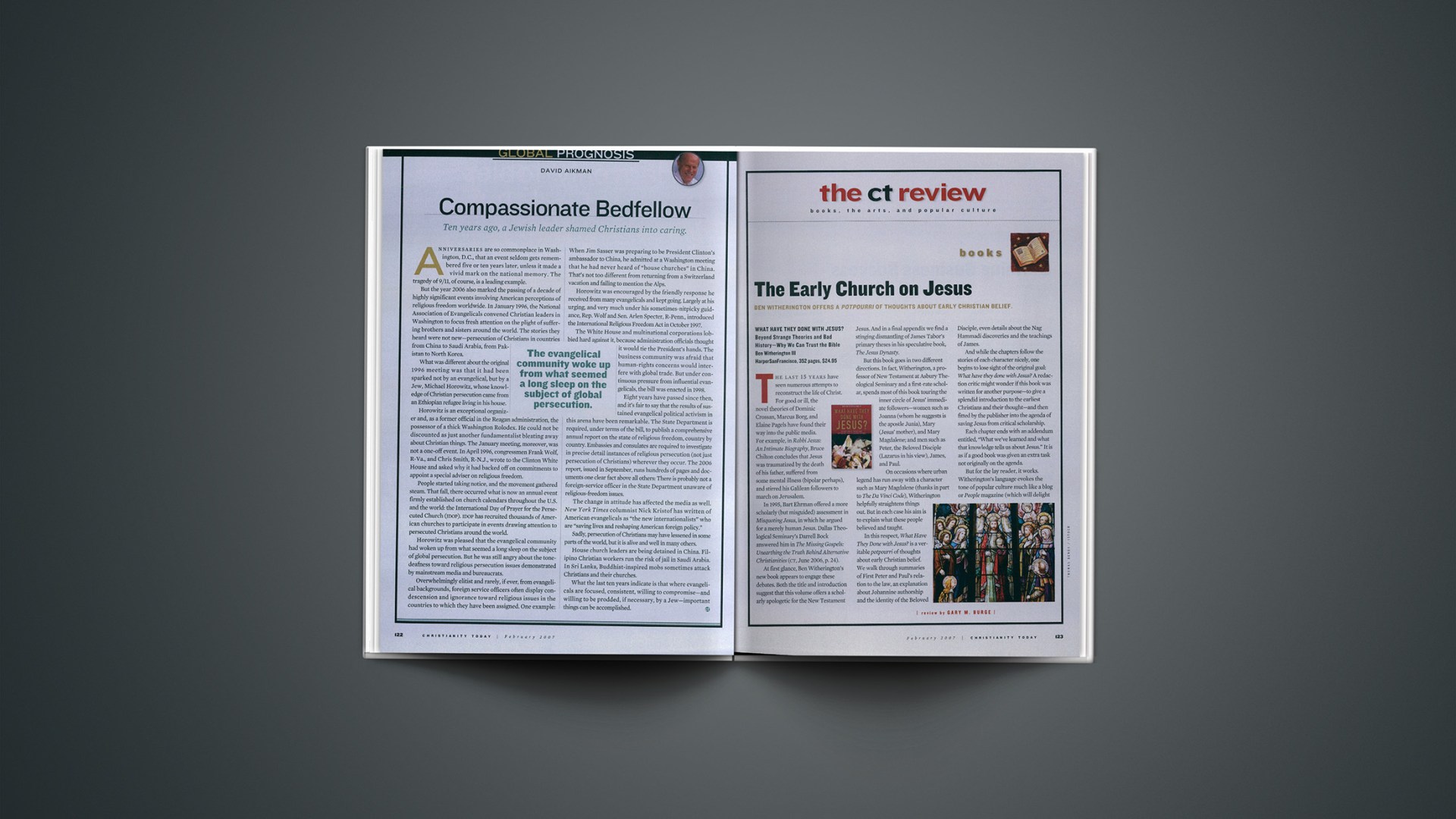
At first glance, Ben Witherington’s new book appears to engage these debates. Both the title and introduction suggest that this volume offers a scholarly apologetic for the New Testament Jesus. And in a final appendix we find a stinging dismantling of James Tabor’s primary theses in his speculative book, The Jesus Dynasty.
But this book goes in two different directions. In fact, Witherington, a professor of New Testament at Asbury Theological Seminary and a first-rate scholar, spends most of this book touring the inner circle of Jesus’ immediate followers—women such as Joanna (whom he suggests is the apostle Junia), Mary (Jesus’ mother), and Mary Magdalene; and men such as Peter, the Beloved Disciple (Lazarus in his view), James, and Paul.
On occasions where urban legend has run away with a character such as Mary Magdalene (thanks in part to The Da Vinci Code), Witherington helpfully straightens things out. But in each case his aim is to explain what these people believed and taught.
In this respect, What Have They Done with Jesus? is a veritable potpourri of thoughts about early Christian belief. We walk through summaries of First Peter and Paul’s relation to the law, an explanation about Johannine authorship and the identity of the Beloved Disciple, even details about the Nag Hammadi discoveries and the teachings of James.
And while the chapters follow the stories of each character nicely, one begins to lose sight of the original goal: What have they done with Jesus? A redaction critic might wonder if this book was written for another purpose—to give a splendid introduction to the earliest Christians and their thought—and then fitted by the publisher into the agenda of saving Jesus from critical scholarship.
Each chapter ends with an addendum entitled, “What we’ve learned and what that knowledge tells us about Jesus.” It is as if a good book was given an extra task not originally on the agenda.
But for the lay reader, it works. Witherington’s language evokes the tone of popular culture much like a blog or People magazine (which will delight some, but exasperate others). Chapter and section divisions include “Gullible’s Travels,” “Naughty Gnostic Gospels,” “For Pete’s Sake,” “Simon Says,” “O Brother, Where Art Thou,” and “Hey Jude, Don’t Make It Bad.” Yet this whimsical style stands with substantial discussions about the New Testament and its earliest witnesses. For some laypersons, it may be the ideal combination that is both charming and challenging.
Gary M. Burge is a professor of New Testament at Wheaton College and Graduate School.
Related Elsewhere:
What Have They Done with Jesus? is available from ChristianBook.com and other retailers.
More about Ben Witherington, including information about his other books, is available from his website.
CT interviewed Witherington about evangelical theology.
Christian History & Biography‘s issues on the early church include The Life & Times of Jesus of Nazareth and The Search For Biblical Jesus.
Other articles and reviews of books about the historical Jesus include:
Q&A: Darrell Bock | CT spoke with Bock, Dallas Theological Seminary research professor of New Testament and author of the forthcoming The Missing Gospels (Nelson), about the stir caused by the Gospel of Judas release in early April. (June 1, 2006)
The Lapsed Evangelical Critic | Bart Ehrman’s doubt as a student at Moody has turned to agnosticism. (June 1, 2006)
Jesus Out of Focus | The Da Vinci Code is raising issues that go to the heart of the Christian faith—and it’s starting to confuse us all. (June 1, 2006)
A Faith Tailored Just for You | The hoopla over the Gospel of Judas is both absurd and revealing. A Christianity Today editorial (May 10, 2006)
Betrayed Again | The Gospel of Judas Roadshow.
The Jesus and Judas Papers: A Look at Recent Claims about Jesus | Questions about history may be sincere, but make no mistake: There is an agenda at work. (April 13, 2006)
The Judas We Never Knew | Disgraced disciple actually conspired with Jesus, according to newly released Gospel of Judas. Should we believe it? (April 6, 2006)
Why the ‘Lost Gospels’ Lost Out | Recent gadfly theories about church council conspiracies that manipulated the New Testament into existence are bad—really bad—history. (May 21, 2004)
Breaking The Da Vinci Code | So the divine Jesus and infallible Word emerged out of a fourth-century power-play? Get real. (Nov. 07, 2003)
Thanks, Da Vinci Code | Tbe book sends us back to Christianity’s “founding fathers”—and the Bible we share with them (Nov. 14, 2003)
The Good News of Da Vinci | How a ludicrous book can become an opportunity to engage the culture. (Jan. 05, 2004)
Leading with Conclusions | Much of Jesus scholarship is about neither the historical Jesus nor good scholarship. (April 29, 2002)
Historical Hogwash | Two books—one new, one newly reissued—debunk false claims about the “real” Jesus. (July 13, 2001)