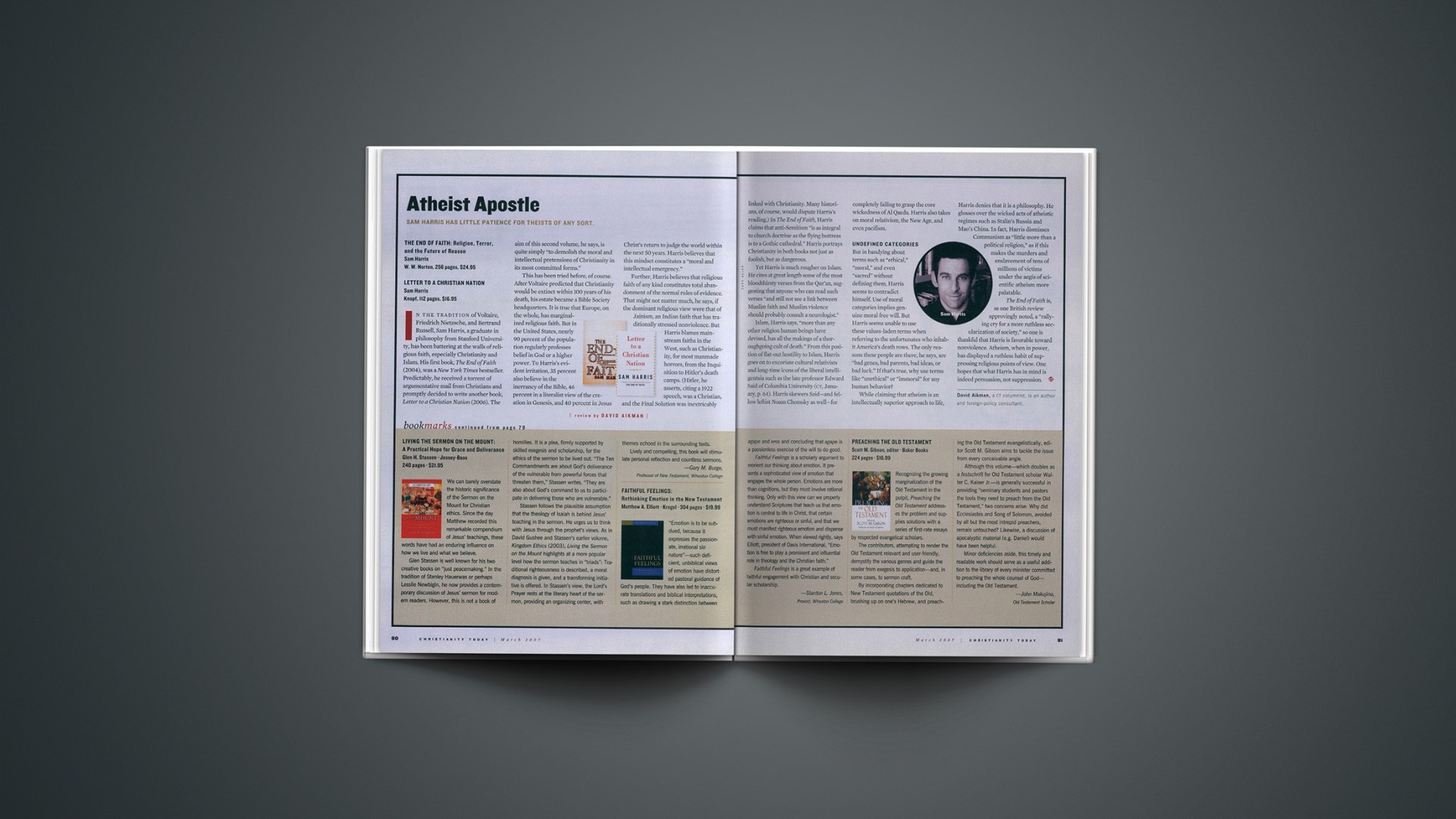

In the tradition of Voltaire, Friedrich Nietzsche, and Bertrand Russell, Sam Harris, a graduate in philosophy from Stanford University, has been battering at the walls of religious faith, especially Christianity and Islam. His first book, The End of Faith (2004), was a New York Times bestseller. Predictably, he received a torrent of argumentative mail from Christians and promptly decided to write another book, Letter to a Christian Nation (2006). The aim of this second volume, he says, is quite simply “to demolish the moral and intellectual pretensions of Christianity in its most committed forms.”
This has been tried before, of course. After Voltaire predicted that Christianity would be extinct within 100 years of his death, his estate became a Bible Society headquarters. It is true that Europe, on the whole, has marginalized religious faith. But in the United States, nearly 90 percent of the population regularly professes belief in God or a higher power. To Harris’s evident irritation, 35 percent also believe in the inerrancy of the Bible, 46 percent in a literalist view of the creation in Genesis, and 40 percent in Jesus Christ’s return to judge the world within the next 50 years. Harris believes that this mindset constitutes a “moral and intellectual emergency.”
Further, Harris believes that religious faith of any kind constitutes total abandonment of the normal rules of evidence. That might not matter much, he says, if the dominant religious view were that of Jainism, an Indian faith that has traditionally stressed nonviolence. But Harris blames mainstream faiths in the West, such as Christianity, for most manmade horrors, from the Inquisition to Hitler’s death camps. (Hitler, he asserts, citing a 1922 speech, was a Christian, and the Final Solution was inextricably linked with Christianity. Many historians, of course, would dispute Harris’s reading.) In The End of Faith, Harris claims that anti-Semitism “is as integral to church doctrine as the flying buttress is to a Gothic cathedral.” Harris portrays Christianity in both books not just as foolish, but as dangerous.
Yet Harris is much rougher on Islam. He cites at great length some of the most bloodthirsty verses from the Qur’an, suggesting that anyone who can read such verses “and still not see a link between Muslim faith and Muslim violence should probably consult a neurologist.”
Islam, Harris says, “more than any other religion human beings have devised, has all the makings of a thoroughgoing cult of death.” From this position of flat-out hostility to Islam, Harris goes on to excoriate cultural relativists and long-time icons of the liberal intelligentsia such as the late professor Edward Said of Columbia University. Harris skewers Said—and fellow leftist Noam Chomsky as well—for completely failing to grasp the core wickedness of Al Qaeda. Harris also takes on moral relativism, the New Age, and even pacifism.
Undefined Categories
But in bandying about terms such as “ethical,” “moral,” and even “sacred” without defining them, Harris seems to contradict himself. Use of moral categories implies genuine moral free will. But Harris seems unable to use these values-laden terms when referring to the unfortunates who inhabit America’s death rows. The only reasons these people are there, he says, are “bad genes, bad parents, bad ideas, or bad luck.” If that’s true, why use terms like “unethical” or “immoral” for any human behavior?
While claiming that atheism is an intellectually superior approach to life, Harris denies that it is a philosophy. He glosses over the wicked acts of atheistic regimes such as Stalin’s Russia and Mao’s China. In fact, Harris dismisses Communism as “little more than a political religion,” as if this makes the murders and enslavement of tens of millions of victims under the aegis of scientific atheism more palatable.
The End of Faith is, as one British review approvingly noted, a “rallying cry for a more ruthless secularization of society,” so one is thankful that Harris is favorable toward nonviolence. Atheism, when in power, has displayed a ruthless habit of suppressing religious points of view. One hopes that what Harris has in mind is indeed persuasion, not suppression.
David Aikman, a CT columnist, is an author and foreign-policy consultant.
Copyright © 2007 Christianity Today. Click for reprint information.
Related Elsewhere:
The End of Faith: Religion, Terror, and the Future of Reason is available from Amazon.com and other retailers.
Books & Culture reviewed The End of Faith in ‘Unbelievable‘
Harris’s website has more information on the author and his ideas, including articles he has written.
NPR interviewed Harris on Letter to a Christian Nation .
David Aikman’s “Atheism and Moral Clarity” is available at the Trinity Forum.
Other Christianity Today articles on atheists and religion include:
The New Intolerance | Fear mongering among elite atheists is not a pretty sight. A Christianity Today editorial (January 25, 2007)
The Twilight of Atheism | Why this once exciting and ‘liberating’ philosophy failed to capture the world’s imagination. (March 2005)
Pledging to Fight | Atheist says battle over ‘under God’ has just begun. (August 1, 2004)
Forced by Logic | It took philosophy and a friend to convince this atheist (June 1, 2003)
Russian Intellectuals Try to Revive Atheism | The Moscow Society of Atheists says its ideology has fallen out of fashion (January 1, 2001)
The Know-Nothing Party | How should Christians respond to ill-informed attacks? (Books & Culture, February 5, 2007)
The Trials of Being Agnostic | A conversation with skeptic Wendy Kaminer. (Books & Culture, January 1, 2000)