





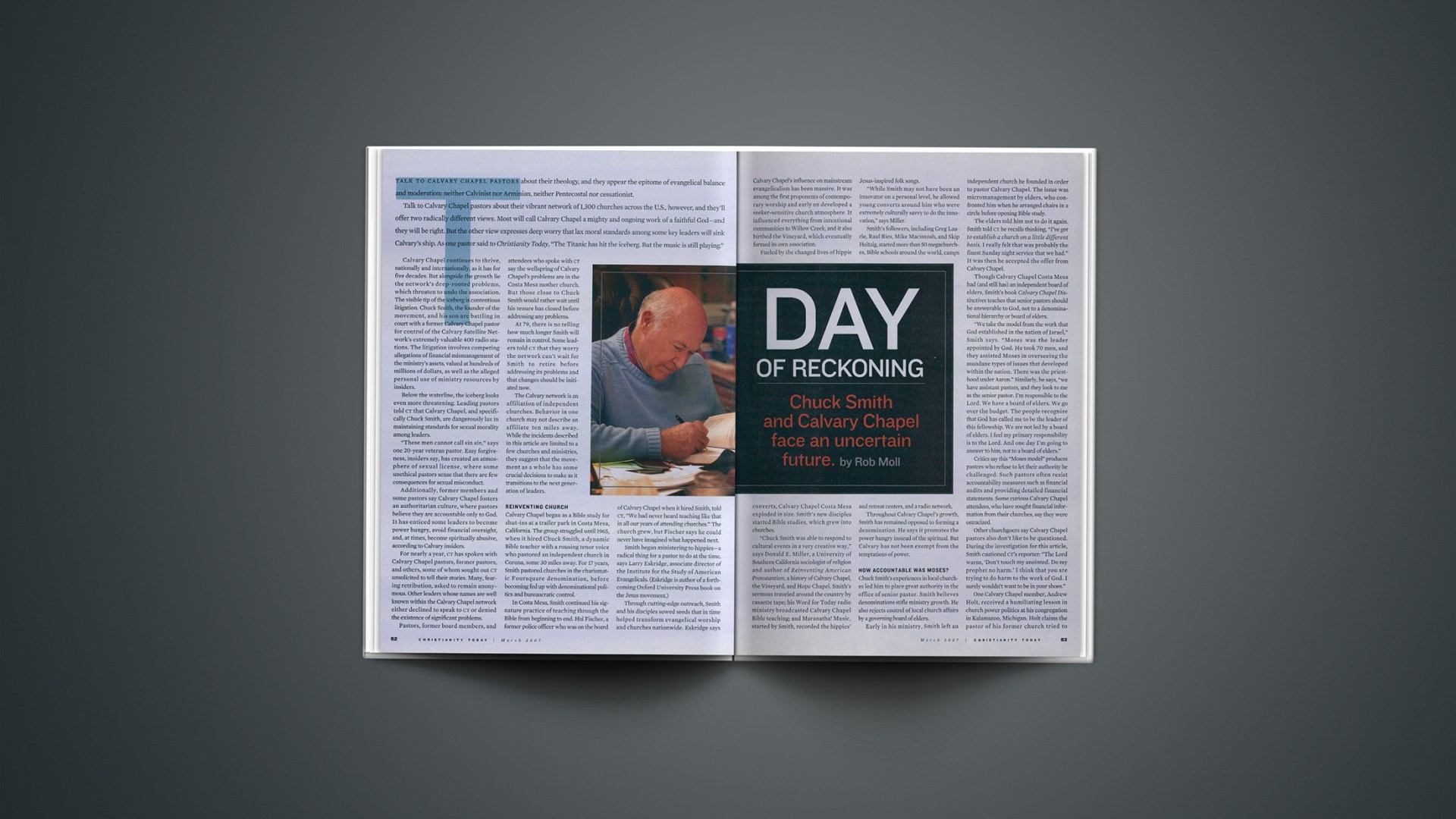

Talk to Calvary Chapel pastors about their theology, and they appear the epitome of evangelical balance and moderation: neither Calvinist nor Arminian, neither Pentecostal nor cessationist.
Talk to Calvary Chapel pastors about their vibrant network of 1,300 churches across the U.S., however, and they’ll offer two radically different views. Most will call Calvary Chapel a mighty and ongoing work of a faithful God—and they will be right. But the other view expresses deep worry that lax moral standards among some key leaders will sink Calvary’s ship. As one pastor said to Christianity Today, “The Titanic has hit the iceberg. But the music is still playing.”
Calvary Chapel continues to thrive, nationally and internationally, as it has for five decades. But alongside the growth lie the network’s deep-rooted problems, which threaten to undo the association. The visible tip of the iceberg is contentious litigation. Chuck Smith, the founder of the movement, and his son are battling in court with a former Calvary Chapel pastor for control of the Calvary Satellite Network’s extremely valuable 400 radio stations. The litigation involves competing allegations of financial mismanagement of the ministry’s assets, valued at hundreds of millions of dollars, as well as the alleged personal use of ministry resources by insiders.
Below the waterline, the iceberg looks even more threatening. Leading pastors told CT that Calvary Chapel, and specifically Chuck Smith, are dangerously lax in maintaining standards for sexual morality among leaders.
“These men cannot call sin sin,” says one 20-year veteran pastor. Easy forgiveness, insiders say, has created an atmosphere of sexual license, where some unethical pastors sense that there are few consequences for sexual misconduct.
Additionally, former members and some pastors say Calvary Chapel fosters an authoritarian culture, where pastors believe they are accountable only to God. It has enticed some leaders to become power hungry, avoid financial oversight, and, at times, become spiritually abusive, according to Calvary insiders.
For nearly a year, CT has spoken with Calvary Chapel pastors, former pastors, and others, some of whom sought out CT unsolicited to tell their stories. Many, fearing retribution, asked to remain anonymous. Other leaders whose names are well known within the Calvary Chapel network either declined to speak to CT or denied the existence of significant problems.
Pastors, former board members, and attendees who spoke with CT say the wellspring of Calvary Chapel’s problems are in the Costa Mesa mother church. But those close to Chuck Smith would rather wait until his tenure has closed before addressing any problems.
At 79, there is no telling how much longer Smith will remain in control. Some leaders told CT that they worry the network can’t wait for Smith to retire before addressing its problems and that changes should be initiated now.
The Calvary network is an affiliation of independent churches. Behavior in one church may not describe an affiliate ten miles away. While the incidents described in this article are limited to a few churches and ministries, they suggest that the movement as a whole has some crucial decisions to make as it transitions to the next generation of leaders.
Reinventing Church
Calvary Chapel began as a Bible study for shut-ins at a trailer park in Costa Mesa, California. The group struggled until 1965, when it hired Chuck Smith, a dynamic Bible teacher with a rousing tenor voice who pastored an independent church in Corona, some 30 miles away. For 17 years, Smith pastored churches in the charismatic Foursquare denomination, before becoming fed up with denominational politics and bureaucratic control.
In Costa Mesa, Smith continued his signature practice of teaching through the Bible from beginning to end. Hal Fischer, a former police officer who was on the board of Calvary Chapel when it hired Smith, told CT, “We had never heard teaching like that in all our years of attending churches.” The church grew, but Fischer says he could never have imagined what happened next.
Smith began ministering to hippies—a radical thing for a pastor to do at the time, says Larry Eskridge, associate director of the Institute for the Study of American Evangelicals. (Eskridge is author of a forthcoming Oxford University Press book on the Jesus movement.)
Through cutting-edge outreach, Smith and his disciples sowed seeds that in time helped transform evangelical worship and churches nationwide. Eskridge says Calvary Chapel’s influence on mainstream evangelicalism has been massive. It was among the first proponents of contemporary worship and early on developed a seeker-sensitive church atmosphere. It influenced everything from intentional communities to Willow Creek, and it also birthed the Vineyard, which eventually formed its own association.
Fueled by the changed lives of hippie converts, Calvary Chapel Costa Mesa exploded in size. Smith’s new disciples started Bible studies, which grew into churches.
“Chuck Smith was able to respond to cultural events in a very creative way,” says Donald E. Miller, a University of Southern California sociologist of religion and author of Reinventing American Protestantism, a history of Calvary Chapel, the Vineyard, and Hope Chapel. Smith’s sermons traveled around the country by cassette tape; his Word for Today radio ministry broadcasted Calvary Chapel Bible teaching; and Maranatha! Music, started by Smith, recorded the hippies’ Jesus-inspired folk songs.
“While Smith may not have been an innovator on a personal level, he allowed young converts around him who were extremely culturally savvy to do the innovation,” says Miller.
Smith’s followers, including Greg Laurie, Raul Ries, Mike Macintosh, and Skip Heitzig, started more than 50 megachurches, Bible schools around the world, camps and retreat centers, and a radio network.
Throughout Calvary Chapel’s growth, Smith has remained opposed to forming a denomination. He says it promotes the power hungry instead of the spiritual. But Calvary has not been exempt from the temptations of power.
How Accountable was Moses?
Chuck Smith’s experiences in local churches led him to place great authority in the office of senior pastor. Smith believes denominations stifle ministry growth. He also rejects control of local church affairs by a governing board of elders.
Early in his ministry, Smith left an independent church he founded in order to pastor Calvary Chapel. The issue was micromanagement by elders, who confronted him when he arranged chairs in a circle before opening Bible study.
The elders told him not to do it again. Smith told CT he recalls thinking, “I’ve got to establish a church on a little different basis. I really felt that was probably the finest Sunday night service that we had.” It was then he accepted the offer from Calvary Chapel.
Though Calvary Chapel Costa Mesa had (and still has) an independent board of elders, Smith’s book Calvary Chapel Distinctives teaches that senior pastors should be answerable to God, not to a denominational hierarchy or board of elders.
“We take the model from the work that God established in the nation of Israel,” Smith says. “Moses was the leader appointed by God. He took 70 men, and they assisted Moses in overseeing the mundane types of issues that developed within the nation. There was the priesthood under Aaron.” Similarly, he says, “we have assistant pastors, and they look to me as the senior pastor. I’m responsible to the Lord. We have a board of elders. We go over the budget. The people recognize that God has called me to be the leader of this fellowship. We are not led by a board of elders. I feel my primary responsibility is to the Lord. And one day I’m going to answer to him, not to a board of elders.”
Critics say this “Moses model” produces pastors who refuse to let their authority be challenged. Such pastors often resist accountability measures such as financial audits and providing detailed financial statements. Some curious Calvary Chapel attendees, who have sought financial information from their churches, say they were ostracized.
Other churchgoers say Calvary Chapel pastors also don’t like to be questioned. During the investigation for this article, Smith cautioned CT’s reporter: “The Lord warns, ‘Don’t touch my anointed. Do my prophet no harm.’ I think that you are trying to do harm to the work of God. I surely wouldn’t want to be in your shoes.”
One Calvary Chapel member, Andrew Holt, received a humiliating lesson in church power politics at his congregation in Kalamazoo, Michigan. Holt claims the pastor of his former church tried to commandeer the prison ministry he ran by reportedly telling the ministry’s board members and supporters that Holt was unfaithful to his wife. Holt denies the allegation.
Roger Ulman is pastor of Calvary Chapel of Kalamazoo and a former board member of Living Stone Counseling and Consulting Center, a prison ministry run by Holt. Holt and his wife attended Calvary Chapel for several years. When the couple went through marital difficulties, they went to Pastor Ulman for counseling. But, Holt told CT, “Ulman took that as an opportunity to divide my wife and me and to try to subsequently take charge of this ministry. He went behind our backs and started to talk to all the board members.”
Holt says Ulman told his wife to leave the marriage. He says Ulman told board members, financial supporters, and ministry clients to quit associating with Holt, because Holt wasn’t faithful to his wife.
It wasn’t long before donations dropped from an average of $2,500 per month to $1,000. “You couldn’t attack us any worse than what they did,” Holt says. He believes Ulman wanted to take control of the ministry and bring it under the auspices of the church. (Ulman declined to be interviewed by CT, saying he wanted to move on from the incident.) Holt was rebuffed when he tried to resolve the situation through Calvary Chapel’s oversight process.
Accountability for network pastors is provided by Calvary Chapel Outreach Fellowships, a ministry of Calvary Chapel Costa Mesa. Senior pastors are asked to oversee regions assigned to them. The ministry is currently run by Paul Smith, Chuck’s brother. Bill Ritchie, pastor of Crossroads Community Church in Vancouver, Washington, watches over Calvary Chapel pastors in churches in the Pacific Northwest. A veteran church leader, Ritchie pastored Methodist churches and worked with the World Council of Churches before joining the Calvary Chapel system.
Ritchie says the accountability system has limits. It is voluntary for both the overseer and the pastors. Then again, he says, there is no foolproof system of accountability. “I’ve seen travesty in every form of governance that exists.”
“Frankly,” he says, “you will be accountable for what you will be accountable for.”
Though its system of accountability may have weaknesses, Calvary Chapel pastors have been asked to step down and occasionally have been removed from the association.
But one 20-year veteran pastor says that while leaders are willing to enforce standards on a host of issues, sexual immorality is treated differently. This pastor, who has been senior pastor at several Calvary Chapels as well as an associate pastor at Calvary Chapel Costa Mesa, says pastors have been removed from ministry for dancing or for abusing drugs, yet while he was on staff at Costa Mesa, he saw a pastor talked out of stepping down after admitting to an addiction to pornography. The pastor says follow-up counseling was done only occasionally.
Sexual License
Calvary Chapel Costa Mesa sometimes hires pastors who have recently been removed from their churches for misconduct and immorality.
In 1992, the board of Calvary Church, Santa Ana (which is not affiliated with Calvary Chapel), removed its then-prominent pastor, David Hocking, for having an affair. Within three months, Chuck Smith had hired him. At the time, Smith told CT, “This man is a gifted Bible teacher. And if he doesn’t resume his teaching, I’m afraid he’ll be literally and totally destroyed.” Hocking’s church complained that Smith had interrupted the restoration process they had established.
In 2005, Calvary Chapel of Laguna Beach, California, fired pastor Joe Sabolick, accusing him of embezzlement and adultery. He denied the charges and sued the church and its board. Smith then hired Sabolick to lead worship in Costa Mesa. Sabolick later dropped the suit.
Former pastors and board members say Calvary Chapel Costa Mesa doesn’t only prematurely restore pastors to ministry; it also covers up the sexual sins of its own pastoral staff. In 2003, John Flores, then a Costa Mesa pastor, was arrested and later convicted of having sex with a 15-year-old girl, the daughter of another pastor at the church.
Knowledgeable church insiders say Flores had been fired previously from a Calvary Chapel Costa Mesa ministry for having sex with an adult woman on church grounds. Other sources familiar with the situation confirmed that Flores had, in fact, been fired twice previously from Calvary ministries, both times for alleged sexual misconduct. “They all knew that this man had been fired,” a former church member says of Costa Mesa’s church leadership, “and no one said, ‘Stay away from him.’ ” Two former board members independently confirmed these details to CT.
During a lengthy interview, Smith told CT that Calvary Chapel Costa Mesa had never had problems with sexual sin among staff members. But when asked about Flores, he admitted the incident had occurred and said the church had cooperated with the police investigation. Smith denied that Flores had been fired previously for sexual immorality, however. He said Flores had been fired from the radio ministry, The Word for Today, simply for failing to do his work. “It wasn’t anything sexual,” he said.
Last year, another episode occurred, about which the facts remain in dispute. Jeff Scheller, a former Calvary Chapel Costa Mesa pastor, says a 12-year-old churchgoer asked his wife for advice in dealing with inappropriate touching by a pastor. As required by law, Scheller reported the incident to the police. But Scheller’s boss denied that the pastor in question had misbehaved, even though he had previously been accused of inappropriate behavior toward minors.
Scheller says he paid a price for sounding the alarm. “They started to make changes without talking to me,” he says. “It was obvious to me that I was being cut out.” Scheller, who was talked out of resigning when Smith hired Sabolick, resigned for good after this incident.
Scheller’s boss, Brian Broderson, did not respond to requests for an interview. When asked about the incident, Smith told CT he couldn’t remember it. Later, when asked again, Smith said Scheller was disgruntled. He said the church cooperated with a police investigation that cleared the pastor, who remains on staff. Santa Ana police told CT that interviews with girls at the church could not verify that anything illegal had occurred.
Smith says he practices restoration and that pastors who have been restored to ministry after sexual sin have gone on to run successful ministries. “If they repent, we do seek to restore in a spirit of meekness, considering ourselves lest we be tempted,” Smith says. “We feel that we have a biblical basis [for doing so].”
If pastors repent and enter counseling, Smith says, they should not be forced to leave the pulpit permanently. “I can tell you of many ministers, great ministers, whom we’ve been in the process of helping restore, and fortunately the problems never became public and so people are not even aware of them. I feel that that’s an honor to God.”
Smith’s approach is at one extreme of typical evangelical views on the restoration of sexually immoral pastors, says Dave Edling, senior ministry consultant of Peacemaker Ministries. He believes restoration should always include a public rebuke for the benefit of the pastor and the congregation. He says that while situations vary, it’s best for a pastor to step down for at least three or four months.
“As a leader of God’s people, a pastor needs to reflect a deep heart change,” he says.
Control of Assets
Former board members say Smith’s practice of keeping pastors in the pulpit after sexual sin is at the heart of the lawsuit and a battle for control over the Calvary Satellite Network (CSN) with its 400 stations.
Mike Kestler is pastor of Calvary Chapel Twin Falls in Idaho and president of CSN. Kestler, who is married, is also embroiled in accusations of sexual harassment and womanizing.
In 1994, the church’s board wanted Kestler to take a leave of absence after women in the church claimed he had pursued relationships with them. Chuck Smith intervened to keep Kestler in the pulpit. Smith says he did not believe the accusations.
Kevin Newbry, a former Twin Falls board member, says there was “more at stake” than whether Kestler should pastor the church. He says Smith didn’t want to jeopardize plans for CSN, which was being created.
In 1996, CSN and Calvary Chapel Twin Falls established the radio network. Together, Calvary Chapel Twin Falls and Calvary Chapel Costa Mesa grew it to 47 full-power stations and 352 translator stations. Costa Mesa funded the expansion, while Twin Falls provided the radio expertise. Jeff Smith (a son of Chuck Smith) and Mike Kestler are the only board members of CSN. Chuck Smith resigned from the board in 2003, he says, because of business disagreements.
But Smith is still involved. In December 2005, Lori Pollitt, a former CSN employee, filed a lawsuit accusing Kestler of sexual harassment. She told CT that Smith offered to help fund the suit.
Smith says he now believes the allegations against Kestler. “We’ve had complaints come to us from numerous women,” Smith says. “When I became convinced that the stories were true, we dropped him from the fellowship of Calvary Chapel.”
The Smiths and Kestler are waging a battle in court, though Smith says he hopes to settle. In February 2006, Kestler and Jeff Smith sued one another. Kestler accused Smith of depositing listener donations in non-CSN accounts, loaning himself money from CSN, and mismanaging CSN’s finances. Kestler also accused Jeff Smith of mingling funds from CSN and The Word for Today, Chuck Smith’s radio ministry.
In response, The Word for Today (TWFT) and Jeff Smith sued Kestler for not paying back $976,975 in loans made by TWFT to Kestler’s church between 1999 and 2001. The Smiths accused Kestler of using his radio program to pursue sexual affairs, “pilfering . . . CSN corporate assets, income, revenues,” and using CSN credit cards for personal purchases.
According to complaints by Jeff Smith, CSN and Calvary Chapel Twin Falls “became inextricably entangled at some broadcast locations,” and CSN is insolvent.
Former board members at Calvary Chapel Costa Mesa, who funded CSN’s expansion, say the problems at CSN began in Costa Mesa. “Chuck Smith should have disciplined [Kestler] long ago,” says a former board member. “If he had, Pollitt wouldn’t have been victimized.”
Board members are especially concerned about CSN because for years the Costa Mesa church provided $100,000 per month to the radio network. Smith says the church gave a total of $11 million. Smith says his accounting department is impeccable, but board members say money from Calvary Chapel Costa Mesa is regularly used to fund ministries, like CSN, from Brazil to Moscow. They complain their gifts and loans are not accompanied by adequate financial oversight.
Learning the Hard Way
One fed-up Calvary Chapel pastor told CT that his congregation and others are considering changing their names. “I believe in the Calvary distinctives,” he says. “But people are losing respect.”
He says loyalty to Chuck Smith is all that holds the association together. Some say after Smith’s passing, Calvary Chapel will break up. Others say it will form a denomination.
Chuck Smith Jr., who was recently expelled from the association for theological reasons, says he is not aware of many of the details spelled out in this article. Still, he believes that Calvary Chapel holds a lesson for evangelicals. Entrepreneurial men with little training start Bible studies, grow churches, or head to the mission field. Their ministries become multimillion-
dollar organizations. Most of the time, these churches and ministries are successful. But failures loom large.
Michael Newnham, a former Calvary Chapel pastor, says his experience suggests the association has systemic problems. “There was adultery in the leadership. There were alcohol and drug problems in the leadership, and none of them were being dealt with. If you did say anything about them, you ended up being ostracized.” Newnham now runs a blog where he reports on scandals and gives a voice to Calvary Chapel members who have been victims of other scandals.
But Ritchie, the pastor of a Calvary Chapel-affiliated church in Vancouver, Washington, and overseer of pastors in the Pacific Northwest, joined Calvary Chapel after starting an independent church precisely because he wanted accountability.
The problem, Ritchie says, is a problem with the American church at large. “More and more large, independent churches are starting up with no relationship or accountability to anybody. They have nobody at any juncture to call them into question.” At the same time, most insiders agree that the network’s loose association and pastor-centered structure is subject to abuse.
“We’re a fast-moving movement,” says Mark Foreman, pastor of North Coast Calvary Chapel in Carlsbad, California. “There is little decision-making red tape.” That’s what makes Calvary Chapel so dynamic, he says. And, he adds, “That’s our Achilles’ heel.”
Foreman has resisted the strong senior pastor model. Since being hired as senior pastor, Foreman has tried to share power with his board and other pastors. He jokes that he has less authority now than when he started.
He also says he’s been impressed with Chuck Smith’s leadership. Smith could have put himself at the head of a national organization. Instead, he gave his mentees freedom to innovate and minister as they saw fit. “Chuck Smith wielded power well,” he says.
Still, he says, the typical Calvary Chapel model may be “an old wineskin that is cracking.” What made Calvary Chapel dynamic was its ability to reach the unchurched in culturally relevant ways. It’s still Calvary Chapel’s strength, he says.
But the association is now at a crossroads, Foreman says. “Will Calvary Chapel go on to the next generation, or will we defeat ourselves?” Its current problems are a test of the network’s ability to institutionalize in a way that corrects problems yet still maintains the dynamism it had during the Jesus movement.
Rob Moll is an associate editor of CT.
Copyright © 2007 Christianity Today. Click for reprint information.
Related Elsewhere:
Calvary Chapel Costa Mesa’s website has a short bio of Chuck Smith and a basic history of Calvary Chapel.
Former Calvary Chapel pastor Michael Newnham runs Phoenix Preacher, a blog that is “seeking the restoration of integrity in ministry.”
Get Religion discussed a 2005 L.A. Times article about the Calvary Satellite Network.
The Rick Ross Institute has a collection of news stories and visitor comments on Calvary Chapel.
Rob Moll has also written two other Christianity Today articles on Calvary Chapel:
Calvary Reunion | New Mexico megachurch pastor returns after leadership conflict. (September 28, 2006)
Unaccountable at Calvary Chapel | Former pastor still pulled strings years after his departure, Calvary of Albuquerque members claim. (May 8, 2006)
Other Christianity Today articles on Calvary Chapel include:
Weblog: The Sin of Talking to a Reporter | Church fires pastor for being sick, elder for being quoted. (April 13, 2006)
Admissions: Rejected | Christian school sues University of California over requirements. (November 2005)
The Peoples are Here | Record immigration pushes Christians out of their comfort zone (February 1, 2003)
Churches Accused of Electioneering (February 8, 1999)
Leadership Journal published Getting Back to Nurture by Chuck Smith Sr. in 1988.
Leadership reviewed Reinventing American Protestantism, which focuses on Hope Chapel, Calvary Chapel, and the Vineyard
Christian History & Biography discussed Calvary Chapel’s role in the Jesus Movement.







