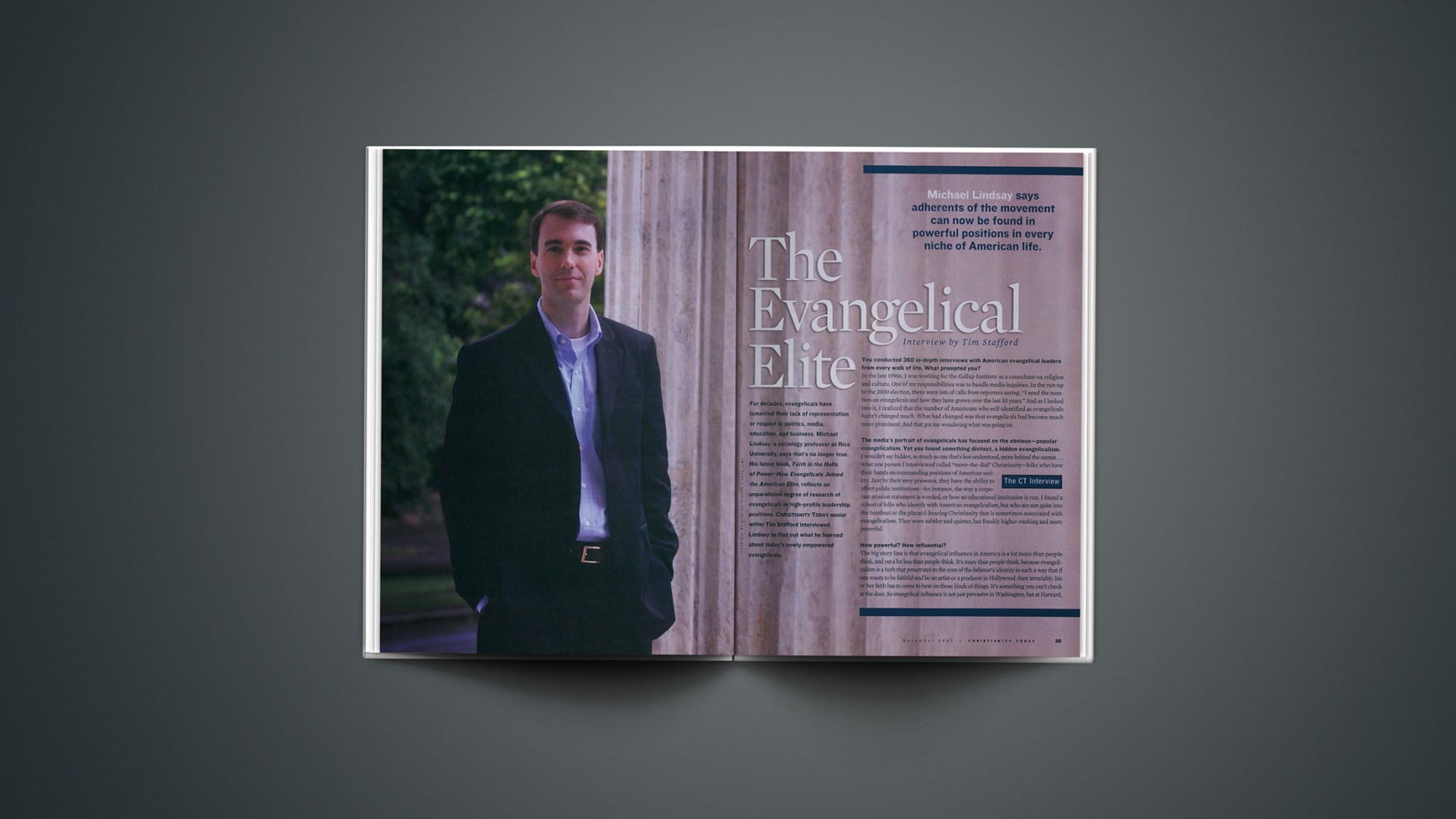
For decades, evangelicals have lamented their lack of representation or respect in politics, media, education, and business. Michael Lindsay, a sociology professor at Rice University, says that’s no longer true. His latest book, Faith in the Halls of Power: How Evangelicals Joined the American Elite, reflects an unparalleled degree of research of evangelicals in high-profile leadership positions. Christianity Today senior writer Tim Stafford interviewed Lindsay to find out what he learned about today’s newly empowered evangelicals.
You conducted 360 in-depth interviews with American evangelical leaders from every walk of life. What prompted you?
In the late 1990s, I was working for the Gallup Institute as a consultant on religion and culture. One of my responsibilities was to handle media inquiries. In the run-up to the 2000 election, there were lots of calls from reporters saying, “I need the numbers on evangelicals and how they have grown over the last 30 years.” And as I looked into it, I realized that the number of Americans who self-identified as evangelicals hadn’t changed much. What had changed was that evangelicals had become much more prominent. And that got me wondering what was going on.
The media’s portrait of evangelicals has focused on the obvious—popular evangelicalism. Yet you found something distinct, a hidden evangelicalism.
I wouldn’t say hidden, so much as one that’s less understood, more behind the scenes … what one person I interviewed called “move-the-dial” Christianity—folks who have their hands on commanding positions of American society. Just by their very presence, they have the ability to affect public institutions—for instance, the way a corporate mission statement is worded, or how an educational institution is run. I found a cohort of folks who identify with American evangelicalism, but who are not quite into the bombast or the placard-bearing Christianity that is sometimes associated with evangelicalism. They were subtler and quieter, but frankly higher-ranking and more powerful.
How powerful? How influential?
The big story line is that evangelical influence in America is a lot more than people think, and yet a lot less than people think. It’s more than people think, because evangelicalism is a faith that penetrates to the core of the believer’s identity in such a way that if one wants to be faithful and be an artist or a producer in Hollywood, then invariably, his or her faith has to come to bear on those kinds of things. It’s something you can’t check at the door. So evangelical influence is not just pervasive in Washington, but at Harvard, in Hollywood, on Wall Street, and in Silicon Valley.
But it’s a lot less than people think because there’s not some unified strategy to co-opt or take over the country. Even if evangelicals wanted to do that (which I don’t find that they do), there’s too much diversity in the movement; the differences of opinion are too great. There’s a lot of space between Rick Warren and Pat Robertson, between Joel Osteen and George Bush. I find no evidence of some vast, right-wing conspiracy being coordinated by evangelical power brokers.
How are these evangelicals different from more “populist” evangelicals?
The cosmopolitan evangelicals I write about are people who are just as committed to their faith, just as involved in mainstream evangelical life. By and large, they are very orthodox in their beliefs. Yet they rub shoulders with a much more diverse population. They’re far from insular or inward-focused. The majority of their working day is spent with people of different faiths or of no faith. They have reached higher levels of education. One in ten of those whom I interviewed earned a degree at Harvard, either undergraduate or graduate. It’s a very elite group, but it’s not really about class sensibility—it’s more about an orientation to the world. They read Christianity Today, but they also read The New York Times. They might go to a Christian rock concert, but they also go to the symphony. And they have a broadmindedness that goes alongside their faith.
I was really struck by how these cosmopolitan evangelicals in New York or Los Angeles or Chicago look more like each other than they do the folks who go to church with them. They might go to a regular congregation, but their faith is broader, or at least espouses a greater appreciation for pluralism and diversity. I would say one of the key differences is that populist evangelicals are very interested in converting the other. That’s a real driving mechanism—trying to persuade others that Christianity is right. I didn’t find that quite as prominent among cosmopolitan evangelicals. They were more interested in legitimacy. They wanted their faith to be seen as valid, something that smart, intelligent people could embrace, that you didn’t have to check your brain at the door to accept. You’ve got this more intelligent, savvy, well-traveled experience that naturally shapes the cosmopolitan’s faith.
A lot of the elites I interviewed are really not that different from their peers. They stay in fancy hotels, they drive nice cars; some of them own their own airplanes. They are high flyers, and they aren’t necessarily living like the poor. Many people I interviewed are living a considerably lower lifestyle than they can afford, because their faith compels them to. But still, many of them stay at hotels like the Four Seasons or the Ritz Carlton, and they have conferences at exotic locales. Their faith extends into these elite corridors. It’s something they incorporate into their elite world; it isn’t something they leave behind.
How do these leaders connect with each other?
For many of these leaders, local church involvement is not the principal source of spiritual solidarity. Rather, it comes from being involved in small groups, often among peers. Business leaders meet with other business leaders for a prayer breakfast or a Bible study the first Tuesday of every month. Or folks in the White House get together for the White House Christian fellowship. And these informal, loose alliances have over time built a dense web of overlapping networks of really powerful people, so that evangelicals in Hollywood know evangelicals in Washington. Social networks or spiritual friendships or faith-formed small groups have come to be so prominent among the nation’s elite. I think these webs have played a big role in advancing evangelicalism over the last 30 years.
What types of networks are most important to them?
There are two major constellations of networks. One of those is constituted by board membership on parachurch evangelical organizations. So board members for World Vision all know one another, though they come from different places and different social contexts, and are intentionally drawn from different spheres of influence. Everyone on that board is a person of influence, and everyone who is there runs in similar circles, only in different towns. That occurs for every national evangelical parachurch ministry. Because those boards meet on a regular basis, long-term, meaningful ties are formed.
The parachurch sector has been the fulcrum of evangelical influence over the last 30 years. I found hundreds of leaders who are far more committed to being involved in a particular small group or in parachurch ministry than they are to being involved in their local church.
The other constellation of networks is the various, widely dispersed special initiatives toward members of the American elite. Campus Crusade has launched the Christian Embassy, a ministry to reach people in Washington and the diplomatic corps in NYC. They have something called Impact 21, which is designed to reach top business leaders across American society. Focus on the Family had a ministry called CEO Forum. Prison Fellowship, Walk Thru the Bible, lots of different ministries hold special weekends that are donor-relations events, and they try to reach folks who might financially support the ministry in a powerful way, but they also are opportunities to reach out to peers. I found those things happen all over the place.
In almost every American city, there is a monthly gathering of top leaders that is by-invitation-only. In Boston there’s a First Tuesday group, convened by Tom Phillips, former CEO of Raytheon. In NYC there’s a group that meets monthly at the Link Club, with a guy named Doug Holladay. In Washington there are several groups, largely supported by the National Prayer Breakfast ministry and a group called “the Fellowship”; in LA there’s a group that meets at the Screenwriters Theater monthly; a pastor in St. Louis flies out to speak to and encourage them.
And these have sprung up independently of each other.
That’s the amazing thing—it’s like 1,000 flowers blooming.
What do you think is behind that?
Two things. One is that evangelicals have been very focused on gaining traction among elite constituents in this country. And second is the entrepreneurial edge of evangelicalism. Evangelicals are head and shoulders above everyone else in terms of using entrepreneurial energy to make a difference. They are constantly trying new strategies. They dedicate a lot of energy and resources to making things happen. This is part of the religious DNA of American evangelicals.
That entrepreneurial spirit matches well with parachurch organizations, which are constantly innovating, but it may not fit so well with the ethos of a local church.
Parachurch board members told me, “I relate more deeply to the people on this board than I do to anyone at my church. We live in the same world and we face the same kinds of problems. That’s usually not true of the members of my church.”
Most evangelical elites continue to attend a local congregation, but they’re often not involved or engaged in the way they are with parachurch ministries. They get impatient with what they consider incompetence. They go to a committee meeting that may be poorly run, and they can’t stand to waste so much time getting so little accomplished. They realize that for some committee members, just being there is a high point of the week, a real source of stimulation. But for them it’s mostly a waste of time. So they engage elsewhere, where things are run with a higher degree of professionalism.
I was also surprised to find many who feel considerable tension with their pastor. This seemed particularly true of some business leaders I interviewed. Sometimes it’s because the pastor is not a good administrator or a good leader in the same mold as the corporate world’s leaders. And then too, most felt that the pastor just doesn’t have any idea about the world they inhabit. Sometimes, in fact, he or she is downright hostile to it. I talked to one CEO whose pastor preached against Christians who owned second houses and enjoyed perks like personal drivers. Well, this CEO was the only one in the church who had a second house and a driver. Why didn’t the pastor come to talk to him, instead of preaching about him to the rest of the church?
It’s not surprising, therefore, that if I found a church where three or four CEOs go, it was almost always a megachurch. In a large church they could blend in, or they had a large amount of respect for the senior pastor, who many times has the same kind of entrepreneurial ability and experience and drive they have.
And megachurches are conducted more like corporations.
That’s right. Megachurches are more in line with the leadership model many of these leaders know and use. Participative democracy is much more the model of local church life than the parachurch.
So where does this lead? You have elite leadership essentially not in step with local churches.
I think local church pastors need to think seriously about the ways they respond to and handle public leaders in their midst. I was struck by how very lonely many of these leaders said they were. A lot of them would have been thrilled to have a pastor come walk beside them, pray regularly with them, and provide pastoral support. But that doesn’t happen often. Some of them said, “I would love to have my pastor come and see what my day is like—to take a single day to experience that.” I think that’s one practical step pastors could take.
Alan Wolfe, the Boston College political scientist, has reached the conclusion that American evangelicals bought into the American dream and left their faith behind. You disagree. Why?
I just didn’t find that in the leaders I interviewed. I did find that Christianity and culture have mixed and intermarried in a lot of different ways. The most intriguing finding was the insignificance of local church life. So if Wolfe wanted to use that as a benchmark of orthodox Christianity, I’d say yeah, I agree with that. But I wouldn’t say it’s a watered-down faith. The leaders I interviewed espoused very traditional beliefs.
Do you find any anxiety about exclusivism among the elite?
You mean about creating a gated community of the soul? I did find that. Many of them who spearhead these exclusive, by-invitation-only events, said, “You know, I’m not sure that is exactly how Jesus would be running them.”
I was really struck by an interview with Dick DeVos, who was involved in a small group through his local church. He told me about another couple in his small group. The husband had just lost his job, they had a young child, and they were struggling with financial issues. He said to me, “If I weren’t involved with these folks, I wouldn’t know what it’s like to pray and say, ‘God, will you provide?'”
Americans by and large are uncomfortable with the very idea of elite. On top of that, add Christian ambivalence about wealth and power. Elite evangelicals have very conflicted feelings. And yet it’s not a debilitating emotion. For many of them it lights a fire in their belly to try to do something. That’s why a lot of these folks are what we would call “cultural entrepreneurs,” trying to do something for the common good. Their faith gives them a compelling sense of activism to make the world right. It also gives them a more positive outlook. They’re more hopeful about their ability to make a difference. Their Rolodexes are full and they have the right connections.
That’s different from what other studies find about the American elite. They look more insular, more focused on self-preservation, trying to maintain the establishment. Evangelicals come from a religious tradition that’s a protest movement—Protestantism—so they’re always about reform. It’s that reform impulse that compels evangelicals to try to make a difference.
There’s also a sense of immediacy. Other religious traditions are a little more patient. Evangelicals are a driven group, and they’re trying to bring that drive and enthusiasm to make a difference in the here and now.
You write that evangelicals practice “elastic orthodoxy.” Can you explain what you mean by that?
It’s what separates evangelicals from fundamentalists. The two groups share beliefs about the Bible, about Jesus, about God and the church. But they differ in how they respond to those shared convictions. Fundamentalists tend to separate from pluralistic society, while evangelicals actually engage it. So both evangelicals and fundamentalists share a core set of beliefs, this notion of orthodoxy. But evangelicals, and particularly those of the most recent generation, have an elasticity to their faith that compels them to build bridges and alliances with many different groups.
A lot of that is occurring in Washington. I think the most important piece of legislation passed in the last 20 years regarding a religious issue is the International Religious Freedom Act of 1998. A broad coalition of various religious groups came together to make religious freedom a bedrock of American foreign policy. It was important because it created more focus on religious freedom from the point of view of the State Department; at the same time, evangelicals have become in some ways the conscience of American foreign policy.
You examined four areas: politics, media, academia, and business. Where did you find evangelical leadership strongest, and where is it weakest?
The largest accumulation of evangelicals is clearly in the business world. And regarding their ability to make a difference, there is a pretty big difference between public companies, traded on the stock exchange, versus private companies. If you are the CEO of a private company run by you and your family, you have a lot of latitude.
The area with the least amount of influence would probably be in Hollywood. There’s really only one evangelical in the country who has the resources to “greenlight” a project, and that’s Phil Anschutz.
And he’s not in the traditional power structure there.
You got it. He’s an outsider who has clout; he’s not working through the existing structures. The existing structures are dominated by secular people. That said, there are more entrepreneurial energies devoted to Hollywood than I see even in the political domain. So I fully expect we will see some dramatic changes.
You infer a palpable distaste among the elite for evangelical culture—for its music, for its Thomas Kinkade artwork, for its suspicion of intellectualism and science.
That’s right. I would say two things go hand in hand that have the potential to cause deep divisions. One is the divide between mainstream cultural consumption and subcultural consumption—only listening to Christian radio, only buying your books from Christian bookstores. And then the other track is church versus non-church spiritual nourishment. Both of those have the potential to create deep divides in evangelicalism.
I think it’s too early to decipher what is going to happen. I don’t notice, for example, that this distaste for evangelical kitsch goes to a deeper level where there is distaste for fellow Christians. Many of the evangelical leaders would couch their comments in saying, “You know, these folks are so sincere about their faith.” They talk about going to Christian conferences where there are the Peter and Paul salt and pepper shakers, and they are dismissive about it. Later on they’ll come back to that as though their conscience is working on them. They’ll say, “You know, I went to one of those conferences and the couple told me about how those salt and pepper shakers meant something very important to them.”
What do you hope people will take away from your book?
There’s been a lot of attention on the stewardship of financial resources, but practically nothing on the stewardship of power. I hope my book will stir greater understanding of how to deal with the issues of power. At this point, the evangelical movement desperately needs more thoughtful reflection on Christians’ exercise of power. Because evangelicals have arrived. They have power that they didn’t have 30 years ago.
Copyright © 2007 Christianity Today. Click for reprint information.
Related Elsewhere:
Faith in the Halls of Power is available from ChristianBook.com and other retailers.
A review of the book accompanies this article.
Michael Lindsay discusses some of his findings on Authors@Google.