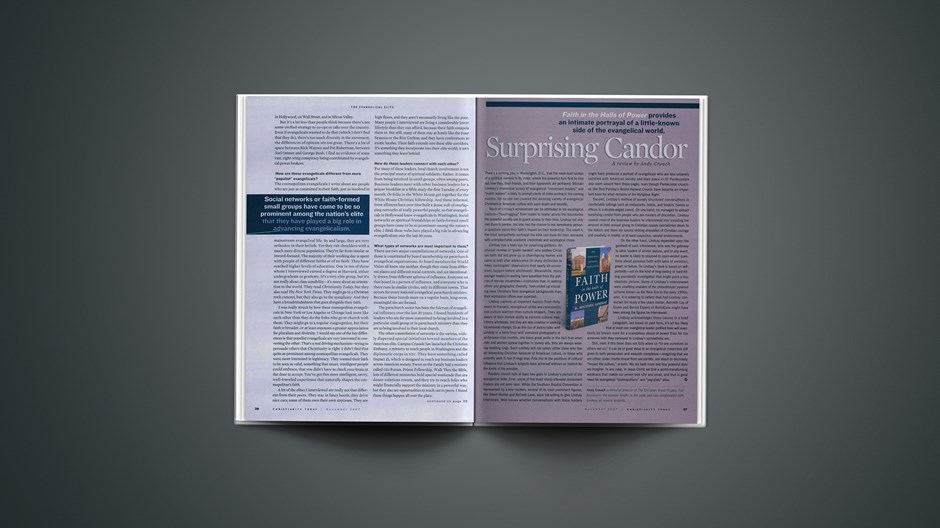
There's a running joke in Washington, D.C., that the most-read section of a political memoir is its index, where the powerful turn first to find out how they, their friends, and their opponents are portrayed. Michael Lindsay's impressive survey of evangelical "movement leaders" and "public leaders" is likely to prompt plenty of index-surfing in the coming months, for no one has covered the amazing variety of evangelical Christians in American culture with such depth and breadth.
Much of Lindsay's achievement can be attributed to his sociological method—"leapfrogging" from leader to leader across the boundaries the powerful usually use to guard access to their time. Lindsay not only met them in person, but also had the chance to ask remarkably personal questions about their faith's impact on their leadership. The result is the most sympathetic portrayal the elite can hope for from someone with unimpeachable academic credentials and sociological chops.
Lindsay has a keen eye for surprising patterns. An unusual number of "public leaders" who profess Christian faith did not grow up in churchgoing homes and came to faith after adolescence (in sharp distinction to many sociologists' observations that nearly all conversions happen before adulthood). Meanwhile, many younger leaders-in-waiting have benefited from the policies of secular universities—institutions that, in seeking ethnic and geographic diversity, have ended up educating more Christians from evangelical backgrounds than their admissions offices ever expected.
Lindsay captures an important nuance: From Hollywood to Harvard, evangelical elites are consistently less culture warriors than culture shapers. They are aware of their limited ability to reinvent cultural institutions wholesale, but they are also creative in seeking incremental change. So as the CEO of Jockey talks with Lindsay in a room lined with oversized photographs of underwear-clad models, she takes great pride in the fact that when men and women appear together in Jockey ads, they are always wearing wedding rings. Such subtlety will not satisfy either those who fear an impending Christian takeover of American culture, or those who ardently seek it, but it rings true: Few rise to the positions of cultural influence that Lindsay's subjects have achieved without an instinct for the limits of the possible.
Readers should note at least two gaps in Lindsay's portrait of the evangelical elite. First, some of the most sharp-elbowed movement leaders are not seen here. While the Southern Baptist Convention is represented by a few insiders, several of its most prominent figures, like Albert Mohler and Richard Land, were not willing to give Lindsay interviews. Who knows whether conversations with these leaders might have produced a portrait of evangelicals who are less urbanely satisfied with American society and their place in it? Pentecostals also seem absent from these pages, even though Pentecostal churches like Rod Parsley's World Harvest Church have become an important base for what remains of the Religious Right.
Second, Lindsay's method of loosely structured conversations in comfortable settings such as restaurants, hotels, and leaders' homes or offices is a double-edged sword. On one hand, he managed to extract surprising candor from people who are masters of discretion. Lindsay coaxed most of the business leaders he interviewed into revealing the amount of their annual giving to Christian causes (sometimes down to the dollar); and there are several striking anecdotes of Christian courage and creativity in hostile, or at least suspicious, secular environments.
On the other hand, Lindsay depended upon the goodwill of each interviewee, who was the gateway to other leaders of similar stature, and in any event, no leader is likely to respond to open-ended questions about personal faith with tales of ambition, greed, or failure. So Lindsay's book is based on self-portraits—not on the kind of long-lasting or hard-hitting journalistic investigation that might paint a less idealistic picture. Some of Lindsay's interviewees were unwitting enablers of the philanthropic pyramid scheme known as the New Era in the early 1990s; also, it is sobering to reflect that had Lindsay conducted his study a few years earlier, Kenneth Lay of Enron and Bernie Ebbers of WorldCom might have been among the figures he interviewed.
Lindsay acknowledges these ironies in a brief paragraph, but based on past form, it's all too likely that at least one evangelical leader profiled here will eventually be known more for a scandalous abuse of power than for the winsome faith they conveyed to Lindsay's sympathetic ear.
Still, even if this book does not fully allow us "to see ourselves as others see us," it can be of great value to an evangelical movement still given to both persecution and messiah complexes—imagining that we are either under mortal threat from secularists, are about to decisively "impact the culture," or both. We are both more and less powerful than we imagine. In any case, in Jesus Christ we find a world-transforming weakness that makes our power look silly and small, and that is good news for evangelical "cosmopolitans" and "populists" alike.
Article continues below
Andy Crouch is editorial director of The Christian Vison Project. Full disclosure: He appears briefly in the book and has collaborated with Lindsay on several projects.

















 While we pray for peace, we need moral clarity about this war.
 A Christian reconciliation group in Israel and Palestine warned that war would come. Now the war threatens their relevance.españolالعربيةFrançaisрусскийУкраїнська
 The rage of the mob is a poor substitute for real community.






