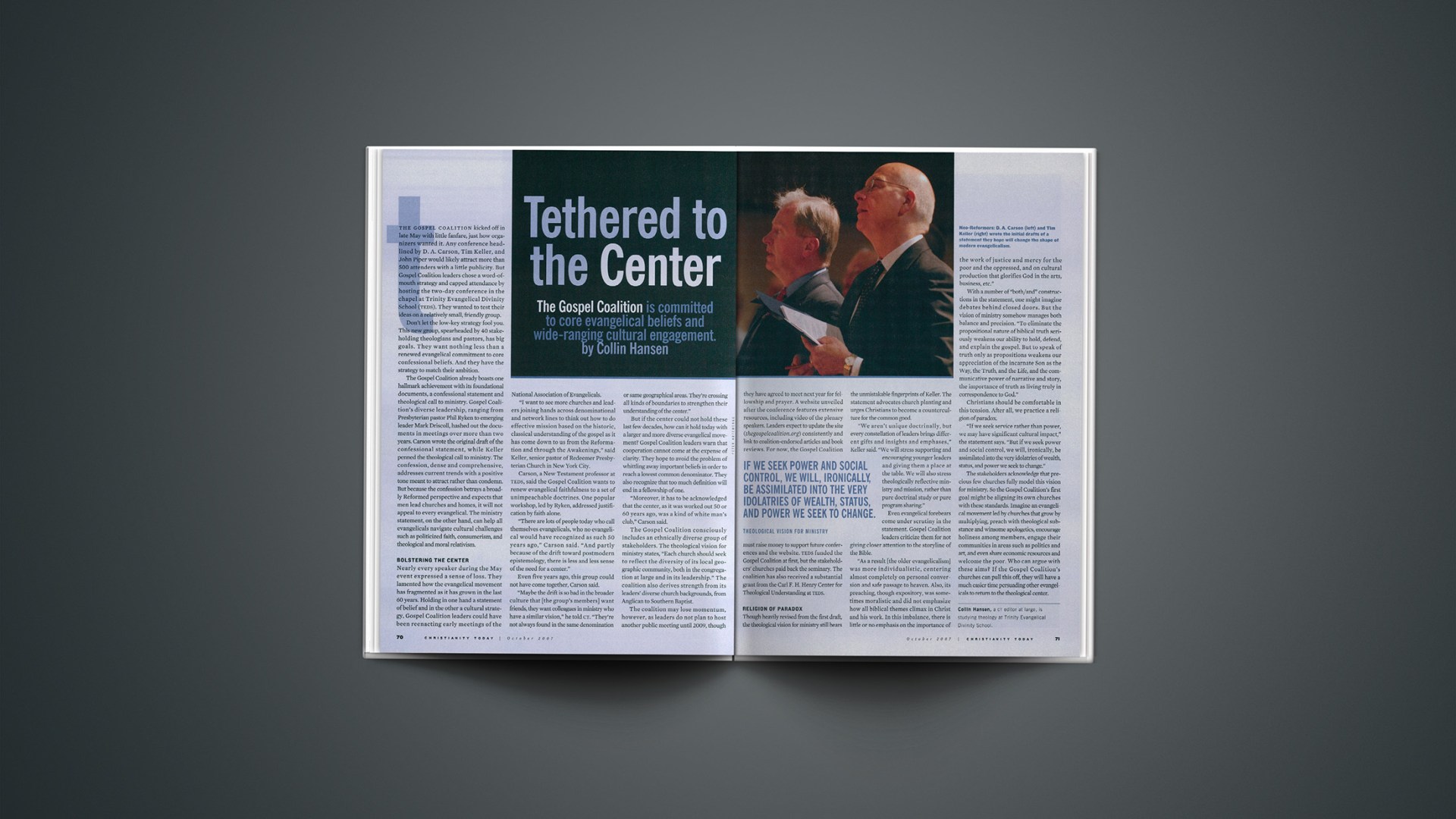

The Gospel Coalition kicked off in late May with little fanfare, just how organizers wanted it. Any conference headlined by D. A. Carson, Tim Keller, and John Piper would likely attract more than 500 attenders with a little publicity. But Gospel Coalition leaders chose a word-of-mouth strategy and capped attendance by hosting the two-day conference in the chapel at Trinity Evangelical Divinity School (TEDS). They wanted to test their ideas on a relatively small, friendly group.
Don’t let the low-key strategy fool you. This new group, spearheaded by 40 stake-holding theologians and pastors, has big goals. They want nothing less than a renewed evangelical commitment to core confessional beliefs. And they have the strategy to match their ambition.
The Gospel Coalition already boasts one hallmark achievement with its foundational documents, a confessional statement and theological call to ministry. Gospel Coalition’s diverse leadership, ranging from Presbyterian pastor Phil Ryken to emerging leader Mark Driscoll, hashed out the documents in meetings over more than two years. Carson wrote the original draft of the confessional statement, while Keller penned the theological call to ministry. The confession, dense and comprehensive, addresses current trends with a positive tone meant to attract rather than condemn. But because the confession betrays a broadly Reformed perspective and expects that men lead churches and homes, it will not appeal to every evangelical. The ministry statement, on the other hand, can help all evangelicals navigate cultural challenges such as politicized faith, consumerism, and theological and moral relativism.
Bolstering the Center
Nearly every speaker during the May event expressed a sense of loss. They lamented how the evangelical movement has fragmented as it has grown in the last 60 years. Holding in one hand a statement of belief and in the other a cultural strategy, Gospel Coalition leaders could have been reenacting early meetings of the National Association of Evangelicals.
“I want to see more churches and leaders joining hands across denominational and network lines to think out how to do effective mission based on the historic, classical understanding of the gospel as it has come down to us from the Reformation and through the Awakenings,” said Keller, senior pastor of Redeemer Presbyterian Church in New York City.
Carson, a New Testament professor at TEDS, said the Gospel Coalition wants to renew evangelical faithfulness to a set of unimpeachable doctrines. One popular workshop, led by Ryken, addressed justification by faith alone.
“There are lots of people today who call themselves evangelicals, who no evangelical would have recognized as such 50 years ago,” Carson said. “And partly because of the drift toward postmodern epistemology, there is less and less sense of the need for a center.”
Even five years ago, this group could not have come together, Carson said.
“Maybe the drift is so bad in the broader culture that [the group’s members] want friends, they want colleagues in ministry who have a similar vision,” he told CT. “They’re not always found in the same denomination or same geographical areas. They’re crossing all kinds of boundaries to strengthen their understanding of the center.”
But if the center could not hold these last few decades, how can it hold today with a larger and more diverse evangelical movement? Gospel Coalition leaders warn that cooperation cannot come at the expense of clarity. They hope to avoid the problem of whittling away important beliefs in order to reach a lowest common denominator. They also recognize that too much definition will end in a fellowship of one.
“Moreover, it has to be acknowledged that the center, as it was worked out 50 or 60 years ago, was a kind of white man’s club,” Carson said.
The Gospel Coalition consciously includes an ethnically diverse group of stakeholders. The theological vision for ministry states, “Each church should seek to reflect the diversity of its local geographic community, both in the congregation at large and in its leadership.” The coalition also derives strength from its leaders’ diverse church backgrounds, from Anglican to Southern Baptist.
The coalition may lose momentum, however, as leaders do not plan to host another public meeting until 2009, though they have agreed to meet next year for fellowship and prayer. A website unveiled after the conference features extensive resources, including video of the plenary speakers. Leaders expect to update the site (thegospelcoalition.org) consistently and link to coalition-endorsed articles and book reviews. For now, the Gospel Coalition must raise money to support future conferences and the website. TEDS funded the Gospel Coalition at first, but the stakeholders’ churches paid back the seminary. The coalition has also received a substantial grant from the Carl F. H. Henry Center for Theological Understanding at TEDS.
Religion of Paradox
Though heavily revised from the first draft, the theological vision for ministry still bears the unmistakable fingerprints of Keller. The statement advocates church planting and urges Christians to become a counterculture for the common good.
“We aren’t unique doctrinally, but every constellation of leaders brings different gifts and insights and emphases,” Keller said. “We will stress supporting and encouraging younger leaders and giving them a place at the table. We will also stress theologically reflective ministry and mission, rather than pure doctrinal study or pure program sharing.”
Even evangelical forebears come under scrutiny in the statement. Gospel Coalition leaders criticize them for not giving closer attention to the storyline of the Bible.
“As a result [the older evangelicalism] was more individualistic, centering almost completely on personal conversion and safe passage to heaven. Also, its preaching, though expository, was sometimes moralistic and did not emphasize how all biblical themes climax in Christ and his work. In this imbalance, there is little or no emphasis on the importance of the work of justice and mercy for the poor and the oppressed, and on cultural production that glorifies God in the arts, business, etc.”
With a number of “both/and” constructions in the statement, one might imagine debates behind closed doors. But the vision of ministry somehow manages both balance and precision. “To eliminate the propositional nature of biblical truth seriously weakens our ability to hold, defend, and explain the gospel. But to speak of truth only as propositions weakens our appreciation of the incarnate Son as the Way, the Truth, and the Life, and the communicative power of narrative and story, the importance of truth as living truly in correspondence to God.”
Christians should be comfortable in this tension. After all, we practice a religion of paradox.
“If we seek service rather than power, we may have significant cultural impact,” the statement says. “But if we seek power and social control, we will, ironically, be assimilated into the very idolatries of wealth, status, and power we seek to change.”
The stakeholders acknowledge that precious few churches fully model this vision for ministry. So the Gospel Coalition’s first goal might be aligning its own churches with these standards. Imagine an evangelical movement led by churches that grow by multiplying, preach with theological substance and winsome apologetics, encourage holiness among members, engage their communities in areas such as politics and art, and even share economic resources and welcome the poor. Who can argue with these aims? If the Gospel Coalition’s churches can pull this off, they will have a much easier time persuading other evangelicals to return to the theological center.
Collin Hansen, a CT editor at large, is studying theology at Trinity Evangelical Divinity School.
Copyright © 2007 Christianity Today. Click for reprint information.
Related Elsewhere:
The Gospel Coalition‘s website has posted their confessional statement, ministry vision, plenary talks from the first conference, and an extensive series of interviews with council members. They have tentatively planned the next conference for April 2009.
Other Christianity Today articles on evangelicalism include:
Pastor Provocateur | Love him or hate him, Mark Driscoll is helping people meet Jesus in one of America’s least-churched cities. (September 21, 2007)
Young, Restless, Reformed | Calvinism is making a comeback—and shaking up the church. (September 22, 2006)
Go and Plant Churches of All Peoples | Crusades and personal witnessing are no longer the cutting edge of evangelism. (September 27, 2007)
The Coral Ridge Strategy | D. James Kennedy explains how lay evangelism can lead to exponential growth. (September 5, 2007)
Why College Doesn’t Turn Kids Secular | Also: Richard Land on the footbath controversy, Falwell’s big Liberty gift, and other stories about higher education and research. (August 16, 2007)
Liberate My People | Theologian and educator Ruth Padilla DeBorst says true Christian mission addresses issues of power and poverty. (August 8, 2007)