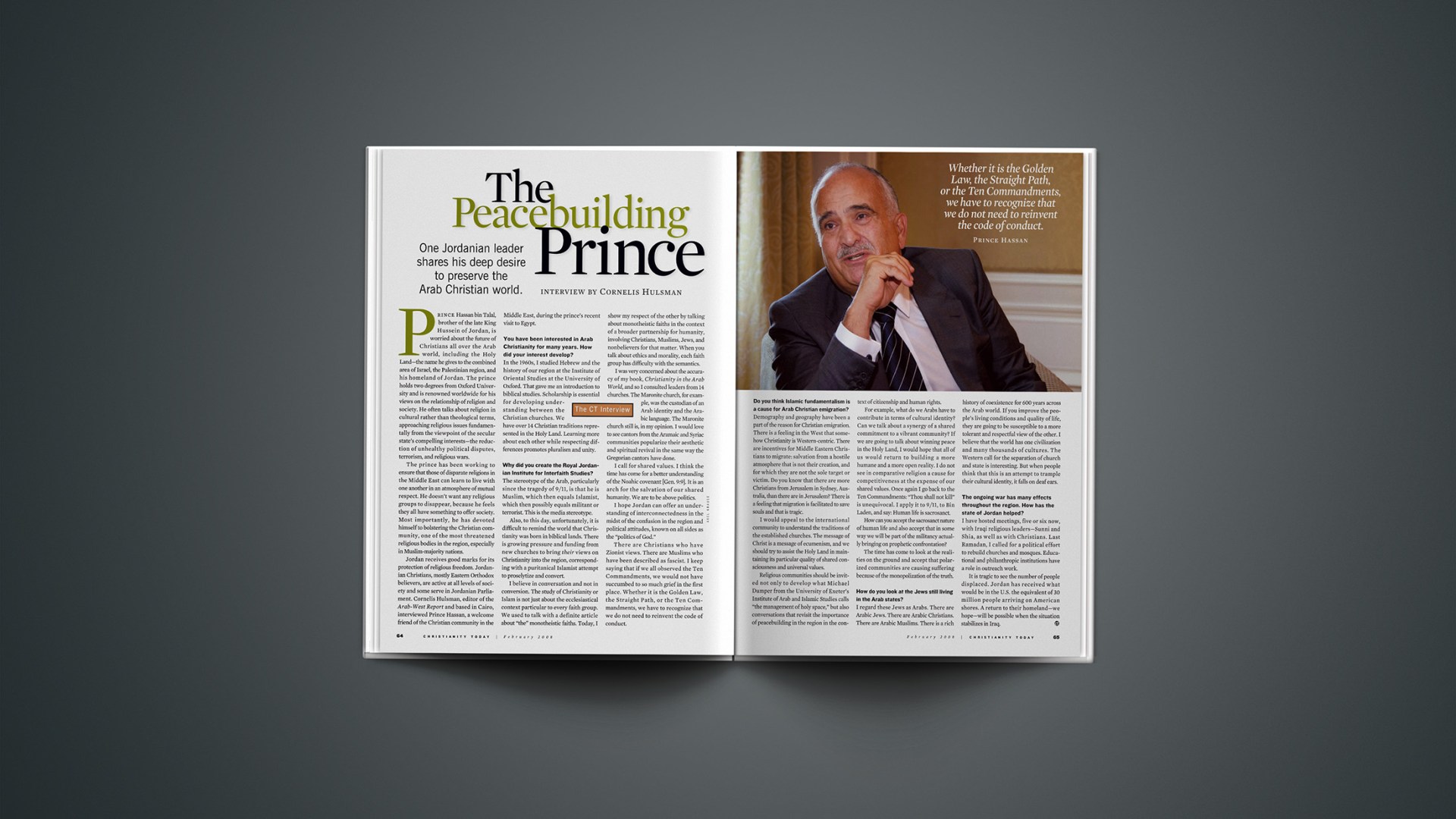

Prince Hassan bin Talal, brother of the late King Hussein of Jordan, is worried about the future of Christians all over the Arab world, including the Holy Land—the name he gives to the combined area of Israel, the Palestinian region, and his homeland of Jordan. The prince holds two degrees from Oxford University and is renowned worldwide for his views on the relationship of religion and society. He often talks about religion in cultural rather than theological terms, approaching religious issues fundamentally from the viewpoint of the secular state’s compelling interests—the reduction of unhealthy political disputes, terrorism, and religious wars.
The prince has been working to ensure that those of disparate religions in the Middle East can learn to live with one another in an atmosphere of mutual respect. He doesn’t want any religious groups to disappear, because he feels they all have something to offer society. Most importantly, he has devoted himself to bolstering the Christian community, one of the most threatened religious bodies in the region, especially in Muslim-majority nations.
Jordan receives good marks for its protection of religious freedom. Jordanian Christians, mostly Eastern Orthodox believers, are active at all levels of society and some serve in Jordanian Parliament. Cornelis Hulsman, editor of the Arab-West Report and based in Cairo, interviewed Prince Hassan, a welcome friend of the Christian community in the Middle East, during the prince’s recent visit to Egypt.
You have been interested in Arab Christianity for many years. How did your interest develop?
In the 1960s, I studied Hebrew and the history of our region at the Institute of Oriental Studies at the University of Oxford. That gave me an introduction to biblical studies. Scholarship is essential for developing understanding between the Christian churches. We have over 14 Christian traditions represented in the Holy Land. Learning more about each other while respecting differences promotes pluralism and unity.
Why did you create the Royal Jordanian Institute for Interfaith Studies?
The stereotype of the Arab, particularly since the tragedy of 9/11, is that he is Muslim, which then equals Islamist, which then possibly equals militant or terrorist. This is the media stereotype.
Also, to this day, unfortunately, it is difficult to remind the world that Christianity was born in biblical lands. There is growing pressure and funding from new churches to bring their views on Christianity into the region, corresponding with a puritanical Islamist attempt to proselytize and convert.
I believe in conversation and not in conversion. The study of Christianity or Islam is not just about the ecclesiastical context particular to every faith group. We used to talk with a definite article about “the” monotheistic faiths. Today, I show my respect of the other by talking about monotheistic faiths in the context of a broader partnership for humanity, involving Christians, Muslims, Jews, and nonbelievers for that matter. When you talk about ethics and morality, each faith group has difficulty with the semantics.
I was very concerned about the accuracy of my book, Christianity in the Arab World, and so I consulted leaders from 14 churches. The Maronite church, for example, was the custodian of an Arab identity and the Arabic language. The Maronite church still is, in my opinion. I would love to see cantors from the Aramaic and Syriac communities popularize their aesthetic and spiritual revival in the same way the Gregorian cantors have done.
I call for shared values. I think the time has come for a better understanding of the Noahic covenant [Gen. 9:9]. It is an arch for the salvation of our shared humanity. We are to be above politics.
I hope Jordan can offer an understanding of interconnectedness in the midst of the confusion in the region and political attitudes, known on all sides as the “politics of God.”
There are Christians who have Zionist views. There are Muslims who have been described as fascist. I keep saying that if we all observed the Ten Commandments, we would not have succumbed to so much grief in the first place. Whether it is the Golden Law, the Straight Path, or the Ten Commandments, we have to recognize that we do not need to reinvent the code of conduct.
Do you think Islamic fundamentalism is a cause for Arab Christian emigration?
Demography and geography have been a part of the reason for Christian emigration. There is a feeling in the West that somehow Christianity is Western-centric. There are incentives for Middle Eastern Christians to migrate: salvation from a hostile atmosphere that is not their creation, and for which they are not the sole target or victim. Do you know that there are more Christians from Jerusalem in Sydney, Australia, than there are in Jerusalem? There is a feeling that migration is facilitated to save souls and that is tragic.
I would appeal to the international community to understand the traditions of the established churches. The message of Christ is a message of ecumenism, and we should try to assist the Holy Land in maintaining its particular quality of shared consciousness and universal values.
Religious communities should be invited not only to develop what Michael Dumper from the University of Exeter’s Institute of Arab and Islamic Studies calls “the management of holy space,” but also conversations that revisit the importance of peacebuilding in the region in the context of citizenship and human rights.
For example, what do we Arabs have to contribute in terms of cultural identity? Can we talk about a synergy of a shared commitment to a vibrant community? If we are going to talk about winning peace in the Holy Land, I would hope that all of us would return to building a more humane and a more open reality. I do not see in comparative religion a cause for competitiveness at the expense of our shared values. Once again I go back to the Ten Commandments: “Thou shall not kill” is unequivocal. I apply it to 9/11, to Bin Laden, and say: Human life is sacrosanct.
How can you accept the sacrosanct nature of human life and also accept that in some way we will be part of the militancy actually bringing on prophetic confrontation?
The time has come to look at the realities on the ground and accept that polarized communities are causing suffering because of the monopolization of the truth.
How do you look at the Jews still living in the Arab states?
I regard these Jews as Arabs. There are Arabic Jews. There are Arabic Christians. There are Arabic Muslims. There is a rich history of coexistence for 600 years across the Arab world. If you improve the people’s living conditions and quality of life, they are going to be susceptible to a more tolerant and respectful view of the other. I believe that the world has one civilization and many thousands of cultures. The Western call for the separation of church and state is interesting. But when people think that this is an attempt to trample their cultural identity, it falls on deaf ears.
The ongoing war has many effects throughout the region. How has the state of Jordan helped?
I have hosted meetings, five or six now, with Iraqi religious leaders—Sunni and Shia, as well as with Christians. Last Ramadan, I called for a political effort to rebuild churches and mosques. Educational and philanthropic institutions have a role in outreach work.
It is tragic to see the number of people displaced. Jordan has received what would be in the U.S. the equivalent of 30 million people arriving on American shores. A return to their homeland—we hope—will be possible when the situation stabilizes in Iraq.
Copyright © 2008 Christianity Today. Click for reprint information.
Related Elsewhere:
Christianity Today‘s coverage of the Middle East’s traditional Christian communities includes:
The Middle East’s Faithful Are Breathing Fine | A response to David Aikman. (January 16, 2008)
Is Life Worth Living Before Death? | Dwelling in the Holy Land has become a curse for many of its inhabitants. (January 7, 2008)
Suffocating the Faithful | Will the last Mideast church leader be sure to turn off the lights? (December 17, 2007)
What Iraq’s Christians Need | Two strategies to build up the church in the war-weary nation. A Christianity Today editorial. (January 22, 2007)
Fleeing Nineveh | Threatened by persistent violence, Assyrian Christians in Iraq want to govern themselves. (December, 18, 2006)
Daring to Dream Again | Chaldean Christians connect with other believers. (August 1, 2003)
Reflections from a Messianic Jew in Israel | When questions are too hard to answer, we must still be about our Father’s business. (August 31, 2006)
The Christian Message in Lebanon | Journalist Rami Khouri on how the church can foster peace in a troubled region. (August 24, 2007)
A Precarious Calm | A year after the July 2006 war, Lebanon’s Christians face a murky future. (June 25, 2007)
The Colors of Lebanon | What would real peace mean? (February 7, 2007)
The ‘Jesus Manifesto’ for Lebanon | Rebuilding the soul of a shattered nation on the brink of civil war. (February 7, 2007)
Orthodox Unity …| Autonomous Orthodoxy isn’t an oxymoron. It’s the fulfillment of a different kind of American dream. (July 1, 2004)
Q&A: Karekin II | The leader of the Armenian Apostolic Church, Karekin II visited the U.S. in October to support a resolution condemning Turkey’s 1915-1917 Armenian genocide. (November 26, 2007)
Death Watch | One of the world’s earliest Christian cultures totters on the edge of extinction. (January 1, 2003)