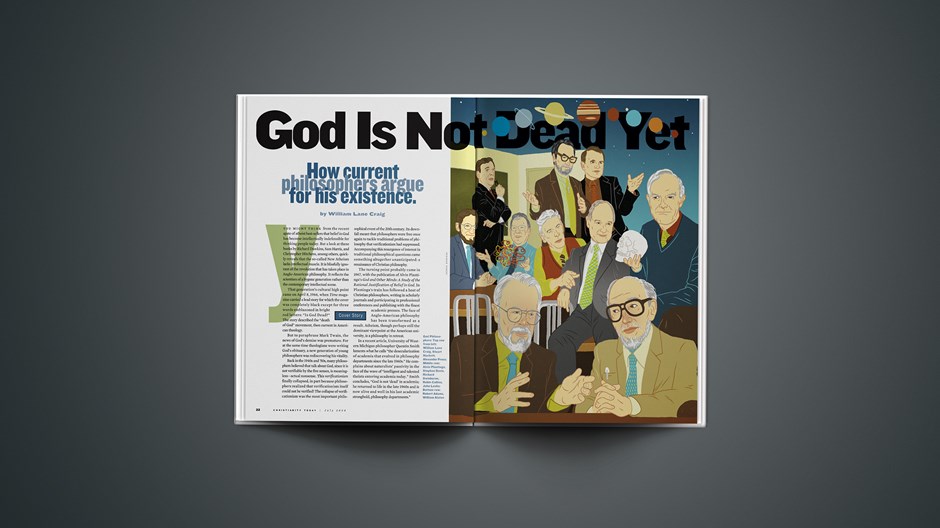
You might think from the recent spate of atheist best-sellers that belief in God has become intellectually indefensible for thinking people today. But a look at these books by Richard Dawkins, Sam Harris, and Christopher Hitchens, among others, quickly reveals that the so-called New Atheism lacks intellectual muscle. It is blissfully ignorant of the revolution that has taken place in Anglo-American philosophy. It reflects the scientism of a bygone generation rather than the contemporary intellectual scene.
That generation's cultural high point came on April 8, 1966, when Time magazine carried a lead story for which the cover was completely black except for three words emblazoned in bright red letters: "Is God Dead?" The story described the "death of God" movement, then current in American theology.
But to paraphrase Mark Twain, the news of God's demise was premature. For at the same time theologians were writing God's obituary, a new generation of young philosophers was rediscovering his vitality.
Back in the 1940s and '50s, many philosophers believed that talk about God, since it is not verifiable by the five senses, is meaningless—actual nonsense. This verificationism finally collapsed, in part because philosophers realized that verificationism itself could not be verified! The collapse of verificationism was the most important philosophical event of the 20th century. Its downfall meant that philosophers were free once again to tackle traditional problems of philosophy that verificationism had suppressed. Accompanying this resurgence of interest in traditional philosophical questions came something altogether unanticipated: a renaissance of Christian philosophy.
The turning point probably came in 1967, with the publication of Alvin Plantinga's God and Other Minds: A Study of the Rational Justification of Belief in God. In Plantinga's train has followed a host of Christian philosophers, writing in scholarly journals and participating in professional conferences and publishing with the finest academic presses. The face of Anglo-American philosophy has been transformed as a result. Atheism, though perhaps still the dominant viewpoint at the American university, is a philosophy in retreat.
In a recent article, University of Western Michigan philosopher Quentin Smith laments what he calls "the desecularization of academia that evolved in philosophy departments since the late 1960s." He complains about naturalists' passivity in the face of the wave of "intelligent and talented theists entering academia today." Smith concludes, "God is not 'dead' in academia; he returned to life in the late 1960s and is now alive and well in his last academic stronghold, philosophy departments."
The renaissance of Christian philosophy has been accompanied by a resurgence of interest in natural theology, that branch of theology that seeks to prove God's existence apart from divine revelation. The goal of natural theology is to justify a broadly theistic worldview, one that is common among Christians, Jews, Muslims, and deists. While few would call them compelling proofs, all of the traditional arguments for God's existence, not to mention some creative new arguments, find articulate defenders today.
The Arguments
First, let's take a quick tour of some current arguments of natural theology. We'll look at them in their condensed form. This has the advantage of making the logic of the arguments very clear. The bare bones of the arguments can then be fleshed out with further discussion. A second crucial question—what good is rational argument in our supposedly postmodern age?—will be dealt with in the next section.
The cosmological argument. Versions of this argument are defended by Alexander Pruss, Timothy O'Connor, Stephen Davis, Robert Koons, and Richard Swinburne, among others. A simple formulation of this argument is:
1. Everything that exists has an explanation of its existence, either in the necessity of its own nature or in an external cause.
2. If the universe has an explanation of its existence, that explanation is God.
3. The universe exists.
4. Therefore, the explanation of the universe's existence is God.
This argument is logically valid, so the only question is the truth of the premises. Premise (3) is undeniable for any sincere seeker of truth, so the question comes down to (1) and (2).
Premise (1) seems quite plausible. Imagine that you're walking through the woods and come upon a translucent ball lying on the forest floor. You would find quite bizarre the claim that the ball just exists inexplicably. And increasing the size of the ball, even until it becomes co-extensive with the cosmos, would do nothing to eliminate the need for an explanation of its existence.
Premise (2) might at first appear controversial, but it is in fact synonymous with the usual atheist claim that if God does not exist, then the universe has no explanation of its existence. Besides, (2) is quite plausible in its own right. For an external cause of the universe must be beyond space and time and therefore cannot be physical or material. Now there are only two kinds of things that fit that description: either abstract objects, like numbers, or else an intelligent mind. But abstract objects are causally impotent. The number 7, for example, can't cause anything. Therefore, it follows that the explanation of the universe is an external, transcendent, personal mind that created the universe—which is what most people have traditionally meant by "God."
Article continues below
The kalam cosmological argument. This version of the argument has a rich Islamic heritage. Stuart Hackett, David Oderberg, Mark Nowacki, and I have defended the kalam argument. Its formulation is simple:
1. Everything that begins to exist has a cause.
2. The universe began to exist.
3. Therefore, the universe has a cause.
Premise (1) certainly seems more plausibly true than its denial. The idea that things can pop into being without a cause is worse than magic. Nonetheless, it's remarkable how many nontheists, under the force of the evidence for premise (2), have denied (1) rather than acquiesce in the argument's conclusion.
Atheists have traditionally denied (2) in favor of an eternal universe. But there are good reasons, both philosophical and scientific, to doubt that the universe had no beginning. Philosophically, the idea of an infinite past seems absurd. If the universe never had a beginning, then the number of past events in the history of the universe is infinite. Not only is this a very paradoxical idea, but it also raises the problem: How could the present event ever arrive if an infinite number of prior events had to elapse first?
Moreover, a remarkable series of discoveries in astronomy and astrophysics over the last century has breathed new life into the kalam argument. We now have fairly strong evidence that the universe is not eternal in the past, but had an absolute beginning about 13.7 billion years ago in a cataclysmic event known as the Big Bang.
The Big Bang is so amazing because it represents the origin of the universe from literally nothing. For all matter and energy, even physical space and time themselves, came into being at the Big Bang. While some cosmologists have tried to craft alternative theories aimed at avoiding this absolute beginning, none of these theories have commended themselves to the scientific community.
In fact, in 2003 cosmologists Arvind Borde, Alan Guth, and Alexander Vilenkin were able to prove that any universe that is, on average, in a state of cosmic expansion cannot be eternal in the past but must have had an absolute beginning. According to Vilenkin, "Cosmologists can no longer hide behind the possibility of a past-eternal universe. There is no escape, they have to face the problem of a cosmic beginning." It follows then that there must be a transcendent cause that brought the universe into being, a cause that, as we have seen, is plausibly timeless, spaceless, immaterial, and personal.
Article continues below
The teleological argument. The old design argument remains as robust today as ever, defended in various forms by Robin Collins, John Leslie, Paul Davies, William Dembski, Michael Denton, and others. Advocates of the Intelligent Design movement have continued the tradition of finding examples of design in biological systems. But the cutting edge of the discussion focuses on the recently discovered, remarkable fine-tuning of the cosmos for life. This finetuning is of two sorts. First, when the laws of nature are expressed as mathematical equations, they contain certain constants, such as the gravitational constant. The mathematical values of these constants are not determined by the laws of nature. Second, there are certain arbitrary quantities that are just part of the initial conditions of the universe—for example, the amount of entropy.
These constants and quantities fall into an extraordinarily narrow range of life-permitting values. Were these constants and quantities to be altered by less than a hair's breadth, the life-permitting balance would be destroyed, and life would not exist.
Accordingly, we may argue:
1. The fine-tuning of the universe is due either to physical necessity, chance, or design.
2. It is not due to physical necessity or chance.
3. Therefore, it is due to design.
Premise (1) simply lists the present options for explaining the fine-tuning. The key premise is therefore (2). The first alternative, physical necessity, says that the constants and quantities must have the values they do. This alternative has little to commend it. The laws of nature are consistent with a wide range of values for the constants and quantities. For example, the most promising candidate for a unified theory of physics to date, superstring theory or "M-Theory," allows a "cosmic landscape" of around 10500 different possible universes governed by the laws of nature, and only an infinitesimal proportion of these can support life.
As for chance, contemporary theorists increasingly recognize that the odds against fine-tuning are simply insurmountable unless one is prepared to embrace the speculative hypothesis that our universe is but one member of a randomly ordered, infinite ensemble of universes (a.k.a. the multiverse). In that ensemble of worlds, every physically possible world is realized, and obviously we could observe only a world where the constants and quantities are consistent with our existence. This is where the debate rages today. Physicists such as Oxford University's Roger Penrose launch powerful arguments against any appeal to a multiverse as a way of explaining away fine-tuning.
Article continues below
The moral argument. A number of ethicists, such as Robert Adams, William Alston, Mark Linville, Paul Copan, John Hare, Stephen Evans, and others have defended "divine command" theories of ethics, which support various moral arguments for God's existence. One such argument:
1. If God does not exist, objective moral values and duties do not exist.
2. Objective moral values and duties do exist.
3. Therefore, God exists.
By objective values and duties, one means values and duties that are valid and binding independent of human opinion. A good many atheists and theists alike concur with premise (1). For given a naturalistic worldview, human beings are just animals, and activity that we count as murder, torture, and rape is natural and morally neutral in the animal kingdom. Moreover, if there is no one to command or prohibit certain actions, how can we have moral obligations or prohibitions?
Premise (2) might seem more disputable, but it will probably come as a surprise to most laypeople to learn that (2) is widely accepted among philosophers. For any argument against objective morals will tend to be based on premises that are less evident than the reality of moral values themselves, as apprehended in our moral experience. Most philosophers therefore do recognize objective moral distinctions.
Nontheists will typically counter the moral argument with a dilemma: Is something good because God wills it, or does God will something because it is good? The first alternative makes good and evil arbitrary, whereas the second makes the good independent of God. Fortunately, the dilemma is a false one. Theists have traditionally taken a third alternative: God wills something because he is good. That is to say, what Plato called "the Good" is the moral nature of God himself. God is by nature loving, kind, impartial, and so on. He is the paradigm of goodness. Therefore, the good is not independent of God.
Article continues below
Moreover, God's commandments are a necessary expression of his nature. His commands to us are therefore not arbitrary but are necessary reflections of his character. This gives us an adequate foundation for the affirmation of objective moral values and duties.
The ontological argument. Anselm's famous argument has been reformulated and defended by Alvin Plantinga, Robert Maydole, Brian Leftow, and others. God, Anselm observes, is by definition the greatest being conceivable. If you could conceive of anything greater than God, then that would be God. Thus, God is the greatest conceivable being, a maximally great being. So what would such a being be like? He would be all-powerful, all-knowing, and all-good, and he would exist in every logically possible world. But then we can argue:
1. It is possible that a maximally great being (God) exists.
2. If it is possible that a maximally great being exists, then a maximally great being exists in some possible world.
3. If a maximally great being exists in some possible world, then it exists in every possible world.
4. If a maximally great being exists in every possible world, then it exists in the actual world.
5. Therefore, a maximally great being exists in the actual world.
6. Therefore, a maximally great being exists.
7. Therefore, God exists.
Now it might be a surprise to learn that steps 2–7 of this argument are relatively uncontroversial. Most philosophers would agree that if God's existence is even possible, then he must exist. So the whole question is: Is God's existence possible? The atheist has to maintain that it's impossible that God exists. He has to say that the concept of God is incoherent, like the concept of a married bachelor or a round square. But the problem is that the concept of God just doesn't appear to be incoherent in that way. The idea of a being which is all-powerful, allknowing, and all-good in every possible world seems perfectly coherent. And so long as God's existence is even possible, it follows that God must exist.
Why Bother?
Of course, there are replies and counterreplies to all of these arguments, and no one imagines that a consensus will be reached. Indeed, after a period of passivity, there are now signs that the sleeping giant of atheism has been roused from his dogmatic slumbers and is fighting back. J. Howard Sobel and Graham Oppy have written large, scholarly books critical of the arguments of natural theology, and Cambridge University Press released its Companion to Atheism last year. Nonetheless, the very presence of the debate in academia is itself a sign of how healthy and vibrant a theistic worldview is today.
Article continues below
However all this may be, some might think that the resurgence of natural theology in our time is merely so much labor lost. For don't we live in a postmodern culture in which appeals to such apologetic arguments are no longer effective? Rational arguments for the truth of theism are no longer supposed to work. Some Christians therefore advise that we should simply share our narrative and invite people to participate in it.
This sort of thinking is guilty of a disastrous misdiagnosis of contemporary culture. The idea that we live in a postmodern culture is a myth. In fact, a postmodern culture is an impossibility; it would be utterly unlivable. People are not relativistic when it comes to matters of science, engineering, and technology; rather, they are relativistic and pluralistic in matters of religion and ethics. But, of course, that's not postmodernism; that's modernism! That's just old-line verificationism, which held that anything you can't prove with your five senses is a matter of personal taste. We live in a culture that remains deeply modernist.
Otherwise, how do we make sense of the popularity of the New Atheism? Dawkins and his ilk are indelibly modernist and even scientistic in their approach. On the postmodernist reading of contemporary culture, their books should have fallen like water on a stone. Instead, people lap them up eagerly, convinced that religious belief is folly.
Seen in this light, tailoring our gospel to a postmodern culture is self-defeating. By laying aside our best apologetic weapons of logic and evidence, we ensure modernism's triumph over us. If the church adopts this course of action, the consequences in the next generation will be catastrophic. Christianity will be reduced to but another voice in a cacophony of competing voices, each sharing its own narrative and none commending itself as the objective truth about reality. Meanwhile, scientific naturalism will continue to shape our culture's view of how the world really is.
A robust natural theology may well be necessary for the gospel to be effectively heard in Western society today. In general, Western culture is deeply post-Christian. It is the product of the Enlightenment, which introduced into European culture the leaven of secularism that has by now permeated Western society. While most of the original Enlightenment thinkers were themselves theists, the majority of Western intellectuals today no longer considers theological knowledge to be possible. The person who follows the pursuit of reason unflinchingly toward its end will be atheistic or, at best, agnostic.
Article continues below
Properly understanding our culture is important because the gospel is never heard in isolation. It is always heard against the background of the current cultural milieu. A person raised in a cultural milieu in which Christianity is still seen as an intellectually viable option will display an openness to the gospel. But you may as well tell the secularist to believe in fairies or leprechauns as in Jesus Christ!
Christians who depreciate natural theology because "no one comes to faith through intellectual arguments" are therefore tragically shortsighted. For the value of natural theology extends far beyond one's immediate evangelistic contacts. It is the broader task of Christian apologetics, including natural theology, to help create and sustain a cultural milieu in which the gospel can be heard as an intellectually viable option for thinking men and women. It thereby gives people the intellectual permission to believe when their hearts are moved.
As we progress further into the 21st century, I anticipate that natural theology will be an increasingly relevant and vital preparation for people to receive the gospel.
William Lane Craig is research professor of philosophy at Talbot School of Theology. He is the coeditor with J. P. Moreland of the forthcoming Blackwell Companion to Natural Theology. His website is reasonablefaith.org. All of the traditional arguments for God's existence find intelligent and articulate defenders in the contemporary philosophical scene.















 While we pray for peace, we need moral clarity about this war.
 But let’s not mistake it for calling.
 Ethan Hawke has made a movie as scandalous as one of the writer’s short stories.