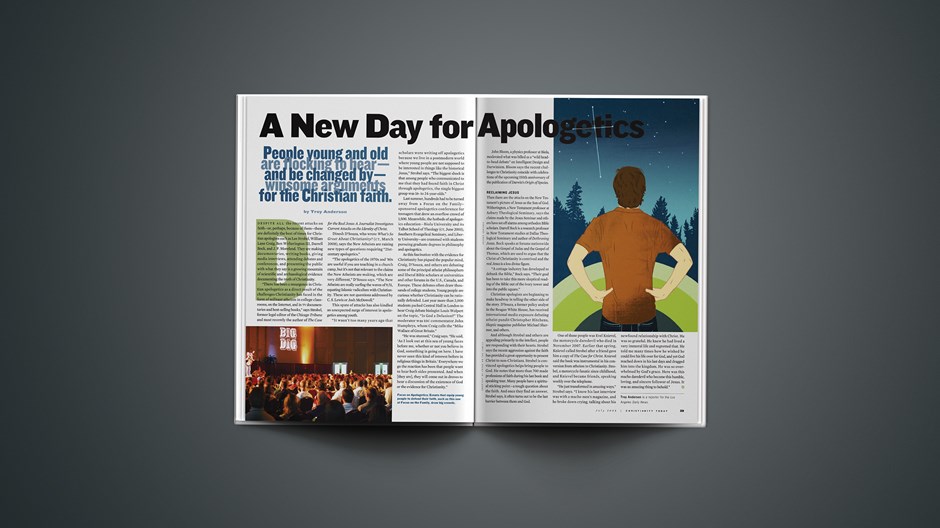
Despite all the recent attacks on faithor, perhaps, because of themthese are definitely the best of times for Christian apologists such as Lee Strobel, William Lane Craig, Ben Witherington III, Darrell Bock, and J. P. Moreland. They are making documentaries, writing books, giving media interviews, attending debates and conferences, and presenting the public with what they say is a growing mountain of scientific and archaeological evidence documenting the truth of Christianity.
"There has been a resurgence in Christian apologetics as a direct result of the challenges Christianity has faced in the form of militant atheism in college classrooms, on the Internet, and in TV documentaries and best-selling books," says Strobel, former legal editor of the Chicago Tribune and most recently the author of The Case for the Real Jesus: A Journalist Investigates Current Attacks on the Identity of Christ.
Dinesh D'Souza, who wrote What's So Great About Christianity? (CT, March 2008), says the New Atheists are raising new types of questions requiring "21st-century apologetics."
"The apologetics of the 1970s and '80s are useful if you are teaching in a church camp, but it's not that relevant to the claims the New Atheists are making, which are very different," D'Souza says. "The New Atheists are really surfing the waves of 9/11, equating Islamic radicalism with Christianity. These are not questions addressed by C. S. Lewis or Josh McDowell."
This spate of attacks has also kindled an unexpected surge of interest in apologetics among youth.
"It wasn't too many years ago that scholars were writing off apologetics because we live in a postmodern world where young people are not supposed to be interested in things like the historical Jesus," Strobel says. "The biggest shock is that among people who communicated to me that they had found faith in Christ through apologetics, the single biggest group was 16- to 24-year-olds."
Last summer, hundreds had to be turned away from a Focus on the Family- sponsored apologetics conference for teenagers that drew an overflow crowd of 1,500. Meanwhile, the hotbeds of apologetics educationBiola University and its Talbot School of Theology (CT, June 2003), Southern Evangelical Seminary, and Liberty Universityare crammed with students pursuing graduate degrees in philosophy and apologetics.
As this fascination with the evidence for Christianity has piqued the popular mind, Craig, D'Souza, and others are debating some of the principal atheist philosophers and liberal Bible scholars at universities and other forums in the U.S., Canada, and Europe. These debates often draw thousands of college students. Young people are curious whether Christianity can be rationally defended. Last year more than 2,000 students packed Central Hall in London to hear Craig debate biologist Louis Wolpert on the topic, "Is God a Delusion?" The moderator was BBC commentator John Humphrys, whom Craig calls the "Mike Wallace of Great Britain."
"He was stunned," Craig says. "He said, 'As I look out at this sea of young faces before me, whether or not you believe in God, something is going on here. I have never seen this kind of interest before in religious things in Britain.' Everywhere we go the reaction has been that people want to hear both sides presented. And when [they are], they will come out in droves to hear a discussion of the existence of God or the evidence for Christianity."
John Bloom, a physics professor at Biola, moderated what was billed as a "wild head-to-head debate" on Intelligent Design and Darwinism. Bloom says the recent challenges to Christianity coincide with celebrations marking the 150th anniversary of the publication of Darwin's Origin of Species.
Reclaiming Jesus
Then there are the attacks on the New Testament's picture of Jesus as the Son of God. Witherington, a New Testament professor at Asbury Theological Seminary, says the claims made by the Jesus Seminar and others have set off alarms among orthodox Bible scholars. Darrell Bock is a research professor in New Testament studies at Dallas Theological Seminary and author of Dethroning Jesus. Bock speaks at forums nationwide about the Gospel of Judas and the Gospel of Thomas, which are used to argue that the Christ of Christianity is contrived and the real Jesus is a less divine figure.
"A cottage industry has developed to debunk the Bible," Bock says. "Their goal has been to take this more skeptical reading of the Bible out of the ivory tower and into the public square."
Christian apologists are beginning to make headway in telling the other side of the story. D'Souza, a former policy analyst in the Reagan White House, has received international media exposure debating atheist pundit Christopher Hitchens, Skeptic magazine publisher Michael Shermer, and others.
And although Strobel and others are appealing primarily to the intellect, people are responding with their hearts. Strobel says the recent aggression against the faith has provided a great opportunity to present Christ to non-Christians. Strobel is convinced apologetics helps bring people to God. He notes that more than 700 made professions of faith during his last book and speaking tour. Many people have a spiritual sticking pointa tough question about the faith. And once they find an answer, Strobel says, it often turns out to be the last barrier between them and God.
Article continues below
One of those people was Evel Knievel, the motorcycle daredevil who died in November 2007. Earlier that spring, Knievel called Strobel after a friend gave him a copy of The Case for Christ. Knievel said the book was instrumental in his conversion from atheism to Christianity. Strobel, a motorcycle fanatic since childhood, and Knievel became friends, speaking weekly over the telephone.
"He just transformed in amazing ways," Strobel says. "I know his last interview was with a macho men's magazine, and he broke down crying, talking about his newfound relationship with Christ. He was so grateful. He knew he had lived a very immoral life and regretted that. He told me many times how he wished he could live his life over for God, and yet God reached down in his last days and dragged him into the kingdom. He was so overwhelmed by God's grace. Here was this macho daredevil who became this humble, loving, and sincere follower of Jesus. It was an amazing thing to behold."
Troy Anderson is a reporter for the Los Angeles Daily News.















 While we pray for peace, we need moral clarity about this war.
 A Christian reconciliation group in Israel and Palestine warned that war would come. Now the war threatens their relevance.españolالعربيةFrançaisрусскийУкраїнська
 How groups like Hillsong learned to let go of the literal in favor of creative collaboration.españolPortuguês






