The President has taken this country to war and the war has not gone well. He has misjudged the spiritual strength of a militarily inconsequential but profoundly committed enemy. War was not even a distant issue when he first became President, and he is increasingly frustrated that this unsuccessful war is defining his presidency. Testy exchanges with journalists have caused him to almost abandon news conferences, he is openly mocked on television and on the street, and his popularity ratings have plummeted. Never one to seek wide counsel, he increasingly surrounds himself only with advisers who give him good news, who tell him what he wants to hear.
No, his name is not George Bush. His name is Lyndon Johnson.
"I am not going to lose Vietnam," Johnson said. "I am not going to be the President who saw Southeast Asia go the way China went." It is significant that Johnson thought of the war in the first person—"I am not going to lose." Johnson had a famously monumental ego and soaring ambition. Friends, fellow politicians, and historians consistently report that what motivated Johnson from his schoolboy days to his presidency was a pure lust for power and control unusual even for a politician. As Johnson's biographer Robert Caro observes, "Johnson's ambition was uncommon—in the degree to which it was unencumbered by even the slightest excess weight of ideology, of philosophy, of principles, of beliefs."
Lyndon Johnson edited reality to suit his needs. Anyone who disagreed with him on Vietnam policy was a "knee-jerk liberal," "crackpot," "nervous Nellie," or "troublemaker." There was no such thing for him as loyal dissent. Lyndon Johnson was as politically competent as any President in history (and he used that competence for good in getting passed the 1964 Civil Rights Act). He lacked, however, the wisdom and moral courage necessary to keep this country from far deeper entanglement in a disastrous war.
Iraq is not Vietnam. George Bush is not Lyndon Johnson. Taking a country to war is not automatically wrong. But grave decisions of war and peace, life and death, prosperity and privation—on the domestic and international fronts—are made by Presidents during their time in office. At election time, we the people decide who our decision makers will be. And we too often decide poorly, because we ask the wrong questions.
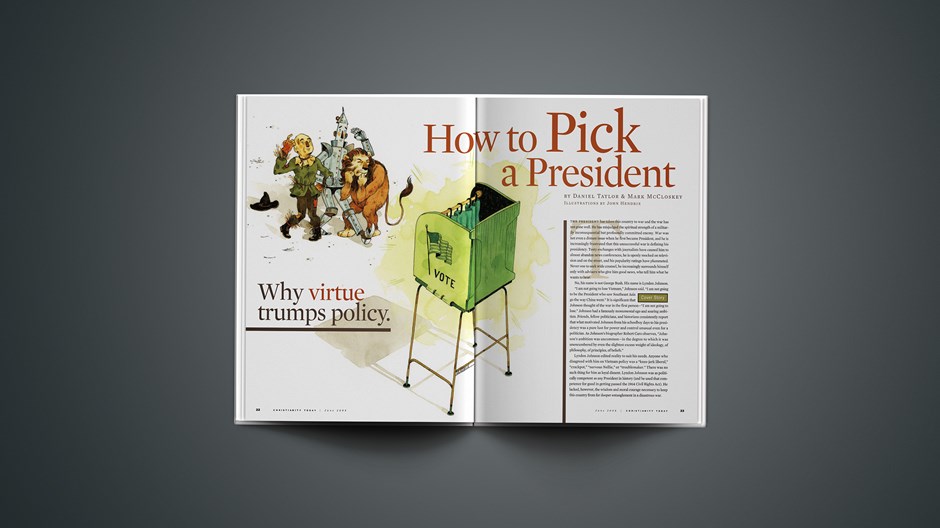
We make the same mistake as one recent grumpy CNN commentator: "What we need from these candidates are details of how they are going to solve our problems. How are they going to stop the slide of the dollar? How are they going to get the troops home from Iraq? How are they going to fix Social Security? That's what we need to know." Grumpy and wrong. There's value in hearing a candidate's plans and proposals, but it's of secondary or even lesser importance. Few if any of those plans and proposals will survive the political process intact. Voting for Obama's health plan or Hillary's economic scheme or McCain's immigration policy is virtual-reality voting, positing an intriguing alternate world, but having little to do with this one. When it comes to picking a President, Gandhi had it right: "The obligation of accepting a position of power is to be, above all else, a good human being."
"You've got to be kidding," one hears our CNN commentator saying. "'Good human being'? Who's to say what constitutes a 'good human being'? I want someone competent to run the country." Wrong again. Competence without virtue is poisonous. It simply makes one more effective at doing wrong. Furthermore, being virtuous is, in itself, an expression of competence. Since virtue is a requirement for leadership, a lack of virtue in a leader is a sign of incompetence and grounds enough for rejecting that leadership. Virtue is a personal matter, but it is never wholly a private one, certainly not in a President.
A suite of values-soaked abilities
The ancient Greeks created most of our vocabulary of virtue and saw virtue as central to politics. In fact, it was wrestling with the question of the kind of leader a community required that led them to investigate virtue, and that made virtue a practical, not merely a philosophical, consideration.
Virtue—moral and physical—was to the Greeks a force, a capacity to do something, a personal power that enabled one to influence and shape oneself and one's community for the better. Virtue was practical, specific, and verifiable. The Greeks saw virtue as intimately connected with character, which can be defined as the working out of values in actual life—values lived—the intersection in the everyday world of stated values with choices and actions. For the Greeks it was meaningless to talk about values (think "family values" or "justice for the poor") apart from concrete actions that render those values visible and useful. And such actions were only virtues if they were recurring, becoming so ingrained in a person's responses to life that they were moral habits, reflexes, something that flowed almost automatically from one's essential nature. Virtue was not a given of birth or instinct, but must be learned and reinforced (hence, education centered on training in virtue).
Article continues below
Virtue is a suite of values-soaked abilities that in active combination form a person's character and give shape to a life. Our choices and actions both reveal and reinforce our character. You cannot judge whether a person will be a good leader—a good President—without knowing and evaluating his or her character—how life has stamped or marked them. A President is, among other things, a decision maker. Decisions flow out of values and experience, that is, out of character. The classical virtues, embraced by Greeks and Romans alike, are prudence (practical wisdom), justice (fairness), fortitude (courage), and temperance (moderation). They not only thought these desirable and useful, but also believed you could not be fully human without them. Each of the four virtues makes the others possible, and a lack of any one of them renders the others ineffective. Courage without wisdom is mere foolhardiness. Justice not backed up by courage is mere wishing. And any of the other virtues is vitiated if one lacks the self-control found in moderation. Virtue involves the whole person—intellect, emotion, will, values, actions.
The other great source of virtues was Judeo-Christian, especially the virtues of faith, hope, and love. The medieval period inherited both traditions, kept virtue at the center of education, and embraced these seven as "the cardinal virtues."
So how does any of this help in choosing a President?
From courage to temperance
Let's start with the virtue perhaps most universally acknowledged and admired: courage. In premodern times, the courage of a leader often had to be physical. In the last 500 years it is more often moral. Moral courage is the ability to do what's right even when it is deeply unpopular, even dangerous. Courage is only found where there is the genuine possibility of loss—loss of friends, reputation, status, power, possessions, or, at the extremes, freedom or life.
It does not require courage to do what is popular or safe. Political leaders in a democracy must, by definition, be popular at election time or they will no longer be leaders. So it is even more difficult for a President, whose choices are not masked by being one vote among many, to be morally courageous than it is for other politicians. Ironically, to be morally courageous, a politician must be willing to forfeit the very position that gives him or her the power to make the morally courageous decision in the first place. Fail to be courageous and your country will suffer and history will criticize you; make the unpopular but morally courageous decision and we may well remove you from office.
Article continues below
Most would credit Lincoln with moral courage in his handling of the Civil War. More contentious cases could be made for Franklin Roosevelt's response to the Depression, for Reagan in his refusal to accept the inevitability of half the world living under Communism, and for Carter in his principled campaign for human rights in a political environment that normally only pays lip service to such things. Whoever your personal political heroes, it is likely that you admire them in significant part because they risked doing the right thing instead of the safe thing. Historian Barbara Tuchman observes, "Aware of the controlling power of ambition, corruption, and emotion, it may be that in the search for wiser government we should look for the test of character first. And the test should be moral courage."
It is not difficult to see how prudence is valuable for any leader. In both Greek and Jewish traditions, prudence or wisdom is knowledge about how to live well and the ability to put that knowledge into practice. It involves right priorities and right choices. Intelligent people can be fools. Knowledgeable people can be impractical.
It is entirely appropriate to evaluate whether a person seeking public office has lived wisely in his or her private life. Too often we attribute the wisdom to lead to someone who has merely been resourceful enough to succeed in business or some other area. We have de-stigmatized many private failures in recent years (divorce, past drug use, sexual irresponsibility), but it is still relevant to expect that public leaders show wisdom in the choices they make in their private lives.
Practical wisdom, as opposed to intelligence or knowledge, is necessary to respond helpfully to the many political problems that involve competing goods or "no good choices." The illegal immigration problem sets the reasonable need to control one's borders against the pragmatic fact of what to do about the millions of illegal immigrants already here. The response to terror in the world requires a balance between the goal (security, certainly, and perhaps the extension of democracy) and the means to reach that goal (wiretapping? torture?). The political system perhaps never "solves" these issues to everyone's satisfaction, but a leader needs the virtue of practical wisdom to move us forward.
Article continues below
No quality is more often invoked in contemporary political campaigns than justice—frequently under the umbrella of fairness. In fact we have trained citizens to present many of their demands in terms of what is fair and of injuries to fairness. The poor, the middle class, and the rich all contend that the tax system is not fair to them. Gays, women, and people of color each present themselves as victims of a society and political system that should, in the name of justice, offer them protection and redress. But so do corporations, lawyers, religious organizations, and many other social entities that by many measures are doing quite well. It is self-evident that a President must care about justice, but what does that mean and what would it look like? We should assess the nature and intensity of candidates' commitment to justice and ask them to articulate both the foundations for their commitments and to give evidence that they have acted to make the world a fairer place. If that action was evident in their private lives even before they sought public office, so much the better. It means more than campaign platitudes and position papers about social justice and helping the poor.
Temperance, or moderation, might seem like both the least attractive of the classical virtues and the least significant for a political leader. The elder George Bush often used the vocabulary of moderation and caution and got himself satirized on television and in the comic strips as timorous and weak ("wouldn't be prudent" was a laugh line for people whose main association with the word temperance is the benighted attempt in the last century to ban alcohol). But temperance is as crucial as any of the other virtues because its lack renders them less effective. Temperance is self-restraint, the ability to control (even say "no" to) harmful drives, impulses, and passions (one reason Aquinas thought it the most difficult virtue, even if the least lofty). It is an expression of discipline and self-mastery that allows a leader to function under pressure, including external pressure from extremists and ideologues to act rashly to accomplish immediate and simplistic goals.
Lincoln's conciliatory attitude toward the defeated South is a marked example of temperance amidst extremists (think also of Nelson Mandela). Harry Truman was noted for temperate intemperance, writing many angry letters and memos (including one calling for the destruction of every major Russian city) but having the temperance to never send them.
Article continues below
Personal intemperance makes a politician more susceptible to debilitating weaknesses such as anger, lust, and an inordinate need for popularity. Many argue that Bill Clinton's sexual appetites were irrelevant to his political leadership, but his famous overnight polling and use of focus groups to detect which way the popular winds were blowing suggest both an intemperate need to be liked and a lack of moral courage to make unpopular decisions. How much longer did Vietnam go on because of Lyndon Johnson's vanity and penchant for ignoring unpleasant realities, or Nixon's bitter, personal anger toward peace activists? Moderation matters.
Faith, Hope, Love—in a President?
Even those who acknowledge the relevance of the four classical virtues in evaluating presidential candidates might question the significance of the three biblical ones. And perhaps as virtues tied to a specific religious tradition they are potentially controversial. But to the extent that these too are universal qualities (as many social scientists and philosophers argue), they can be expressed in ways that both the religious and secular can affirm.
The ultimate expression of faith may be religious, but in nonsectarian terms it has to do with commitment to a larger story than one's individual life. Politically, faith is commitment to the story of America—its fundamental worth, its potential for good, its ability to heal its wounds. In this sense, both Martin Luther King—a prophetic critic—and Ronald Reagan—a vocal advocate—demonstrated great faith in America. The key issue in assessing this quality in a candidate is not whether they engage in happy talk about the country, but whether they are capable of calling people to have faith in its essential worth and to work to better realize that inherent possibility.
Similarly with hope. Hope is not mere wishing. It is a reasonable expectation based on past experience. It is not reasonable for me to hope to win the lottery, because I have no experiential or mathematical reason to think it will happen. It is reasonable to hope that America will be more just tomorrow than it is today because we know from history and experience that America is capable of acting justly, even if it has never succeeded in being completely just. We know that people have worked and sacrificed for justice with significant success, and so we can rightly hope to go even further (or to recover lost ground) in that direction.
Article continues below
This ability to inspire hopefulness, of course, must be influenced by practical wisdom, and not be mere blinkered cheerleading. Hope is an expectation of future good that is mingled with the understanding that good is never guaranteed and that the obstacles are many. Ronald Reagan's famous slogan, "It's morning in America," expressed perhaps his greatest virtue—the ability to engender hope. Again, Martin Luther King ("we shall overcome") was doing the same thing. Both had to back up those words with actions in order to make such hope a reality. If Obama is the candidate most identified with hope today (as was Bill Clinton, "the man from Hope"), he will have to do more than talk about it—hope is not a plan—and that will be a test of his character, not just of his rhetoric or policies.
Love has its ultimate expression in the things of God and the Spirit, but it is relevant to our political and social lives as well. If love is the greatest of the biblical virtues, it is possibly also the ultimate home for all the virtues. We are courageous in order to protect people and things we love. We fight for justice for those we love (even at a distance). We exercise the self-control of moderation and seek to bring wisdom into the world for the sake of what and whom we love. Our earnest love for a certain kind of world gives us faith and hope that such a world can be brought into being.
It is very difficult to assess the quality of love in political candidates. Perhaps one manifestation of it is passion. Passion comes from the Greek word for pain or suffering. To say we love or are passionate about something is a declaration that we are willing to suffer for it. What are candidates passionate about? That is, what are they willing to suffer for? What have they spent their lives doing apart from jobs and political office? What loves or passions made them pursue political office?
Virtue trumps policies and ideology
It would of course be a false dichotomy to suggest that one must choose between assessing virtue and assessing policy or ideology. Virtue and character can and should express themselves in both policy and ideology. One's virtue as a leader is inescapably revealed by ideological stances and policy decisions on, for instance, partial-birth abortion or the need for health care for all citizens. If so, why not let policy be the objective index to personal qualities and focus on such concrete things, rather than get into the messy subjectivity of virtue and character?
Article continues below
Chief among the many reasons is that many crucial political decisions of the future will revolve around unpredictable events and issues. No candidate's "policy" on terrorism foresaw or was adequate for 9/11. No candidate had a policy or ideology that would have made Hurricane Katrina greatly less painful (would even the most compassionate and competent President in 2004 have chosen, from all other needs, to spend many millions of dollars to reinforce the dikes in New Orleans?). No one in the 1970s was prepared for AIDS in the 1980s and '90s. Few people clearly foresaw the collapse of Communism, or the rise thereafter of Islamic fundamentalism. A political leader must be able to respond to ever-changing and unprecedented situations. We should vote for a person whom we believe has the qualities—the virtues, the character—to decide wisely in situations where policies, positions, and ideologies will be of little help.
In addition, campaign policies are illustrative at best and deceitful at worst. Politicians offer proposals that they very well know can never be enacted in the form proposed or have the effects they claim. Are we really to believe that a President Obama could get troops out of Iraq as quickly as he is suggesting, or that a President Hillary Clinton can actually "fix" a struggling, multitrillion dollar economy with her modest policy proposals, or that a President McCain has the power—given Democratic majorities in Congress—to preserve all the Bush tax cuts, even if he truly wants to?
And if policies are not much of a guide, neither is ideology. Even foundational political philosophies work better in textbooks and tracts than in Washington. Are we to believe, yet again, that Democratic candidates can find the money in a real Congress for all the social equity promises they make every four years? Or that Republican candidates can actually, even if they want to, dramatically shrink the size of government? Or that anyone is genuinely revolutionary or powerful enough to invoke overwhelming "change" in Washington? There's a systemic momentum to government and its bureaucracies that eats ideology for lunch. Simple realism indicates we have a better chance of making a generally accurate assessment of a candidate's character—and hoping in that—than we have of using policy or ideology to predict their future actions or success.
Article continues below
The closer we are in time to a President or presidential campaign, the more likely we are to focus on minutiae of policy, platform, likeability, and style. But Hugh Sidey, longtime observer of Presidents, believed other things are more important: "The presidency to this day rests more on the character of the person who inhabits the office than on anything else. The founding fathers designed it that way. It was their idea to find a man in America with a great character and let him invest a tradition and shape a national character." They found that man in George Washington, a President who refused to be king and who had the virtue to walk away from power when people were begging him to hold on to it.
The greatest fear we have regarding leaders is that they will misuse the power we grant them. The corrupting potential of power is well documented. But power need not corrupt and in a virtuous person it will not. Psychologist Erich Fromm distinguishes between power used for domination and selfish ends, and what he calls "potency" or "generative power." Such power is strength for others (a definition of virtue), and it motivates creativity and service. All the proper policies and ideology and technical competency in the world will not protect a leader from using power corruptly. In fact, the greatest temptation for a well-meaning leader is to use power corruptly in order to accomplish seemingly benevolent ends. The best insurance against corrupt power is to choose leaders with the combination of virtues necessary to use power well.
Look at ordinary life
How, specifically, could one ever hope to discern these things in a candidate? There is no easy or foolproof way. But start with what they do when no one is looking. Pascal observed, "The strength of a man's virtue must not be measured by his efforts, but by his ordinary life."
There is nothing ordinary about being a President. Politicians are public performers, playing always to the watchful electorate. So look at what they did and how they conducted their lives before they went on the political stage. And look at what they do when they hope no one is looking after they are in office. It speaks well of Barack Obama that he worked extensively with the poor before he ran for office, and for Hillary Clinton that she worked out of law school for the welfare of children. And almost no one, including political opponents, questions the significance of John McCain's courage and service to his country in the prison cells of North Vietnam. It may, however, also say something that Al Gore, as Vice President, was shown to contribute almost nothing to charitable causes out of his own pocket until he needed to position himself for a run for the presidency.
Article continues below
Look also for any record of willingness to speak and act from conviction when doing so has threatened their careers or self-interest. (It was said of George Marshall of Marshall Plan fame that "he told the truth even when it hurt his cause.") That is, where have they shown moral courage?
If Hillary gets high marks for service before she moved into politics, has she since sacrificed conviction for political expediency? Was her initial vote for the Iraq war based on conviction or calculation—figuring perhaps that the war might go well and that she needed to protect herself against the traditional charge that Democrats (not to mention a woman) are weak on national security?
McCain showed conviction and political courage in advocating for more troops in Iraq when most everyone else was either defending the status quo or screaming to throw in the towel. But is he sprinting away from his own proposals regarding illegal immigration because members of his party howled in protest? One should not evaluate these things only in terms of whether you agree with their positions or not, but also in terms of whether they are capable of doing what is broadly unpopular (not just unpopular with their political opponents) if they believe it is right.
Explore also how they treat their opponents. Are critics seen as people to dialogue with, work with, and perhaps even learn from, or as enemies to be destroyed? How inclined are they to vilify, demonize, and use dirty tricks? How often are they intellectually dishonest or jingoistic (for instance, any claim that automatically links opposition to a war to lack of patriotism)? Johnson and Nixon are the negative poster boys here, with both Reagan and Carter getting high marks for largely refusing to engage in slash-and-burn politics. Obama, Clinton, and McCain all claim to be able to heal divisions and work with political opponents, but we need to look closely to see if their legislative records support such claims.
Consider also how they respond to getting or losing power. Lincoln pointed out, "Nearly all men can stand adversity, but if you want to test a man's character, give him power." Or take it away. Virtuous leaders hold on to power loosely. They share it easily. They encourage it in others. They see it as invested in healthy institutions, not in themselves personally. Unvirtuous, and therefore dangerous, leaders accumulate power for themselves (and their causes), use it to intimidate and manipulate, to reward and punish, and never release it voluntarily. Lyndon Johnson's abusive use of power as a Senator—in which he made loyalty to himself more important than either morality or ideology—hurt the nation.
Article continues below
Yet another place to look is how candidates have dealt with adversity in their own lives. McCain survived torture with his honor intact (even while admitting he sometimes broke under torture), G. W. Bush had the fortitude and spiritual resources to defeat alcoholism. Franklin Roosevelt overcame the effects of polio. But of course all candidates have failures in their lives, too. If a candidate is given to private anger and pettiness, or has a history of broken personal relationships, does that tell us absolutely nothing about what kind of leader he or she might be? Is that none of our business, as some would say, or very much our business if that candidate is asking to be President?
The issue is not that candidates have failures, but how they have dealt with those failures. For they are certain to have public failures while in office. If in private life they run from failure or cover it up or rationalize it, are they not likely to do the same in public life? The goal of seeking virtuous people for high office is not to find perfect people, but to find people with the greatest potential to provide, despite their acknowledged limitations (humility being a prudent quality in a leader), the kind of leadership a community needs to flourish. We are not looking for saints to lead us, but we should be looking for people trying to live virtuously and largely succeeding.
It matters little that people will not agree exactly on a list of key virtues. The question of what virtues are most important, and how they should be defined and expressed, should be a fruitful part of an ongoing discussion. But it matters greatly that such a discussion take place. Recent polls indicate a broad recognition that we have a virtue deficit in this country and in its leaders that makes budget deficits pale in importance.
When we are choosing someone to lead us, we do best to look for a "good human being." Such a person is not likely to be moralistic or pious or politically correct. But he or she needs to be virtuous. Because, over time, nations flourish only to the degree that their collective virtue sustains.
Daniel Taylor is professor of English at Bethel University in St. Paul, Minnesota. Mark McCloskey is professor of Ministry Leadership at Bethel Seminary, St. Paul.















 While we pray for peace, we need moral clarity about this war.
 A Christian reconciliation group in Israel and Palestine warned that war would come. Now the war threatens their relevance.españolالعربيةFrançaisрусскийУкраїнська
 How groups like Hillsong learned to let go of the literal in favor of creative collaboration.españolPortuguês






