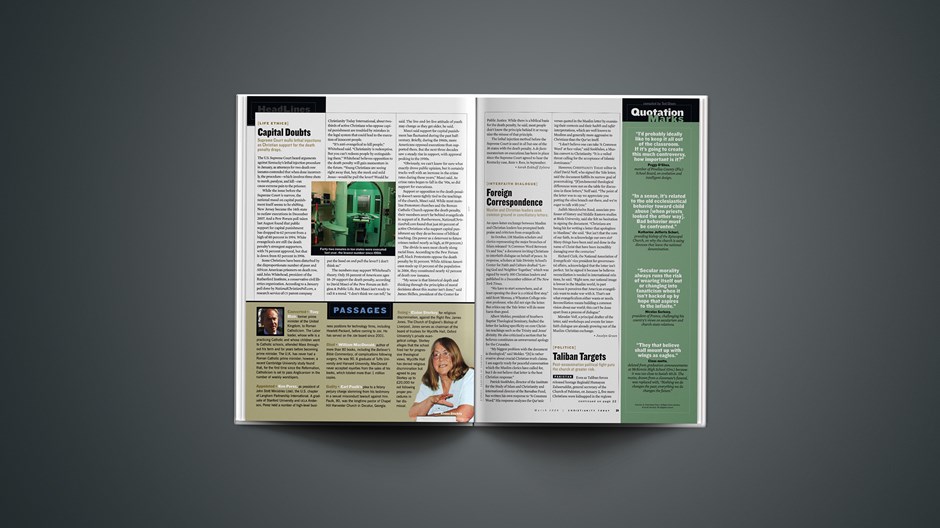
The U.S. Supreme Court heard arguments against Kentucky's lethal injection procedure in January, as attorneys for two death row inmates contended that when done incorrectly, the procedure—which involves three shots to numb, paralyze, and kill—can cause extreme pain to the prisoner.
While the issue before the Supreme Court is narrow, the national mood on capital punishment itself seems to be shifting. New Jersey became the 14th state to outlaw executions in December 2007. And a Pew Forum poll taken last August found that public support for capital punishment has dropped to 62 percent from a high of 80 percent in 1994. White evangelicals are still the death penalty's strongest supporters, with 74 percent approval, but that is down from 82 percent in 1996.
Some Christians have been disturbed by the disproportionate number of poor and African American prisoners on death row, said John Whitehead, president of the Rutherford Institute, a conservative civil liberties organization. According to a January poll done by NationalChristianPoll.com, a research service of CT parent company Christianity Today International, about two-thirds of active Christians who oppose capital punishment are troubled by mistakes in the legal system that could lead to the execution of innocent people.
"It's anti-evangelical to kill people," Whitehead said. "Christianity is redemptive. But you can't redeem people by extinguishing them." Whitehead believes opposition to the death penalty will gain momentum in the future. "Young Christians are seeing right away that, hey, the meek and mild Jesus—would he pull the lever? Would he put the hood on and pull the lever? I don't think so."
The numbers may support Whitehead's theory. Only 55 percent of Americans ages 18–29 support the death penalty, according to David Masci of the Pew Forum on Religion & Public Life. But Masci isn't ready to call it a trend. "I don't think we can tell," he said. The live-and-let-live attitude of youth may change as they get older, he said.
Masci said support for capital punishment has fluctuated during the past half-century. Briefly, during the 1960s, more Americans opposed executions than supported them. But the next three decades saw a steady rise in support, with approval peaking in the 1990s.
"Obviously, we can't know for sure what exactly drove public opinion, but it certainly tracks well with an increase in the crime rates during those years," Masci said. As crime rates began to fall in the '90s, so did support for executions.
Support or opposition to the death penalty doesn't seem tightly tied to the teachings of the church, Masci said. While most mainline Protestant churches and the Roman Catholic Church oppose the death penalty, their members aren't far behind evangelicals in support of it. Furthermore, NationalChristianPoll.com found that just 60 percent of active Christians who support capital punishment say they do so because of biblical teaching. (Its power as a deterrent to future crimes ranked nearly as high, at 59 percent.)
The divide is seen most clearly along racial lines. According to the Pew Forum poll, black Protestants oppose the death penalty by 51 percent. While African Americans made up 13 percent of the population in 2006, they constituted nearly 42 percent of death row inmates.
"My sense is that historical depth and thinking through the principles of moral decisions about this matter isn't done," said James Skillen, president of the Center for Public Justice. While there is a biblical basis for the death penalty, he said, most people don't know the principle behind it or recognize the misuse of that principle.
The lethal injection method before the Supreme Court is used in all but one of the 36 states with the death penalty. A de facto moratorium on executions has been in place since the Supreme Court agreed to hear the Kentucky case, Baze v. Rees, in September.
















 While we pray for peace, we need moral clarity about this war.
 A Christian reconciliation group in Israel and Palestine warned that war would come. Now the war threatens their relevance.españolالعربيةFrançaisрусскийУкраїнська
 Beyoncé’s right. Whether listening to Cowboy Carter or reading theology, diversity is a good thing.






