The great director John Ford's American pilgrimage included many films informed by his Catholic roots, even though he found biblical stories "pretty dull."
When asked to name his three favorite directors, Orson Welles answered, "John Ford, John Ford, and John Ford." Ingmar Bergman dubbed Ford the greatest director who ever lived. The only director to win four Best Director Academy Awards, Ford was also the first recipient of the American Film Institute Life Achievement Award, and was awarded the Presidential Medal of Freedom, both in 1973, the year he died.
Ford claimed to be a practicing Catholic all his life, though his bouts with alcoholism caused his devotion to waver. But his faith evident as late as the 1960s when he gave his rosary beads to an interviewer who described himself as an atheist and communist. Ford's grandson and biographer Dan Ford states that Ford's "simple faith in Jesus Christ was a comfort to him in his last days."
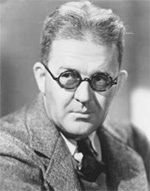
John Ford
But when it came to making films, Ford was no Bresson ascetic, but wholeheartedly a man of the flesh, depicting with relish feasts, saloons, barroom brawls, dancing, and music. Especially music. Music inspired him. He played period music as he wrote and planned his films, and even played some songs on the set to capture the tone; many of the songs wound up on his soundtracks and even in the titles of the films.
Born John Martin Feeney in 1894 in Maine, symbols of Ford's Irish heritage and Catholic religious tradition manifest themselves often in his films, as does his devotion to the foremost of American historical Christ figures: Abraham Lincoln. In Young Mr. Lincoln (1939), Ford chose to film Lincoln's early days, making him more human than most other portraits on film of our nation's great President.
Go West, Young Ford
Ford was an average student, but an avid reader with a vivid imagination. Throughout his life, he made up stories about himself and changed his name frequently until he became famous. In the early days of the silents, his older brother Francis ran off and hit it big in Hollywood, changing his last name to Ford.
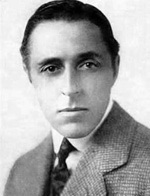
D.W. Griffith
John soon followed suit and apprenticed with brother, first acting, then directing scores of films. He even had a bit part in D.W. Griffith's landmark 1915 film The Birth of a Nation, as a Klansman who, ironically, has to lift his hood to be able to see.
Griffith was a huge influence on Ford, as was legendary actor Harry Carey. Ford had John Wayne—who played in 24 of Ford's movies—imitate a lot of Carey's gestures, including holding his elbow and leaning on one hip, and his broken rhythms of speech and frequent pauses.
Ford had a stable of actors, like a stock company, that he worked with, including John Wayne, Will Rogers, Henry Fonda, and James Stewart. Though he could be a bullying director, he did not give much direction as far as how to act a scene. He cast actors more for their physicality and gesture than their delivery. He shot them as moving statues in fluid architecture and monumental landscape. Ford often only took one take, and shot in sequence, cutting in the camera, reducing the re-cutting the studios could perform; restricting them to his creative vision alone.
In 1920, Ford married Mary McBryde Smith, a non-Catholic divorcee. They remained married for life, but the union was troubled by alcoholism and arguments, as well as Ford's five-year affair with Katharine Hepburn after Ford cast her in Mary of Scotland (1936).
After being impressed by Murnau's watershed film Sunrise (1927), eschewing close-ups and the moving camera, Ford focused on camera placement and formal composition of the geometric space to frame, even trap, his characters—free-willed agents in a fated universe.
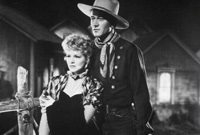
John Wayne and Claire Trevor in 'Stagecoach'
'Marks of his Catholic imagination'
A journey by horse-drawn carriage carrying nearly every type in American society, Stagecoach (1939) is Ford's Canterbury Tales. Adding social commentary in addition to riveting storytelling, this film marks two firsts: Ford's first film with John Wayne and his first film in what would soon be his claimed territory: Monument Valley in Utah. Orson Welles said he watched Stagecoach 40 times before filming Citizen Kane.
Richard A. Blake, in his book Afterimage, says of Ford's first major work, "His notions of community, salvation, conscience, and life as a journey to a homeland in the hereafter bear the unmistakable marks of his Catholic imagination even in the telling of a good, non-religious adventure story."
Ford's most accessible film—and in some ways more timely than ever—The Grapes of Wrath (1940) shows his alignment with progressive politics (he fought vigorously against McCarthyism in Hollywood), as well as deceptively simple storytelling. Welles would take Wrath's chiaroscuro cinematographer Greg Toland for Kane the following year, and the rest is history.
'Biblical stories are pretty dull'
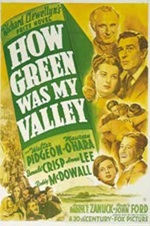
Ford's sentimentality and piety come to the fore in How Green Was My Valley (1941), a nostalgic elegy of life in a pastoral Welsh mining town as the Industrial Revolution begins.
The pastor, Mr. Gruffydd, proclaims to a crowd, "Fear has brought you here. Horrible, superstitious fear. Fear of divine retribution, a bolt of fire from the skies. The vengeance of the Lord and the justice of God. But you have forgotten the love of Jesus. You disregard His sacrifice."
Article continues below
But Ford's characters rarely sermonize: "One can be a fervent Catholic and hate sermons," Ford told an interviewer. "Biblical stories … I don't know, are pretty dull. They all forget that Christ was a human being. A man." He also turned down religious films because he was a Catholic, saying he would treat the subject too reverentially and that studios should get an atheist or a Jewish director instead.
During World War II, Ford made propaganda films in the Navy, most notably The Battle of Midway (1942). Covering such events as the Normandy Invasion, he rose to the rank of rear admiral. During the liberation of France, since he was Catholic and American, he was asked by a nun to light the first candle of their abbey after being freed, which he told an interviewer was one of the highlights of his life. Having documented some of the war's greatest victories, he returned home to dramatize America's greatest defeat in They Were Expendable (1945), offering Wayne one of his greatest acting turns.
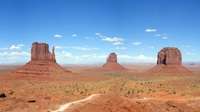
Utah's Monument Valley
Monument Valley
Ford excels at period pieces and is cinema's foremost historian of America, depicting stories from the Revolutionary War, the Civil War, the American West, the Fin de Siecle, the Depression, World Wars I and II, Korea and Vietnam. Yet he is also a director of the world, setting stories in Ireland, Scotland, India, Samoa and China.
But he is best known for his Westerns set in Monument Valley, a string of which began with My Darling Clementine (1946), a tale of Wyatt Earp in Tombstone. Ford's legendary "Cavalry Trilogy" is an excellent introduction to the director, consisting of Fort Apache (1948), Rio Grande (1949) and She Wore a Yellow Ribbon (1950), in which Wayne's character movingly visits his wife's grave to give her frequent updates on his life, echoing Henry Fonda doing the same in the earlier film about Lincoln.
Final Masterworks
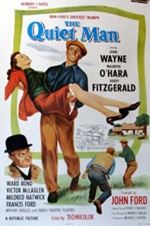
Returning to his Irish roots, Ford has Wayne's character, a retired boxer, do the same. In The Quiet Man (1952) Wayne's character, a retired boxer, returns to Ireland to get himself a home and a wife.
Wayne and Maureen O'Hara in 'The Quiet Man'
Wayne shows range beyond his drawling cowpoke, and Ford shows some unusual stylistic moves in the boxer's flashbacks that influence later films, most notably Raging Bull.
A tough film that grants its rewards only with repeated visits, The Searchers (1956)—perhaps Wayne's greatest role—shows Ford as a master of suspense, epic, pilgrimage and, above all, Christian forgiveness and agape love., All of Ford's themes are in full play here, as his talent is at its most mature and masterful. Ford earned his trademark eye patch during this film, having ignored doctor's orders after cataract surgery and removed his bandages too early.
Article continues below
Bringing Jimmy Stewart and John Wayne together for the first time, The Man Who Shot Liberty Valance (1962) highlights the last of Ford's great themes: how a man of law and order, and even peace, must take up his guns once in a while to put down evildoers. It started the anti-myth Westerns, and the postmodern skepticism about history, illustrated by the quip of the newspaper editor in the film, "When the legend becomes fact, print the legend," a fitting epitaph to a man who was a legend himself, and who gifted to us the legacy of our own mythology.
Filmmakers of Faith, an occasional feature at Christianity Today Movies, highlights directors who adhere to the Christian faith—sometimes strongly, sometimes loosely, and sometimes somewhere in between. This series will include everyone from biblically-minded evangelicals to directors who may only have a "church background" and perhaps a lapsed faith … but their films are clearly informed by their spiritual history.












 While we pray for peace, we need moral clarity about this war.
 A Christian reconciliation group in Israel and Palestine warned that war would come. Now the war threatens their relevance.españolالعربيةFrançaisрусскийУкраїнська
 The plan would organize UMC churches in four global regions, with each given more leeway around same-sex marriage and other theological issues.