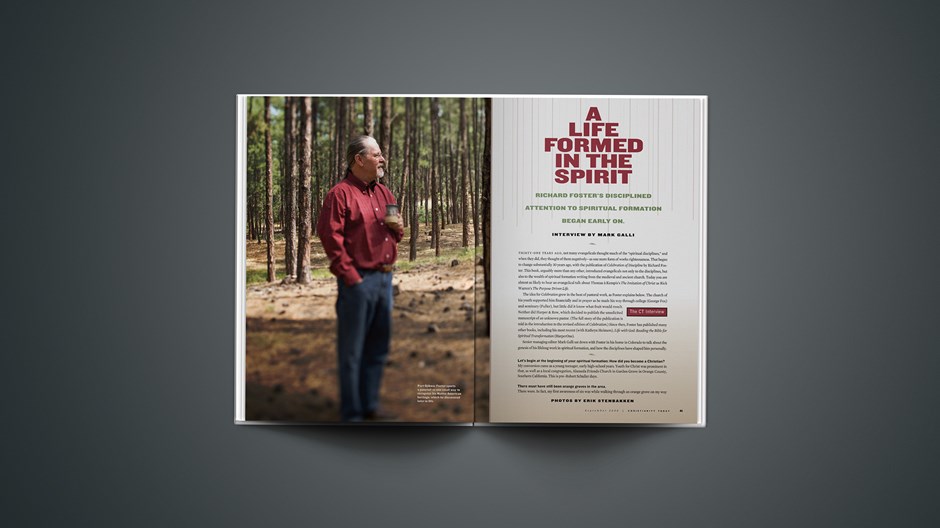
Thirty-one years ago, not many evangelicals thought much of the "spiritual disciplines," and when they did, they thought of them negatively—as one more form of works righteousness. That began to change substantially 30 years ago, with the publication of Celebration of Discipline by Richard Foster. This book, arguably more than any other, introduced evangelicals not only to the disciplines, but also to the wealth of spiritual formation writing from the medieval and ancient church. Today you are almost as likely to hear an evangelical talk about Thomas à Kempis's The Imitation of Christ as Rick Warren's The Purpose Driven Life.
The idea for Celebration grew in the heat of pastoral work, as Foster explains below. The church of his youth supported him financially and in prayer as he made his way through college (George Fox) and seminary (Fuller), but little did it know what fruit would result. Neither did Harper & Row, which decided to publish the unsolicited manuscript of an unknown pastor. (The full story of the publication is told in the introduction to the revised edition of Celebration.) Since then, Foster has published many other books, including his most recent (with Kathryn Helmers), Life with God: Reading the Bible for Spiritual Transformation (HarperOne).
Senior managing editor Mark Galli sat down with Foster in his home in Colorado to talk about the genesis of his lifelong work in spiritual formation, and how the disciplines have shaped him personally.
Let's begin at the beginning of your spiritual formation: How did you become a Christian?
My conversion came as a young teenager, early high-school years. Youth for Christ was prominent in that, as well as a local congregation, Alameda Friends Church in Garden Grove in Orange County, Southern California. This is pre-Robert Schuller days.
There must have still been orange groves in the area.
There were. In fact, my first awareness of sin was while walking through an orange grove on my way to school and stealing some oranges, not to eat them, but, like Augustine when he stole the pears, for the sheer delight of it.
But here's this church—a wonderful group of Christians on the high-school campus who drew me in lovingly. My friends and I would go to the Young Life meetings at the church on Saturday nights. I debated with the Christians. There was one guy who was a very bright guy, and he enjoyed conversations with me. After about seven months, the issue was the resurrection of Jesus. When I became intellectually convinced of the resurrection, I knew that this had to mean that Jesus was alive, here to teach his people himself.
Was there a particular argument that convinced you?
First, this group of ordinary teenagers had a reality about them that was substantial, a deep joy, as C. S. Lewis put it.
Then there was the more intellectual side. I did some reading, and I became convinced that Jesus really did rise from the dead. I remember I was at home alone when I said a little prayer to enter into life with Jesus. Nobody taught me this, but I remember getting up the next morning an hour early to do some physical exercise, but then to pray and read the Bible.
What were the key influences in your early Christian faith?
One was a youth pastor at that church; he was very serious and didn't go in much for the fun and games. He took us through a two-year study of the Book of Romans; I mean a real study. In terms of anchoring me theologically, that was great.
A second was Bonhoeffer and his writings, especially The Cost of Discipleship. His writing was the only place I could find serious engagement with discipleship. And that probably saved me from abandoning the faith. If all this stuff I read in the Gospels were really true, then that should change everything, but when I looked at the churches in my youthful idealism, I didn't see it. But I saw it in The Cost of Discipleship. And then, of course, his story was compelling because of his own martyrdom. So I clung to that. I still have the old book, taped together.
Your mother was seriously ill in your adolescence. That must have shaped your faith in some way.
Actually, my parents were both quite ill during those years. My mother had multiple sclerosis, and it was a very long and painful death for her. We didn't know much about it in those days.
My first prayer as a new Christian was for my mother's healing. It wasn't to be. The first verse I ever memorized wasn't John 3:16; it was 1 Peter 1:7: "That the trial of your faith, being much more precious than gold that perishes, though it be tried with fire, might be found unto praise and honor and glory at the appearing of Jesus Christ."
When I went away to college, about a thousand miles away, my brother and I had a long discussion about what to do. Three times that freshman year, I had to rush back because they said she was dying. But each time she would rally a bit. So finally my brother and I made the tough decision that he wouldn't let me know until she died. As it ended up, it happened when I was home that next summer on break. In fact, I was the last to see her in the hospital.
Article continues below
How did you start to become interested in spiritual formation in a more focused way?
My first church out of seminary was a Friends church in San Fernando Valley in Southern California, with between 55 and 80 people on Sunday mornings. Dallas Willard and his wife attended there—she was the organist, and he led singing. Dallas also taught classes at the church, material that eventually became The Divine Conspiracy.
In that little church, when I taught, people might come, but when Dallas taught, they brought their tape recorders. And I did too! I cancelled all adult Sunday school classes when he taught.
We not only had teaching, but we would also visit in homes. This church was a little ragtag group of people that had no middle-class props. There were many people from prison, from the drug culture. And they were hungry for God. I remember this one guy, Bob Harrington, would study probably 15 hours a week just to go to the class, because Dallas gave a lot of homework!
I gave that congregation everything I learned in seminary in the first three months. Here were these very needy people, and I knew that I didn't have enough substance to really help them. So I went to our elders, the ruling body, and said, "I need to learn the spiritual life. I need to get to know God." And they heartily agreed. So we arranged for me to take a weeklong retreat four times a year.
That was probably the place where I really encountered Scripture in large pieces. I remember the first retreat reading the Book of Jeremiah. Jeremiah was the prophet whom I identified with most. There's suffering again in that. So that was formative.
And—I don't know exactly why—I instinctively went to the old writers. I just felt like Augustine's Confessions and Teresa's Interior Castle—this was real meat. The first line of Celebration is, "Superficiality is the curse of our age." And I guess I felt that. It was all around me.
How did this start to shape your ministry?
Early on we were moving into a building program. And we did the various studies and so on and so forth, so I really could justify it. But I was also learning about prayer at that time. I remember Dallas asking, "Have we really prayed about it?" I realized we really hadn't.
I remember calling a meeting, a worship gathering on a Sunday night, to pray over this building project. We had all the approvals, and we were about ready to launch the fund drive. In a Quaker context, there's an open meeting for worship. So singing would happen, silence would happen, Scripture would be read, different things like that.
Article continues below
During the meeting, nobody ever said we ought to do it or not do it—that was not the spirit at all. The service lasted a couple of hours. I went into that meeting feeling that we probably should do the building, and I came out of it sure we shouldn't. During worship, my heart was revealed to me—that a big building and a big church would have been for me signs that I was a successful pastor. If anybody had actually said that to me beforehand, I would have denied it. But that night, learning to die to that was important. I'm not against buildings, but for me, it was crucial to give that up.
The other thing I began to do was focus on the lives of these people, their soul growth. We were teaching in the homes. We would ask, "How's it going? What are you learning? How is this working with your children and your marriage?" We had wonderful things happen, and we had terrible things happen.
For example?
Well, this dear lady had gotten a hold of the verse, "I can do all things through Christ who strengthens me," but she did not have much good sense. She took in some homeless guy who kept her awake for two nights straight. Then he raped her and robbed her. We found her under the kitchen table in a fetal position. She ended up in a mental hospital for six months.
In another instance, one man had sex with women like I'd eat a candy bar. When he became a Christian, all of this stuff was still in him. You know that verse about how the wicked are like the waves of the sea that toss up mire and dirt—just the natural motions of the ocean produce mire and dirt? Well, that was this man. He could walk down the street and attract trouble, drug problems and all kinds of things. He would come into my office, repent, confess. He'd pray and pray through these deep, ingrained habits of sin.
To see him work his way through that and develop habits of righteousness—that was wonderful. And he was just a great expression to me of grace. He had a lovely wife, but he was such a promiscuous guy for so long. But finally he was able to work his way through that.
You were conceiving of pastoral work primarily as spiritual formation, which would have been pretty unusual at the time.
God was gracious. We were there doing what we could do and fumbling around and learning and growing and teaching and trying it. All the stuff that later came out in Celebration of Discipline, we were doing it all. And we had really good experiences and we had failures, too. I tried to get the congregation to have experiences of fasting. I never was very good at that. People would always have headaches from caffeine withdrawal. I found it was much better for just a few of us to try things out and see what we learned and go from there.
Article continues below
We were a small congregation. Dallas once told me that I should really be glad that that was the case, because we could experiment with all these things. And also, we were far removed from the powers. We weren't a significant anything.
How did the practice of the disciplines work itself out as you raised a family?
That is so important, because this is where I think we have a lot of work to do. The work of formation is to be found in the midst of all of life and should never be sequestered to the cloister. The two major places where spiritual formation should work, and where the disciplines are vital elements, are the home—children, family—and work. Those are the two places where most of our lives are spent.
I often counsel mothers, for example, who have their little ones they are nursing that they shouldn't try to do retreats. When they are nursing their children, that's the time of prayer. What better metaphor for the transference of the life of God to us than a mother with a baby? Or when you're playing with your kids—that's the laughter of God. You discover God in that and not outside of it.
I used to take our kids, sit them on my lap. We'd talk about the day a little bit. "Now let's be still for a moment and think about that. Let's thank God for the day, just for a few moments." And then they're up and going.
Both of our kids played soccer as they were growing up, and our front yard was the local soccer field for the kids. To find that God is with us in all of that was important.
Do you practice spiritual formation with your wife?
Until just recently, Carolyn and I have never been in the same spiritual formation group. Right now we're in a group with three couples, and this is our first experience with that. But before, she's always been in a formation group with women, and I've been in a formation group with men. When you're with couples, it just means that some subjects will not be brought up, and if you're comfortable with that, that's all right. But I think that there's another agenda in a marriage, and that it's better not to try to make spiritual formation a part of the marriage covenant.
Article continues below
Writing has been a large part of your spiritual formation work. When did you first start writing for publication?
Writing emerged early on in my ministry. At the time, I never told anybody about this, not even Carolyn. I was too embarrassed about it. But I began to think about it. Churches in those days would often have a midweek newsletter. In that newsletter I would write an essay. It was a teaching, a 500-word essay every week.
Then I had this experience when I asked a friend to come and pray for me. He had been a missionary in South America. He prayed one of the deepest prayers I have ever experienced, which included the laying on of hands and anointing with oil. And one of the things he prayed was, "I pray for the hands of a writer."
This is unbidden?
Absolutely. I had never said a single word to him about writing. So that's when I began writing for magazines, initially anonymously as John Q. Catalyst. I did maybe 50 or 60 little articles that way for publications like Quaker Life, and one for Moody Monthly.
As you look back on a life of spiritual formation, what part of you has been most shaped by the disciplines?
Remember Aesop's fable about the flea on the chariot wheel looking back and saying, "My, what a dust storm I've caused"? This sense that we're the center of the universe—to freely and joyfully die to that has been a great grace.
You start out in ministry with a lot of idealism and hope. Jeremiah's word to his servant Baruch—"Do you seek great things for yourself? Seek them not"—you just hear the wisdom and the bitter experience in that.
The freedom from the need to be important, the freedom to be part of a team of people and to look for the good of the advancement of the kingdom of God—to whatever extent that's been true for me, it has come through spiritual practices like the discipline of solitude. This helps you learn that you are not the center of things, that God is in charge, and that your task is to work in cooperation.
How do you hope spiritual disciplines will shape you in the next 10 years?
To learn more about joy in the midst of suffering. I don't mean necessarily my suffering. I mean the kind of suffering that goes on when you're with people, because you take on their burdens and carry that, but carry it in such a way that it doesn't destroy you, so you can have joy in it.
Article continues below
Evangelicals, among others, have been reading your book for 30 years. What is the discipline that you think we need to be exploring more at this point?
Solitude. It is the most foundational of the disciplines of abstinence, the via negativa. The evangelical passion for engagement with the world is good. But as Thomas à Kempis says, the only person who's safe to travel is the person who's free to stay at home. And Pascal said that we would solve the world's problems if we just learned to sit in our room alone. Solitude is essential for right engagement.
I so appreciated in Bonhoeffer's Life Together the chapter, "The Day Alone," and the next chapter, "The Day Together." You can't be with people in a right way without being alone. And of course, you can't be alone unless you've learned to be with people. Solitude teaches us to live in the presence of God so that we can be with people in a way that helps them and does not manipulate them.
Another thing we learn in solitude is to love the ways of God; we learn the cosmic patience of God. There's the passage in Isaiah in which God says, "Your ways are not my ways," and then goes on to describe how God's ways are like the rain that comes down and waters the earth. Rain comes down and just disappears, and then up comes the life. It's that type of patience.
In solitude, I learn to unhook myself from the compulsion to climb and push and shove. When I was pastoring that little church, I'd go off for some solitude and worry about what was happening to people and how they're doing and whether they would get along without me. And of course, the great fear is that they'll get along quite well without you! But you learn that's okay. And that God's in charge of that. You learn that he's got the whole world in his hands.
You've spent your whole life focused on spiritual formation. Do you ever want a vacation from it?
When I wrote the book on prayer [Prayer: Finding the Heart's True Home], of course, it was a really intensive time. And I remember I wrote the last sentence on New Year's Eve. I got up the next morning, and I didn't want to pray. I was sick of it.
That week I met with my spiritual formation group. There were five of us. One of the questions that we would ask each other was, "What experiences of prayer and meditation have you had this past week?" So I had to tell them: "I don't want to pray."
Our rules for the group were to give encouragement as much as we could, and to give advice only once in a great while; we gave rebuke only when absolutely necessary, and we gave condemnation never. This was one of the times when they gave a little advice. They said, "We think you shouldn't pray. We will become your prayer for you."
Article continues below
They encouraged me to rest a little bit, to quit work a little early. And I did. There were some little lakes nearby at a county park. It was in the wintertime, January. I went and walked around these partly frozen lakes. And my spirit was renewed, and I wanted to pray again.
On the other hand, spiritual formation is life. And in one sense it never gets tiring, because we're working with people's stories and people's lives with God. And that's always fresh. There's a little chorus that nobody sings anymore, and the first line goes, "In a new and living way, Jesus comes to us today." It's always fresh and new because we are living out our lives in a new and living way. We can never get away from it, because it's our life.
Foster is head of Renovaré, an interdenominational renewal movement.
Christianity Today interviewed Richard Foster and Dallas Willard on the Renovaré Spiritual Formation Bible and on the difference between discipleship and spiritual formation.
















 While we pray for peace, we need moral clarity about this war.
 A Christian reconciliation group in Israel and Palestine warned that war would come. Now the war threatens their relevance.españolالعربيةFrançaisрусскийУкраїнська
 The rage of the mob is a poor substitute for real community.






