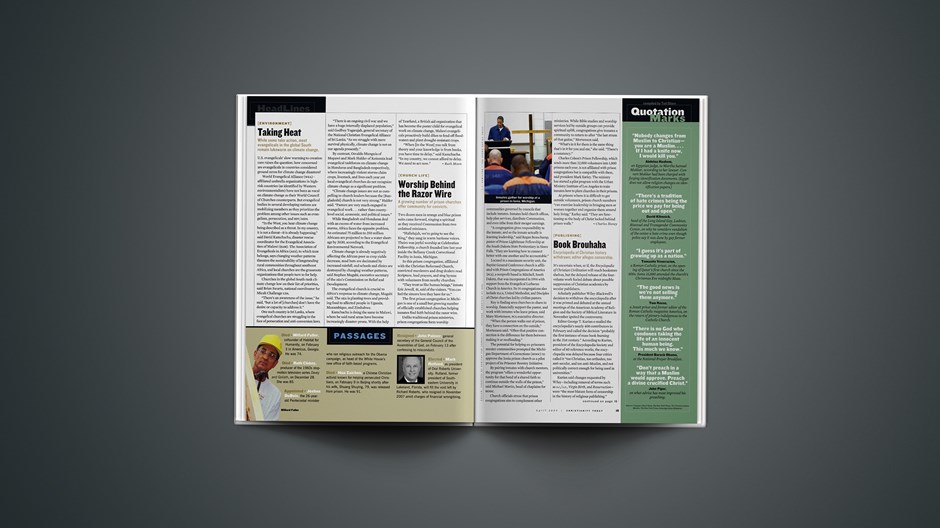
Two dozen men in orange and blue prison suits came forward, singing a spiritual as they received Communion from two ordained ministers.
"Hallelujah, we're going to see the King," they sang in warm baritone voices. Theirs was joyful worship at Celebration Fellowship, a church founded late last year inside the Bellamy Creek Correctional Facility in Ionia, Michigan.
In this prison congregation, affiliated with the Christian Reformed Church, convicted murderers and drug dealers read Scripture, lead prayers, and sing hymns with volunteers from nearby churches.
"They treat us like human beings," inmate Eric Jewell, 41, said of the visitors. "You can feel the sincere love they have for us."
The first prison congregation in Michigan is one of a small but growing number of officially established churches helping inmates find faith behind the razor wire.
Unlike traditional prison ministries, prison congregations form worship communities governed by councils that include inmates. Inmates hold church offices, help plan services, distribute Communion, and even tithe from their meager earnings.
"A congregation gives responsibility to the inmate, and so the inmate actually is learning leadership," said Regan Beauchamp, pastor of Prison Lighthouse Fellowship at the South Dakota State Penitentiary in Sioux Falls. "They are learning how to connect better with one another and be accountable."
Located in a maximum-security unit, the Baptist General Conference church is affiliated with Prison Congregations of America (PCA), a nonprofit based in Mitchell, South Dakota, that was incorporated in 1994 with support from the Evangelical Lutheran Church in America. Its 14 congregations also include ELCA, United Methodist, and Disciples of Christ churches led by civilian pastors.
Key is finding area churches to share in worship, financially support the pastor, and work with inmates who leave prison, said Mary Mortenson, PCA executive director.
"When the person walks out of prison, they have a connection on the outside," Mortenson said. "Often that positive connection is the difference for them between making it or reoffending."
The potential for helping ex-prisoners reenter communities prompted the Michigan Department of Corrections (MDOC) to approve the Ionia prison church as a pilot project of its Prisoner Reentry Initiative.
By pairing inmates with church mentors, the program "offers a wonderful opportunity for that bond of a shared faith to continue outside the walls of the prison," said Michael Martin, head of chaplains for MDOC.
Church officials stress that prison congregations aim to complement other ministries. While Bible studies and worship services led by outside groups can provide spiritual uplift, congregations give inmates a community to return to after "the last strum of that guitar," Mortenson said.
"What's in it for them is the same thing that's in it for you and me," she said. "There's a constancy."
Charles Colson's Prison Fellowship, which sends more than 22,000 volunteers into 1,800 prisons each year, is not affiliated with prison congregations but is compatible with them, said president Mark Earley. The ministry has started a pilot program with the Urban Ministry Institute of Los Angeles to train inmates how to plant churches in their prisons.
At prisons where it is difficult to get outside volunteers, prison church members "can exercise leadership in bringing men or women together and organize them around holy living," Earley said. "They are functioning as the body of Christ locked behind prison walls."
The Legacy of Prisoner 23226 | Twenty-six years after leaving prison, Charles Colson has become one of America's most significant social reformers. (June 29, 2001)
The Changing Face of Prison Fellowship | Organization says closing 20 offices and eliminating 100 staff positions are part of attempt to involve churches and volunteers more directly in prison ministry. (Sept. 28, 2000)
A Healthy 'Cult' | A lively response by one unusual audience shows how God's power transforms culture. (June 12, 2000)
Setting Captives Free | It takes more than getting a woman inmate out of jail to turn her life around (Jan. 10, 2000)
















 While we pray for peace, we need moral clarity about this war.
 A Christian reconciliation group in Israel and Palestine warned that war would come. Now the war threatens their relevance.españolالعربيةFrançaisрусскийУкраїнська
 The plan would organize UMC churches in four global regions, with each given more leeway around same-sex marriage and other theological issues.






