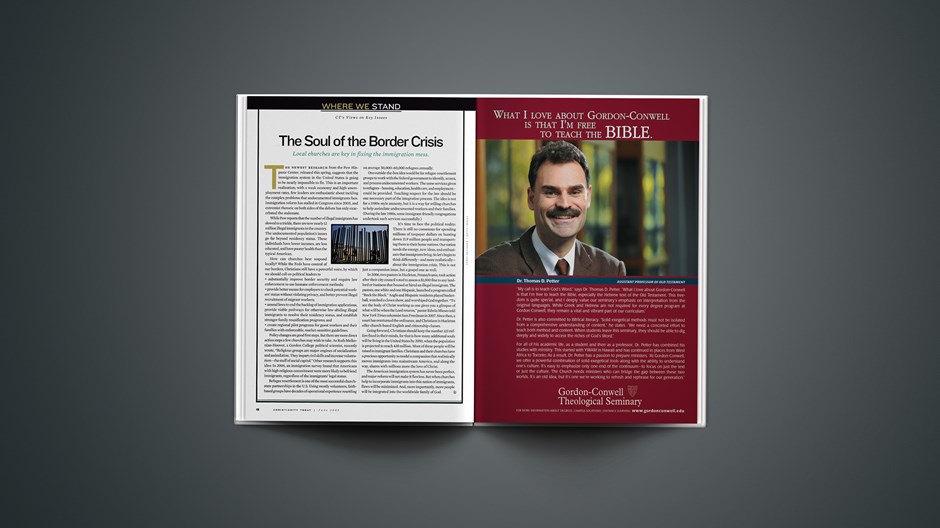
The newest research from the Pew Hispanic Center, released this spring, suggests that the immigration system in the United States is going to be nearly impossible to fix. This is an important realization; with a weak economy and high unemployment rates, few leaders are enthusiastic about tackling the complex problems that undocumented immigrants face. Immigration reform has stalled in Congress since 2005, and extremist rhetoric on both sides of the debate has only exacerbated the stalemate.
While Pew reports that the number of illegal immigrants has slowed to a trickle, there are now nearly 12 million illegal immigrants in the country. The undocumented population's issues go far beyond residency status. These individuals have lower incomes, are less educated, and have poorer health than the typical American.
How can churches best respond locally? While the Feds have control of our borders, Christians still have a powerful voice, by which we should call on political leaders to
substantially improve border security and require law enforcement to use humane enforcement methods;
provide better means for employers to check potential workers' status without violating privacy, and better prevent illegal recruitment of migrant workers;
amend laws to end the backlog of immigration applications, provide viable pathways for otherwise law-abiding illegal immigrants to resolve their residency status, and establish stronger family reunification programs; and
create regional pilot programs for guest workers and their families with enforceable, market-sensitive guidelines.
Policy changes are good first steps. But there are more direct action steps a few churches may wish to take. As Ruth Melkonian-Hoover, a Gordon College political scientist, recently wrote, "Religious groups are major engines of socialization and assimilation. They impart civil skills and increase voluntarism—the stuff of social capital." Other research supports this idea: In 2006, an immigration survey found that Americans with high religious commitment were more likely to befriend immigrants, regardless of the immigrants' legal status.
Refugee resettlement is one of the most successful church-state partnerships in the U.S. Using mostly volunteers, faith-based groups have decades of operational experience resettling on average 50,000–60,000 refugees annually.
One outside-the-box idea would be for refugee-resettlement groups to work with the federal government to identify, screen, and process undocumented workers. The same services given to refugees—housing, education, health care, and employment—could be provided. Teaching respect for the law should be one necessary part of the integration process. The idea is not for a 1980s-style amnesty, but it is a way for willing churches to help assimilate undocumented workers and their families. (During the late 1980s, some immigrant-friendly congregations undertook such services successfully.)
It's time to face the political reality: There is still no consensus for spending millions of taxpayer dollars on hunting down 11.9 million people and transporting them to their home nations. Our nation needs the energy, new ideas, and enthusiasm that immigrants bring. So let's begin to think differently—and more realistically—about the immigration crisis. This is not just a compassion issue, but a gospel one as well.
In 2006, two pastors in Hazleton, Pennsylvania, took action after their city council voted to assess a $1,000 fine to any landlord or business that housed or hired an illegal immigrant. The pastors, one white and one Hispanic, launched a program called "Rock the Block." Anglo and Hispanic residents played basketball, watched a clown show, and worshiped God together. "To see the body of Christ working as one gives you a glimpse of what will be when the Lord returns," pastor Edwin Mieses told New York Times columnist Sam Freedman in 2007. Since then, a court has overturned the ordinance, and Christians in Hazleton offer church-based English and citizenship classes.
Going forward, Christians should keep the number 133 million fixed in their minds, for that is how many additional souls will be living in the United States by 2050, when the population is projected to reach 438 million. Most of these people will be raised in immigrant families. Christians and their churches have a precious opportunity to model a compassion that realistically moves immigrants into mainstream America, and along the way, shares with millions more the love of Christ.
The American immigration system has never been perfect, and major reform will not make it flawless. But when churches help to incorporate immigrants into this nation of immigrants, flaws will be minimized. And, more importantly, more people will be integrated into the worldwide family of God.















 While we pray for peace, we need moral clarity about this war.
 As my doubts about his teachings grew, so did a secret fascination with Jesus.
 The rage of the mob is a poor substitute for real community.






