
Jump directly to the content

Feature

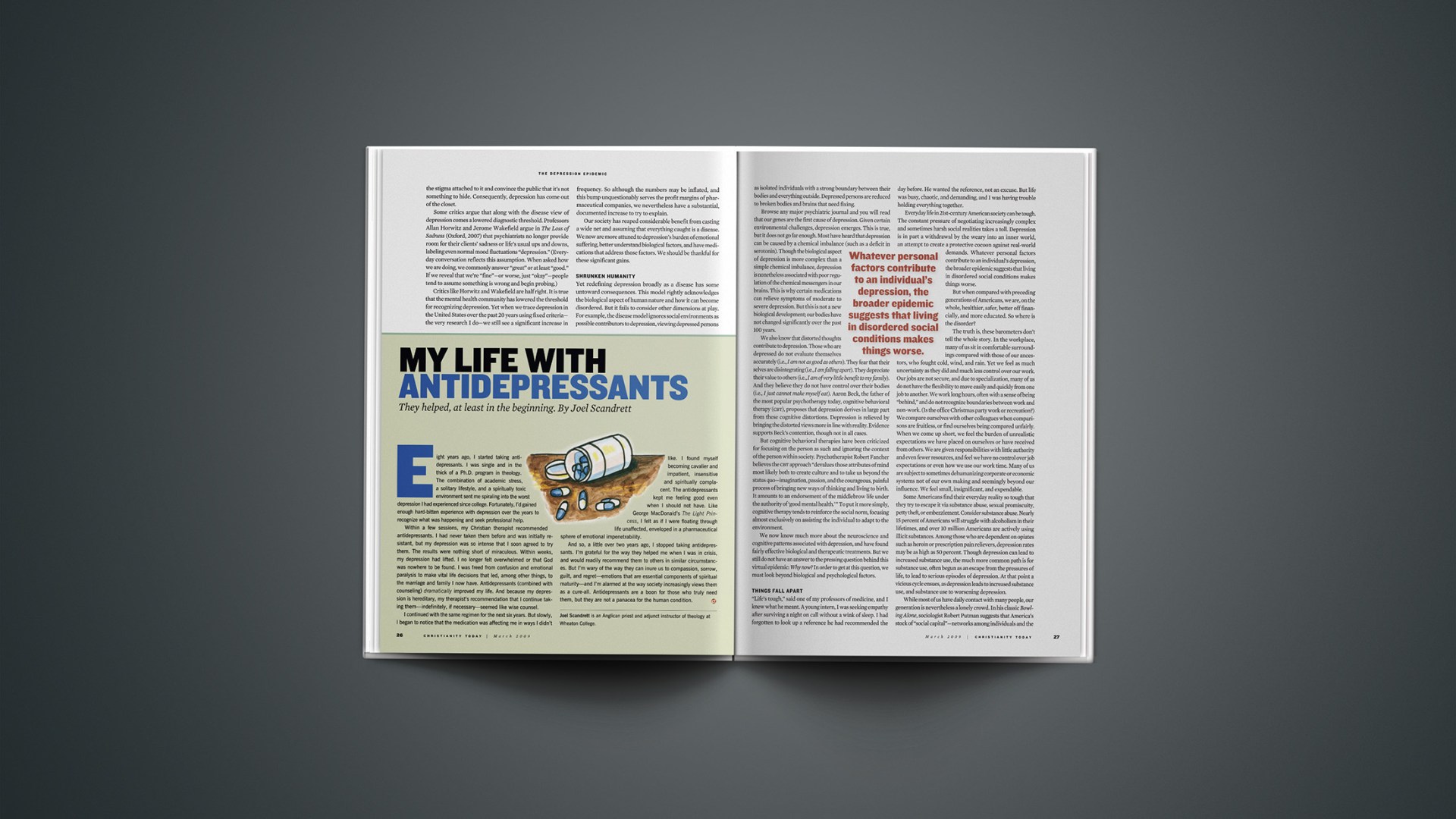
My Life with Antidepressants

They helped, at least in the beginning.

Eight years ago, I started taking antidepressants. I was single and in the thick of a Ph.D. program in theology. The combination of academic stress, a solitary lifestyle, and a spiritually toxic environment sent me spiraling into the worst depression I had experienced since college. Fortunately, I'd gained enough hard-bitten experience with depression over the years to recognize what was happening and seek professional help.

Within a few sessions, my Christian therapist recommended antidepressants. I had never taken them before and was initially resistant, but my depression was so intense that I soon agreed to try them. The results were nothing short of miraculous. Within weeks, my depression had lifted. I no longer felt overwhelmed or that God was nowhere to be found. I was freed from confusion and emotional paralysis to make vital life decisions that led, among other things, to the marriage and family I now have. Antidepressants (combined with counseling) dramatically improved my life. And because my depression is hereditary, my therapist's recommendation that I continue taking them—indefinitely, if necessary—seemed like wise counsel.

I continued with the same regimen for the next six years. But slowly, I began to notice that the medication was affecting me in ways I didn't like. I found myself becoming cavalier and impatient, insensitive and spiritually complacent. The antidepressants kept me feeling good even when I should not have. Like George MacDonald's The Light Princess, I felt as if I were floating through life unaffected, enveloped in a pharmaceutical sphere of emotional impenetrability.

And so, a little over two years ago, I stopped taking antidepressants. I'm grateful for the way they helped me when I was in crisis, and would readily recommend them to others in similar circumstances. But I'm wary of the way they can inure us to compassion, sorrow, guilt, and regret—emotions that are essential components of spiritual maturity—and I'm alarmed at the way society increasingly views them as a cure-all. Antidepressants are a boon for those who truly need them, but they are not a panacea for the human condition.

Joel Scandrett is an Anglican priest and adjunct instructor of theology at Wheaton College.


Related Elsewhere:

This article and "Light When All is Dark" are part of Christianity Today's March cover package on "The Depression Epidemic."

Previous articles on depression and suicide include:

The Gospel According to Prozac | Can a pill do what the Holy Spirit could not? (August 1, 1995)
To Be Happy in Jesus | Are evangelical Christians really happier than their neighbors? (March 8, 2006)
Good Question: Is Suicide Unforgivable? | Question: What is the biblical hope and comfort we can offer a suicide victim's family and friends? (July 10, 2000)
More from Christianity Today

La complejidad hispana: Todo cambió en el 2012

¿Hacia dónde vamos?—Una palabra para los creyentes hispanos sobre forjar un futuro.
Jesus' Elevator Speech

Jesus' Elevator Speech

Or was it his inaugural address? There's a difference.

The Latest in Movie News, May 20, 2013

Box office news, Benedict Cumberbatch, Cannes, and AFI honors Mel Brooks.
Divine Rehab

Divine Rehab

Whatever your addiction, God's grace is the only hope for a way out.
Get Instant Access
Christianity Today Magazine
Subscribe now for a year (10 issues) at $24.95 for print, iPad, and instant web access.

International Orders

Comments

Displaying 1–3 of 18 comments

RC

March 15, 2009  9:34pm

i've been on eLaviL For nearLy 11years and am thanKfuL for it. I can stiLL Laugh and cry. This is anoLder drug over 3O yrS. on the market.

Judith

March 11, 2009  9:11am

I suffered with depression and did not consult medical help, take antidepressants or anyother props. I did use valium and other sleping aids. I realised early that my depression was an attack form satan. I used the verse from Isaiah that says "He will keep him in perfect peace whose mind is stayed on Him (God)". In fact God pointed out this verse at a seminar. I pursued with God in a deeper way and found intermittent relief from prayer and other spiritual activities.Once I actually senses a demon a few inches away from me trying to get in me to steal my sleep and joy. i rebuked it and found 90% relief. I still sink in every once in a while but use pray to keep afloat.Depression really hurts and can lead to suicide, anti social habits and a host of other pains. We in the church have a duty to send a message to the people about God's help. I do not propose that all depression comes from satan or that medical help is not useful.

H. Wagemaker,MD

March 09, 2009  7:44am

90 % of the patients I see as a psychiatrist are depressed. I treat them with antidepressants. Most of my patients do very well on them. Some of my patients need to be on them a long time. Depression is a product of genetics and brain chemistry. Medication changes brain chemistry. Theres a big difference between wellness and wholeness. Medication can cause wellness but not wholeness. Thanks for discussing depression. The incidence of depression is the same in the Christian community as it is among non Christians. Many Christians are not treated for their depression. Depression is treatable.

See All 18 Comments
You must be a Christianity Today subscriber to post comments
(on articles open to the public, you must at least register for a free account).
Login
or
Subscribe
or
Register

Don't Miss

Forgiving Iran

Forgiving Iran

Long before I knew the true God, he helped me release my hatred.
Guilt Gone Wild

Guilt Gone Wild

The right kind of guilt can be healthy. But false guilt depletes your soul and ministry.

Training for "One Pitch" Preachers

Training for "One Pitch" Preachers

If you're stuck in a rut, this is how to mix things up.

more | current issue

Facebook

CT eBooks & Bible Studies


Shopping