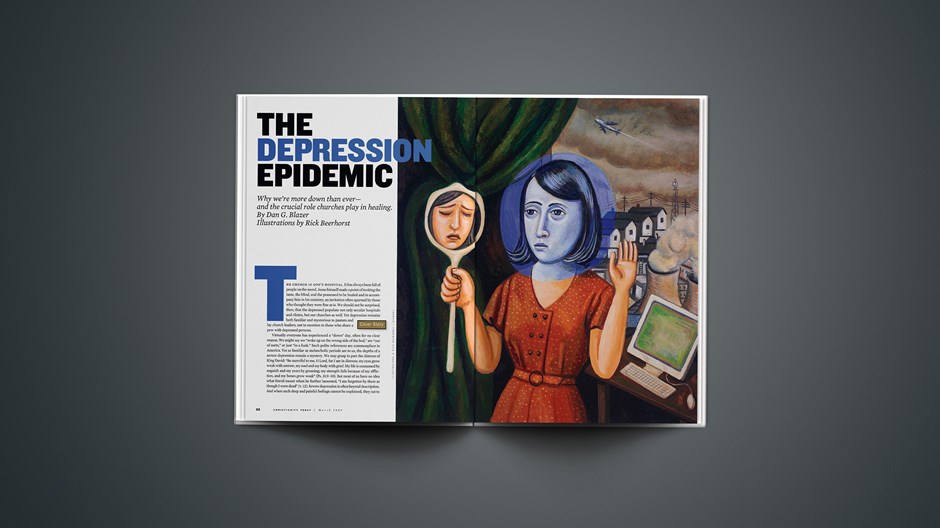
The church is God's hospital. It has always been full of people on the mend. Jesus himself made a point of inviting the lame, the blind, and the possessed to be healed and to accompany him in his ministry, an invitation often spurned by those who thought they were fine as is. We should not be surprised, then, that the depressed populate not only secular hospitals and clinics, but our churches as well. Yet depression remains both familiar and mysterious to pastors and lay church leaders, not to mention to those who share a pew with depressed persons.
Virtually everyone has experienced a "down" day, often for no clear reason. We might say we "woke up on the wrong side of the bed," are "out of sorts," or just "in a funk." Such polite references are commonplace in America. Yet as familiar as melancholic periods are to us, the depths of a severe depression remain a mystery. We may grasp in part the distress of King David: "Be merciful to me, O Lord, for I am in distress; my eyes grow weak with sorrow, my soul and my body with grief. My life is consumed by anguish and my years by groaning; my strength fails because of my affliction, and my bones grow weak" (Ps. 31:9-10). But most of us have no idea what David meant when he further lamented, "I am forgotten by them as though I were dead" (v.12). Severe depression is often beyond description. And when such deep and painful feelings cannot be explained, they cut to the heart of one's spiritual being.
Humans are intricately complex creatures. When things go wrong in us, they do so in myriad and nuanced ways. If churches want to effectively minister to the whole of fallen humanity, they must reckon with this complexity. Depression indicates that something is amiss. But what? And what should churches be doing about it?
What is depression?
First we need to clarify what we are talking about. In order to distinguish severe or "major depression" from everyday blues, the American Psychiatric Association offers the following diagnostic criteria:
Major depression is diagnosed when an adult exhibits one or both of two core symptoms (depressed mood and lack of interest), along with four or more of the following symptoms, for at least two weeks: feelings of worthlessness or inappropriate guilt; diminished ability to concentrate or make decisions; fatigue; psychomotor agitation (cannot sit still) or retardation (just sitting around); insomnia or hypersomnia (sleeping too much); significant decrease or increase in weight or appetite; and recurrent thoughts of death or suicidal ideation.
This clinical definition is sterile, however, and fails to capture the unique quality of the severely depressed person's suffering.
Deep depression is embodied emotional suffering. It is not simply a state of mind or a negative view of life but something that affects our physical being as well. Signs of a severe episode of depression include unfounded negative evaluations of friends, family, and oneself, emotional "pain," physical problems such as lethargy, difficulty getting one's thoughts together, and virtually no interest in one's surroundings. Though most of us know at least an acquaintance who has committed suicide, this tragic act baffles us perhaps as much as it pains us. "I just don't understand," we say. The irony is that survivors of serious suicide attempts frequently reflect on those attempts with a similar attitude: "I have no idea what came over me." The pain and mental dysfunction of major depression are that deep.
How big is the problem?
However we choose to define depression, both its frequency and its disruption of normal life are staggering. The World Health Organization named depression the second most common cause of disability worldwide after cardiovascular disease, and it is expected to become number one in the next ten years. In the United States, 5 to 10 percent of adults currently experience the symptoms of major depression (as previously defined), and up to 25 percent meet the diagnostic criteria during their lifetime, making it one of the most common conditions treated by primary care physicians. At any given time, around 15 percent of American adults are taking antidepressant medications.
Studies of religious groups, from Orthodox Jews to evangelical Christians, reveal no evidence that the frequency of depression varies across religious groups or between those who attend religious services and those who do not. So in a typical congregation of 200 adults, 50 attendees will experience depression at some point, and at least 30 are currently taking antidepressants.
How do we explain these numbers? In part, they result from a two-pronged shift in cultural attitudes about depression. Groups such as the National Alliance on Mental Illness and pharmaceutical companies have aggressively promoted the view that depression is not a character flaw but a biological problem (a disease) in need of a biological solution (a drug). The efforts to medicalize depression have helped to remove the stigma attached to it and convince the public that it's not something to hide. Consequently, depression has come out of the closet.
Article continues below
Some critics argue that along with the disease view of depression comes a lowered diagnostic threshold. Professors Allan Horwitz and Jerome Wakefield argue in The Loss of Sadness (Oxford, 2007) that psychiatrists no longer provide room for their clients' sadness or life's usual ups and downs, labeling even normal mood fluctuations "depression." (Everyday conversation reflects this assumption. When asked how we are doing, we commonly answer "great" or at least "good." If we reveal that we're "fine"—or worse, just "okay"—people tend to assume something is wrong and begin probing.)
Critics like Horwitz and Wakefield are half right. It is true that the mental health community has lowered the threshold for recognizing depression. Yet when we trace depression in the United States over the past 20 years using fixed criteria—the very research I do—we still see a significant increase in frequency. So although the numbers may be inflated, and this bump unquestionably serves the profit margins of pharmaceutical companies, we nevertheless have a substantial, documented increase to try to explain.
Our society has reaped considerable benefit from casting a wide net and assuming that everything caught is a disease. We now are more attuned to depression's burden of emotional suffering, better understand biological factors, and have medications that address those factors. We should be thankful for these significant gains.
Shrunken humanity
Yet redefining depression broadly as a disease has some untoward consequences. This model rightly acknowledges the biological aspect of human nature and how it can become disordered. But it fails to consider other dimensions at play. For example, the disease model ignores social environments as possible contributors to depression, viewing depressed persons as isolated individuals with a strong boundary between their bodies and everything outside. Depressed persons are reduced to broken bodies and brains that need fixing.
Browse any major psychiatric journal and you will read that our genes are the first cause of depression. Given certain environmental challenges, depression emerges. This is true, but it does not go far enough. Most have heard that depression can be caused by a chemical imbalance (such as a deficit in serotonin). Though the biological aspect of depression is more complex than a simple chemical imbalance, depression is nonetheless associated with poor regulation of the chemical messengers in our brains. This is why certain medications can relieve symptoms of moderate to severe depression. But this is not a new biological development; our bodies have not changed significantly over the past 100 years.
Article continues below
We also know that distorted thoughts contribute to depression. Those who are depressed do not evaluate themselves accurately (i.e., I am not as good as others). They fear that their selves are disintegrating (i.e., I am falling apart). They depreciate their value to others (i.e., I am of very little benefit to my family). And they believe they do not have control over their bodies (i.e., I just cannot make myself eat). Aaron Beck, the father of the most popular psychotherapy today, cognitive behavioral therapy (CBT), proposes that depression derives in large part from these cognitive distortions. Depression is relieved by bringing the distorted views more in line with reality. Evidence supports Beck's contention, though not in all cases.
But cognitive behavioral therapies have been criticized for focusing on the person as such and ignoring the context of the person within society. Psychotherapist Robert Fancher believes the CBT approach "devalues those attributes of mind most likely both to create culture and to take us beyond the status quo—imagination, passion, and the courageous, painful process of bringing new ways of thinking and living to birth. It amounts to an endorsement of the middlebrow life under the authority of 'good mental health.' " To put it more simply, cognitive therapy tends to reinforce the social norm, focusing almost exclusively on assisting the individual to adapt to the environment.
We now know much more about the neuroscience and cognitive patterns associated with depression, and have found fairly effective biological and therapeutic treatments. But we still do not have an answer to the pressing question behind this virtual epidemic: Why now? In order to get at this question, we must look beyond biological and psychological factors.
Things fall apart
"Life's tough," said one of my professors of medicine, and I knew what he meant. A young intern, I was seeking empathy after surviving a night on call without a wink of sleep. I had forgotten to look up a reference he had recommended the day before. He wanted the reference, not an excuse. But life was busy, chaotic, and demanding, and I was having trouble holding everything together.
Article continues below
Everyday life in 21st-century American society can be tough. The constant pressure of negotiating increasingly complex and sometimes harsh social realities takes a toll. Depression is in part a withdrawal by the weary into an inner world, an attempt to create a protective cocoon against real-world demands. Whatever personal factors contribute to an individual's depression, the broader epidemic suggests that living in disordered social conditions makes things worse.
But when compared with preceding generations of Americans, we are, on the whole, healthier, safer, better off financially, and more educated. So where is the disorder?
The truth is, these barometers don't tell the whole story. In the workplace, many of us sit in comfortable surroundings compared with those of our ancestors, who fought cold, wind, and rain. Yet we feel as much uncertainty as they did and much less control over our work. Our jobs are not secure, and due to specialization, many of us do not have the flexibility to move easily and quickly from one job to another. We work long hours, often with a sense of being "behind," and do not recognize boundaries between work and non-work. (Is the office Christmas party work or recreation?) We compare ourselves with other colleagues when comparisons are fruitless, or find ourselves being compared unfairly. When we come up short, we feel the burden of unrealistic expectations we have placed on ourselves or have received from others. We are given responsibilities with little authority and even fewer resources, and feel we have no control over job expectations or even how we use our work time. Many of us are subject to sometimes dehumanizing corporate or economic systems not of our own making and seemingly beyond our influence. We feel small, insignificant, and expendable.
Some Americans find their everyday reality so tough that they try to escape it via substance abuse, sexual promiscuity, petty theft, or embezzlement. Consider substance abuse. Nearly 15 percent of Americans will struggle with alcoholism in their lifetimes, and over 10 million Americans are actively using illicit substances. Among those who are dependent on opiates such as heroin or prescription pain relievers, depression rates may be as high as 50 percent. Though depression can lead to increased substance use, the much more common path is for substance use, often begun as an escape from the pressures of life, to lead to serious episodes of depression. At that point a vicious cycle ensues, as depression leads to increased substance use, and substance use to worsening depression.
Article continues below
While most of us have daily contact with many people, our generation is nevertheless a lonely crowd. In his classic Bowling Alone, sociologist Robert Putman suggests that America's stock of "social capital"—networks among individuals and the reciprocity and trustworthiness that arise from them—has declined substantially over the past few decades. We are less likely to vote, give blood, play cards, join in league bowling, or have friends or neighbors over for dinner. Perhaps some of these opportunities to build social networks have been replaced with others, such as soccer games or Facebook. Yet we are increasingly disconnected from family, neighbors, and friends.
And the nature of the relationships we do have is changing. Many have become what British sociologist Anthony Giddens labels "pure relationships"—"pure" in that they are detached from any social context, external structure, or security. There is no covenant, community, or being to orient the relationship or provide ongoing assurance, direction, and support. All of this must be generated by the relationship itself, which exacts a heavy burden. We can never relax in pure relationships because there is no pledge of fidelity or constancy on which to rest. We must "maintain" these relationships ourselves. Over time, constant vigilance and sustained insecurity often lead to frustration, anxiety, and weariness. These relationships are just too hard to keep up.
Complex societies built on interdependence require trust, yet this precious public resource continues to decline as society becomes even more complex. "Who can you believe these days?" has become a familiar refrain. Reality, we are told, has become little more than the shared worldview of small communities. In response, some encourage us to accept all views, but this leaves us disoriented. Others suggest we cling tenaciously to our views and mistrust anything new, leaving us isolated and alienated. From this double bind, the leap to a symptom of severe depression—paranoia—is not that far. The depressed lose confidence not only in themselves, but also in those around them.
Article continues below
Finally, no symptom is more central to depression than the loss of hope. And if last year's election cycle revealed anything, it was that hope is at a premium in American society. Fear of catastrophe—due to terrorists, financial collapse, or ecological disaster—haunts our times. Some busy themselves with survival strategies, withdrawing from communal concerns to personal preoccupations. Many more, uncertain about the future, anxiously gorge themselves on our culture's smorgasbord of instantly gratifying diversions.
Opportunity for the church
Uncertainty, insignificance, and powerlessness. Destructive, self-indulgent escape. Loneliness and isolation. Fear and distrust. Loss of hope. Retreat. Although hasty and incomplete, this sketch of the early-21st-century American cultural mood picks up dark details masked by indices of societal well-being. It also reminds us that to focus exclusively on the individual in our efforts to understand the depression epidemic is to miss the forest for the trees.
When used wisely, antidepressants and cognitive behavioral therapy can restore stability to individuals so that they can better negotiate everyday challenges. For those in the thick of paralyzing depression, the effects of medicine and CBT might even prompt gratitude for common grace. And they should give thanks. Yet neither of these approaches provides much help in understanding or addressing the more fundamental and intractable problems of which the depression epidemic is a symptom. These approaches provide needed relief, but not answers or prevention.
The medical models come up short because they can only go as far as their understanding of the subject of the problem will take them. And both slight their subject: human beings. Cultural institutions and authorities may sometimes treat human beings as if we are nothing but brains in bodies, but this does not make it so. For those with eyes to see, the depression epidemic is in part a witness to the complexity of human nature. In particular, it reminds us that we are social and spiritual (as well as physical) creatures, and that a fallen society's afflictions are often inscribed on the bodies of its members. We have misjudged humanity if we expect our bodies to be impervious to social travail. ("And being in anguish, he prayed more earnestly, and his sweat was like drops of blood falling to the ground," Luke 22:44.)
Article continues below
In fact, sometimes an episode of what looks like depression does not indicate that the human organism is malfunctioning, but is instead being true to her spiritual-social-physical nature. Embodied emotional pain can be an appropriate response to suffering in a world gone wrong. The author of Lamentations must have felt such pain as he gazed upon the destruction of Jerusalem around 588 B.C. "My eyes fail from weeping, I am in torment within, my heart is poured out on the ground because my people are destroyed, because children and infants faint in the streets of the city" (Lam. 2:11). Christians are called to weep with those who weep, and should welcome emotional pain that results from empathy and draws us alongside the afflicted. If we have grown numb to the pain and suffering around us, we have lost our humanity.
Christian teaching about sin and its reverberating effects frees the church from surprise about the disordered state of human affairs. We can acknowledge the effects of sin both within and without. We can look at wrecked reality squarely in the eye and call it what it is.
And thanks be to God, who raised the One who entered fully into our condition, breaking the power of sin, death, and hell, that we not only can name wrecked reality, but also lean into it on the promise that Christ is making all things new.
Those who bear the marks of despair on their bodies need a community that bears the world's only sure hope in its body. They need communities that rehearse this hope again and again and delight in their shared foretaste of God's promised world to come. They need to see that this great promise, secured by Christ's resurrection, compels us to work amidst the wreckage in hope. In so doing, the church provides her depressed members with a plausible hope and a tangible reminder of the message they most need to hear: This sin-riddled reality does not have the last word. Christ as embodied in his church is the last word.
Dan G. Blazer is J. P. Gibbons Professor of Psychiatry and Behavioral Sciences at Duke University Medical Center and author of The Age of Melancholy (Routledge, 2005). Download a companion Bible study for this article at ChristianBibleStudies.com.
To Be Happy in Jesus | Are evangelical Christians really happier than their neighbors? (March 8, 2006)
Good Question: Is Suicide Unforgivable? | Question: What is the biblical hope and comfort we can offer a suicide victim's family and friends? (July 10, 2000)
[ This article is also available in
简体中文 and
繁體中文. ]
Have something to add about this? See something we missed? Share your feedback here.
Our digital archives are a work in progress. Let us know if corrections need to be made.















 While we pray for peace, we need moral clarity about this war.
 We’ve got little information on Jesus’ appearance and personality. But that’s the way God designed it.españolFrançais
 How groups like Hillsong learned to let go of the literal in favor of creative collaboration.españolPortuguês






